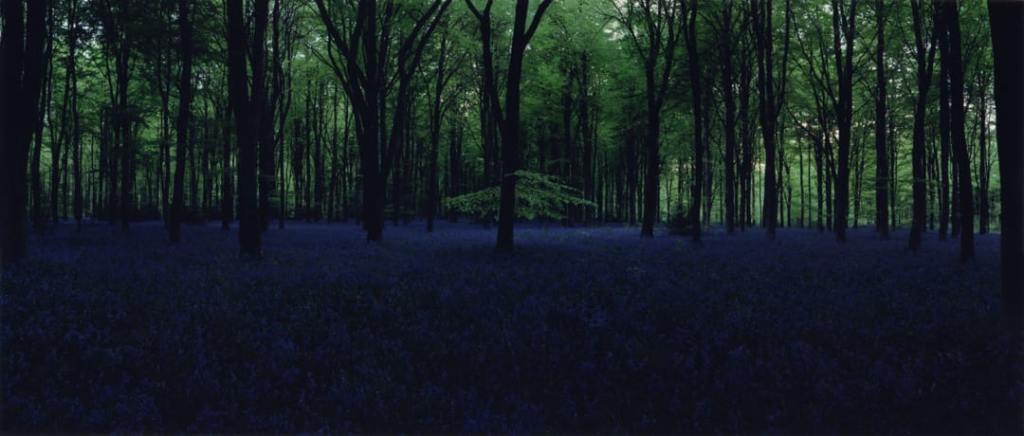
This small book is a little wonder. Despite its small size, Between Dog and Wolf (2006) provides an utterly immersive experience into the various twilights of Finland, England, Belgium and Japan. This isn’t just because Lebas’ chosen format is the panorama, nor that the images often take up their entire pages, but particularly due to Lebas’ unashamed, even brazen, embrace of black.
untitled #4, 2005, Chrystel Lebas
The series Blue Hour, included here, lingers in the same bluebell glade until only a few unidentifiable dots of colour break up the final shot. The viewer is made to strain, made to work, just as when faced with dying light. The known becomes abstract and slightly unsettling, the complexities of woodland reduced to vague structures.
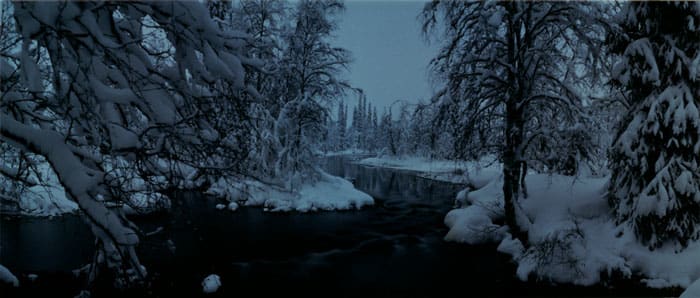
untitled #9, 2005, Chrystel Lebas
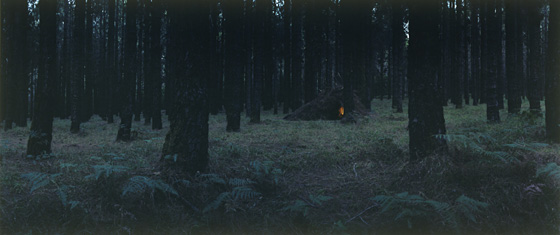
Even where the trees’ shapes are more defined – as with the snow series Between Dog and Wolf (a French term for twilight) – the presence of large dark patches, or dark borders, implies an encroaching darkness. Lebas leaves much of the perception of this work to the viewer’s imagination, a perfect analogy of twilight’s cultural heritage.
untitled #1, 2003, Chrystel Lebas
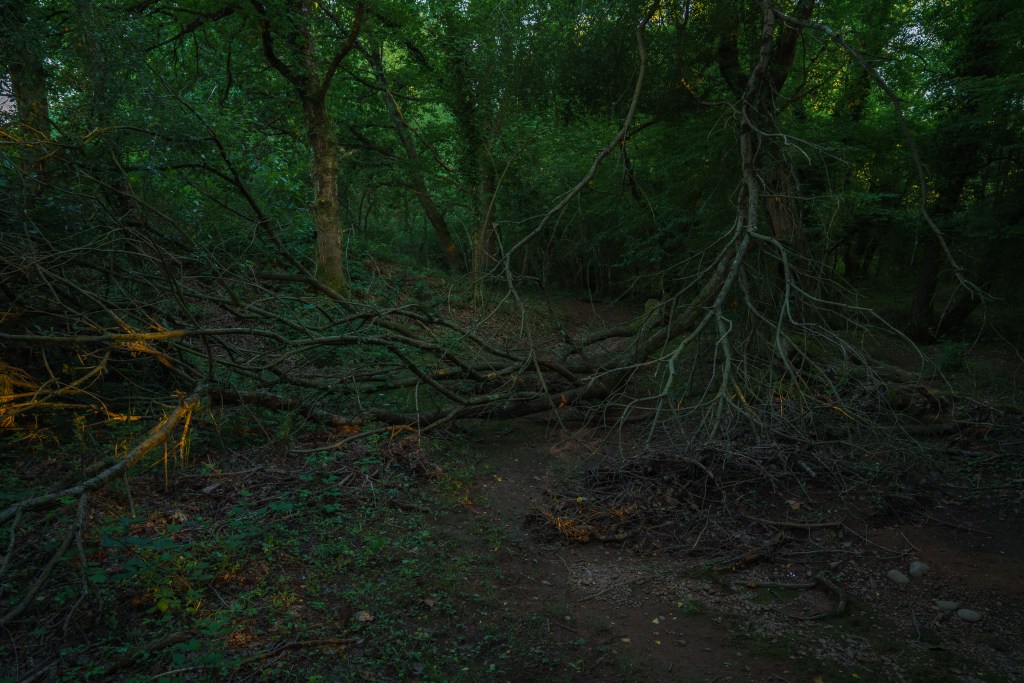
I have much to learn here. Digital photography permits an almost forensic analysis of light, details in the shadows unavailable to the naked eye unveiled through Lightroom. I often find this an irresistible temptation: to lift the leaves, bark and pebbles from obscurity is an act of discovery with a certain amount of childish delight attached to it. However, doing so does not necessarily make for images that communicate affect as effectively as Lebas fuzzy edges and jet black patches, and it’s affect that interests me the most – at least at present – working as I am with the end of the day. Just because my camera has recorded detail in the shadows should not dictate that I reveal it. I am already beginning to darken some images, plunging details back into obscurity and leaving sections of the images featureless for the viewer to make their own mind up about.
Harpford Common, 2020, Andy Thatcher
It’s also worth mentioning that I find high summer a difficult time for me to photograph. I’m drawn to geometric structures and the profusion of dark texture makes branches, paths, and streams complex and dense. Through plunging them back into darkness, the forms, paradoxically, begin to emerge once more, while new shapes emerge in the diminished points of light which have struggled through the foliage.
Woodbury Common, 2020, Andy Thatcher
Lebas, C. 2006. Between Dog and Wolf. London: Azure Publishing.
Geographer Yi-Fu Tuan’s writing has resonated across disciplines and his term topophilia, or love of place, has entered into relatively common parlance. Like other geographers I’m interested in, Tuan’s focus is on place and on space (1977). I’ve been incorporating Doreen Massey’s (2005) work in this field in considering my own practice for some time, but I’m new to Tuan. Their analysis is markedly different, though not, I believe, contradictory. Both are useful and valid perspectives from which to consider these elusive terms.
Uphams Plantation, 2020, Andy Thatcher
One key differences is, to my mind, that while Massey sees place-making as being a collective, social activity in which an individual involves themselves, for Tuan, place-making is a more individualistic, willed process of cognitive configuration in response to need and intention. For Massy, place acts upon us and we become entangled in it, our actions shaping the place not just for ourselves but for others; it is an interactive, social process. For Tuan, place is primarily constituted by the individual – the resident, the architect, artist, the scientist – through specific forms of gaze, enclosure and categorisation. Massey does acknowledge this as a part of place-making, but argues that it sets up conflict and a tendency towards enforcing stasis on place, as seen with conservationists, heritage organisations at one end of the scale and extreme nationalists at the other. Using this more individualistic model, Tuan is thus able to interrogate why place-making is a fundamental form of human conceptionalisation, arguing that doing so provides physical and emotional stability and calm, as well as a means of practical comparison between places.
Uphams Plantation, 2020, Andy Thatcher
Space, on the other hand, is abstract, threatening, unformed, that to which we respond fearfully when we find ourselves lost; place, in essence, is tamed space. Space is movement; place is stasis. Massey, however, argues that the movement of space is unstoppable, and place is simply a combining and exclusion of different trajectories which constitute space.
Uphams Plantation, 2020, Andy Thatcher
The timing of reading Tuan’s work is fortuitous, as I’m focussing on a more determinedly subjective response to the Pebblebed Heaths during this module, in preparation for exploring the subjective responses of others. Previously, I had let myself be open to and informed by the Heaths, when photographing, in social encounters, and through research. Now, however, I’m more interested in my own responses and, particularly, how I am constituting places and choosing places according to my own needs. I have mentioned previously my turn to the melancholy, but I believe the environments I seek out also provide psychological benefits; there is something reassuring in being enclosed by trees in some of the dense woodland, just as the emptiness of the plantations at the end of the day provides not just solitude but a privacy not possible on the heaths. I am aware of such places as being pre-made as such – enclosure banks, naming on maps, the prevalence of dens and trail adaptations – but I am also drawing on this material to constitute the place for myself, after my own fashion.
Uphams Plantation, 2020, Andy Thatcher
What constitutes Uphams Plantation, for instance, as ‘place’ is quite different for me as for the mountain biker, the forester, the young family, the conservationist. Indeed, I’m increasingly finding myself subdividing the placeof the heaths in smaller and smaller places, with affect being the foundation of these. I suspect those groups previously mentioned will also be doing so, but for the mountain-biker, the trail is a place, for the conservationist, so is the Dartford Warbler habitat; Tilley and Cameron-Daum’s anthropological study of the heaths (2017) included map-making from different users, from model aircraft flyers to Marines, demonstrates the diversity of such placemaking, even amongst the same user groups.
Uphams Plantation, 2020, Andy Thatcher
As the heaths’ role in my personal life has been its support for my mental wellbeing – it was the place I knew I must visit first when recovering from nervous exhaustion – it makes sense that my own map, constituted by placemaking according to my own needs, should be the focus of a more subjective engagement with this considerable and varied tract of land. Conversely, it also helps account for the difficulty I have in capturing affect in areas to which I find it less easy to develop intimacy.
Massey, D. 2005. For Space. London: SAGE Publications.
Tilley, C., & Cameron-Daum, K. 2017. An Anthropology of Landscape. London: UCL Press.
Tuan, Y. 1977. Space and Place: The Perspective of Experience. Minneapolis: University of Minnesota Press.
Melancholy is a neglected, maligned and misunderstood word. There’s something distinctly archaic about it, with a whiff of Byronic Romantic excess. It’s also collapsed with milder forms of depression and thus suffers the cultural fear of contagion which still, alas, accompanies conceptions of mental illness and fragility. It is, to some extent, both of these things, but is also much more than that. Melancholy is an innately pleasurable form of sadness – think of Allegri’s Miserere, Love’s Forever Changes, the paintings of Edward Hopper, the haiku of Shiki. It is a productive, not an overwhelming sadness, for in melancholy one can contemplate and begin to resolve difficult feelings, such as grief, loss, despair, loneliness, or simply the ultimate transience of that which is good. In a contemporary culture slavishly obsessed with happiness, whatever that might mean, the Melancholy is both devalued and conversely, given the rising rates of depression and anxiety, more necessary than ever.
Jacky Bowring’s Melancholy in the Landscape (2017) examines the different forms though which melancholy is expressed in landscape from the urban to the wilderness. While concentrating on landscape architecture, Bowring also addresses the visual arts, including photography. Her central argument is that melancholy needs to be considered alongside and interdependent with the Picturesque, the Beautiful and the Sublime as drawing on the same cultural and historic wellspring; in essence, she argues, we need to speak in terms of the Melancholy. It is crucial in parsing these terms to consider their affective differences, for while the Beautiful leans towards the joyful and transcendent, the Picturesque to a pleasing sense of worldly order, the Sublime to awe and terror, the Melancholy, according to Edmund Burke, in music emphasises ‘that melting, that sinking, that languor’. (28) The Melancholy thus, according to Karen Till (39) speaking of Holocaust memorials, carefully opens up a ‘wound’ to permit difficult emotions to emerge in a safe space; to this extent, it could therefore be said the Melancholy provides a valuable therapeutic function without proposing a cure. Speaking of Sontag’s discussion of the anaesthetising effects of overexposure to human suffering, Bowring also argues that the Melancholy, through its subtlety, engages and makes possible an empathetic engagement with the suffering of others (43).
Bowring sets out this argument eloquently and persuasively in Part 1; in Part 2, she sets out a taxonomy of expressions of the Melancholy. Bowring’s taxonomy overlaps to no small extent with Mark Fisher’s (2016) parsing of the Weird and the Eerie from the Uncanny (see earlier post on this). Certainly, all three make possible the Melancholy, and indeed the Uncanny is included here specifically. I have found Bowring’s taxonomy extraordinary with regards to my own practice, as here is set out the overwhelming majority of my stylistic, affective, and contextual drive as a photographer. This is to some extent unsurprising, as I have struggled with varying forms of anxiety and depression throughout my life since my mid-teens. I have sought out music, art, films, literature – and photography – which neither makes me confront the terrors of these emotions, nor escape them, but to permit me to dwell in them and thus find consolation and, to some extent, a resolution. It thus makes sense to address how I see this taxonomy reflected in my work, and to demonstrate this, I will make use of a single photo shoot, at East Budleigh Common, in the evening of June 14th of this year.
East Budleigh Common, 2020, Andy Thatcher.
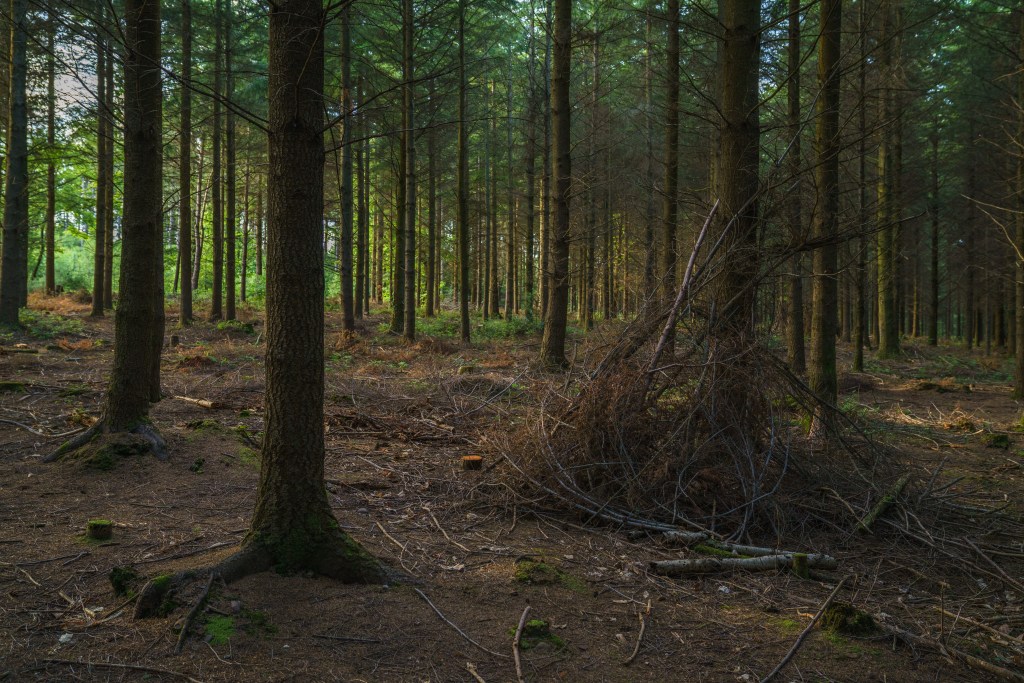
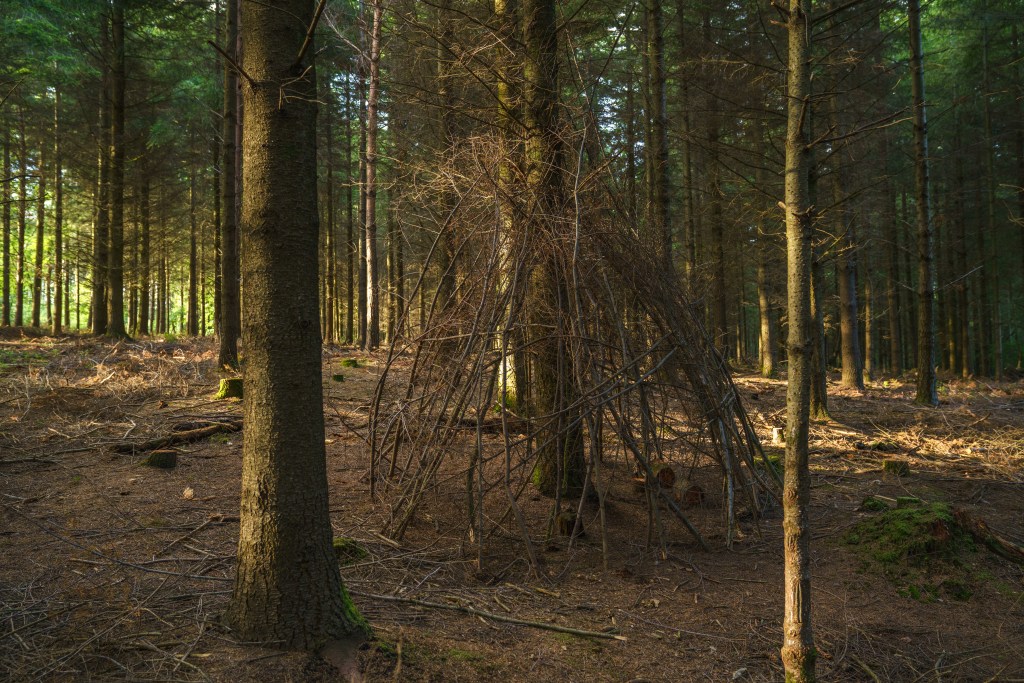
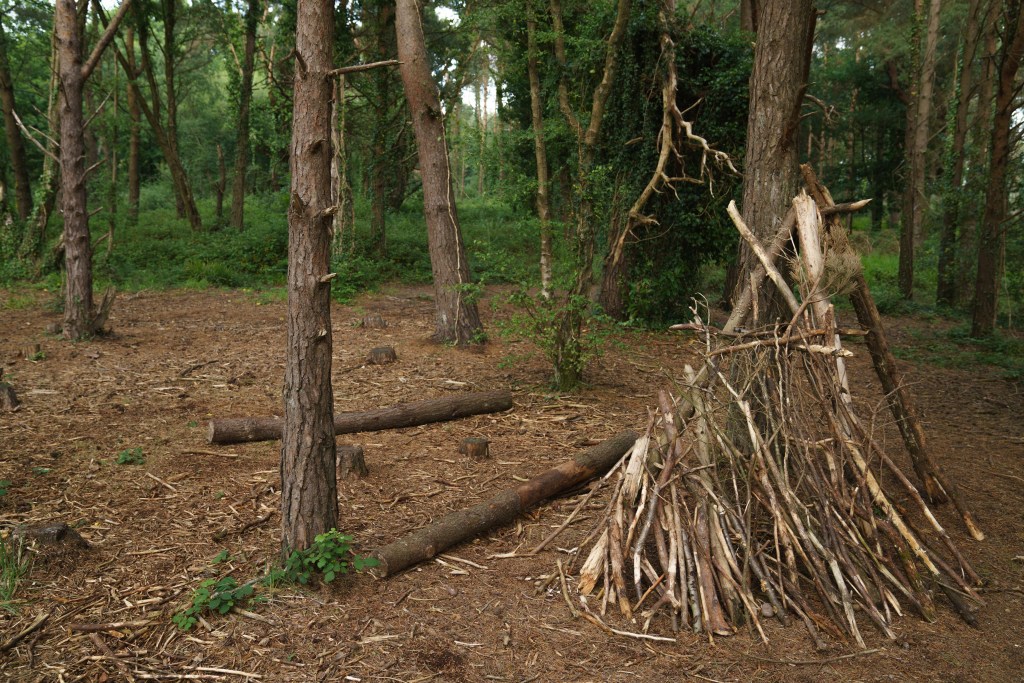
The Void implies an absence due to abandonment, and thus loss, and Bowring evaluates commemorative memorials which make use of empty chairs including scenic benches and an installation dedicated to the victims of the Christchurch earthquake of 2011. I have become fascinated with the many den structures found across the Pebblebed Heaths and photographed them often, though have largely been dissatisfied with the results. My interest is in part their interesting geometries, the angles and triangular shapes a deep contrast with the woodland around them, but it is also that they imply the hands which built them and the bodies which inhabited them. This is made all the more poignant for the dens’ connection with childhood and parenthood, a period of life itself characterised by transience and eventual loss.
East Budleigh Common, 2020, Andy Thatcher.
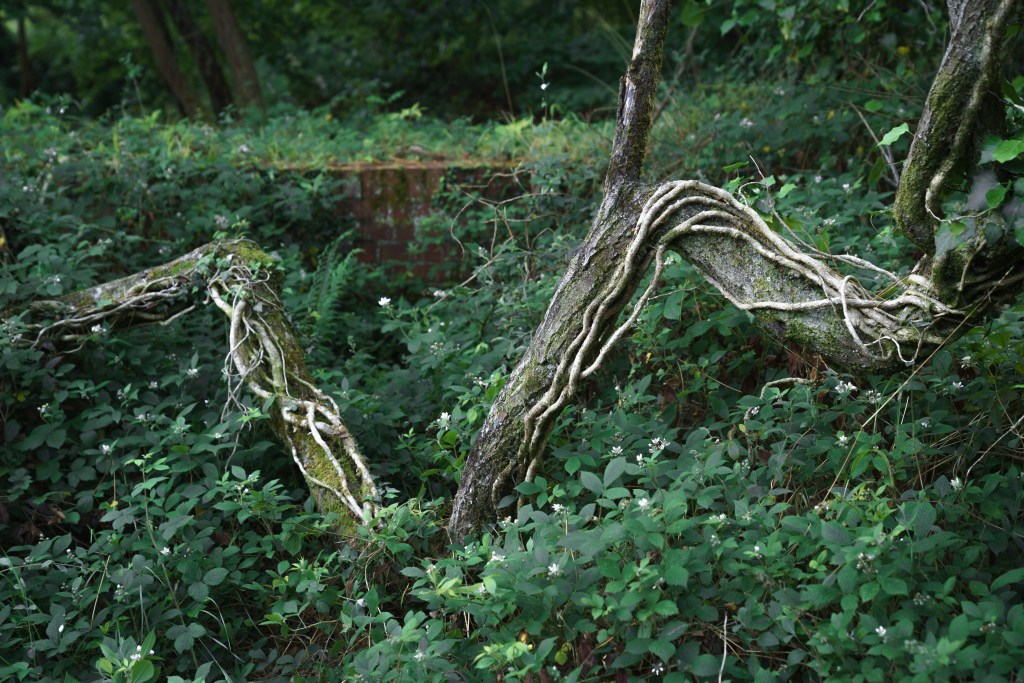
Bowring simplifies The Uncanny as making the familiar strange, with or without doubling, and this is something that informs much of my work. I have become a little obsessed with the strange, tentacular structures which parasitic vines leave on trees, and which remind me of horror writers such as H.P. Lovecraft and Spielberg’s derided but rather wonderful War of the Worlds. Woodland is, culturally and affectively, often a weird place, and this is part of its appeal. My recurrent shots of these vines reflect this; that woodlands, often considered life-giving and even therapeutic in the case of shinrin-yoku, might also be sinister, even hostile.
East Budleigh Common, 2020, Andy Thatcher.
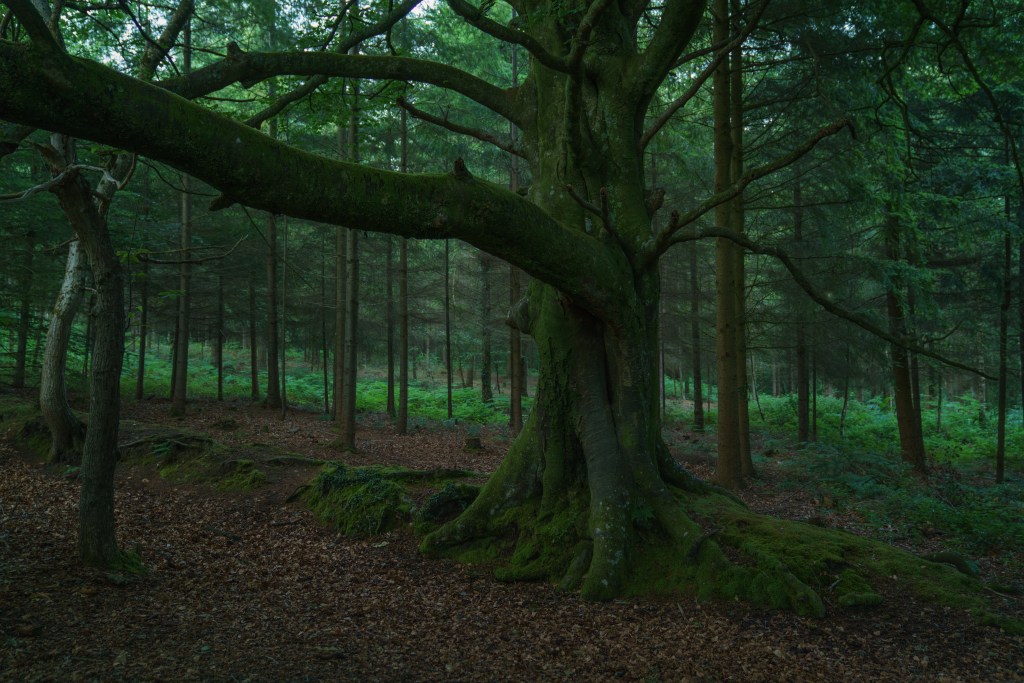
Shadows and darkness can be horrific in the sense of the Sublime, but they can also be merely threatening, or simply unsettling. They imply absence, defamiliarisation and the loss of certainty, of sensory competency, and of the things one holds dear. Metaphorically, they already signify melancholy and sadness – the darkening of mood, the dark pit of despair. In this shot of a beech tree, the tree is almost a silhouette, the absent lush, vibrant green of the leaves and moss almost teasingly suggested by the ferns behind, the darkened crevices of the trunk seemingly reptilian.
East Budleigh Common, 2020, Andy Thatcher.
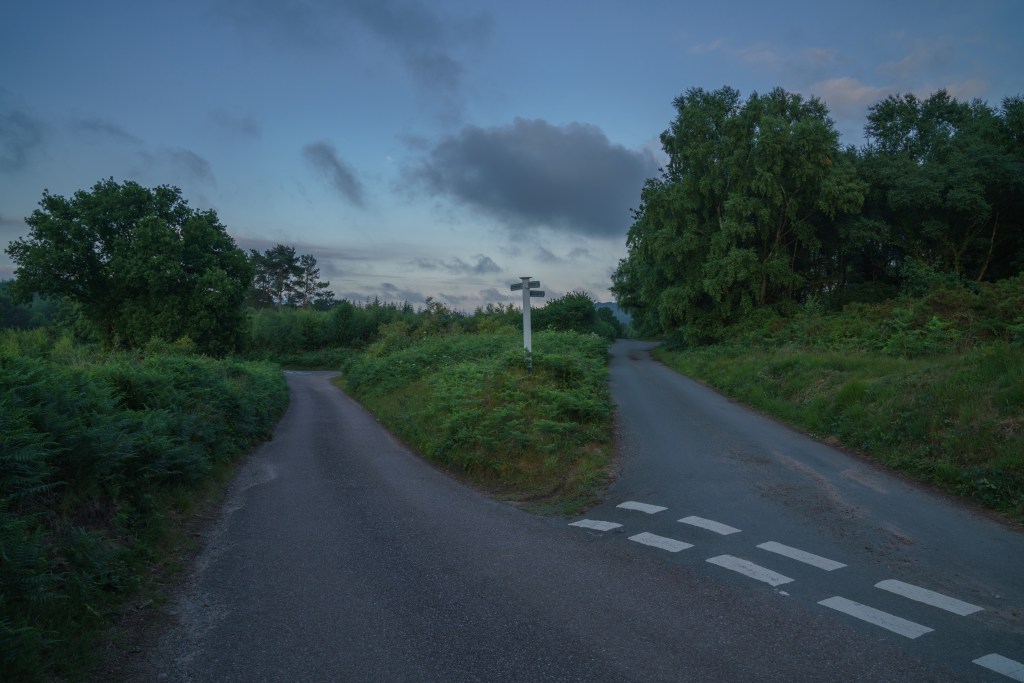
Liminality can be expressed in a variety of ways and liminal spaces have been the subject of previous work of mine. I’m interested in entranceways, meeting points, passages, and ‘edgeland’ areas, and gates and border areas continue to feature in my work on the commons. The passage from one state to another suggests transience and the anxiety of indeterminacy. In the case of twilight, this also suggests death and like darkness and shadows, this draws on deeply-ingrained cultural and mythological iterations. I’ve long been drawn to photograph over the long summer evenings, once the golden light reddens and especially in the otherworldly turquoises and purples following sunset. This image is itself a liminal space, a triangular road junction of unused land, at a liminal moment. The empty roads further accentuate the melancholy mood here.
East Budleigh Common, 2020, Andy Thatcher.
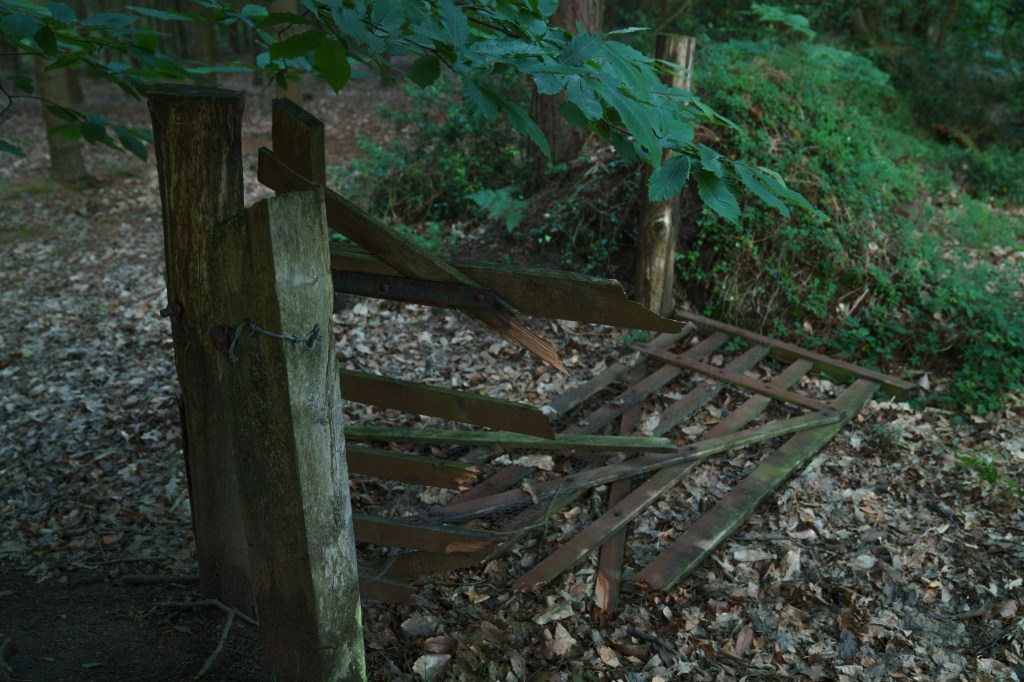
Fragments in the form of ruins are one of the most familiar features of Picturesque landscape paintings and are associated with Sublime forms such as the Gothic. They are themselves liminal, poised between a complete structure and their inevitable, eventual complete destruction, and this infers transience and loss. Cognitively, their incompletion prompts their imaginative reconstruction, and doing so suggests the limits of knowledge just as it does, by comparison, the sadness of their degraded state. All lives have their ruins – ruined marriages, ruined childhoods, ruined Christmases, ruined opportunities – and contemplating ruins outside of the Picturesque and the Sublime makes possible an empathic self-evaluation. This gate indicates a ruined intention, a failure to assert power.
East Budleigh Common, 2020, Andy Thatcher.
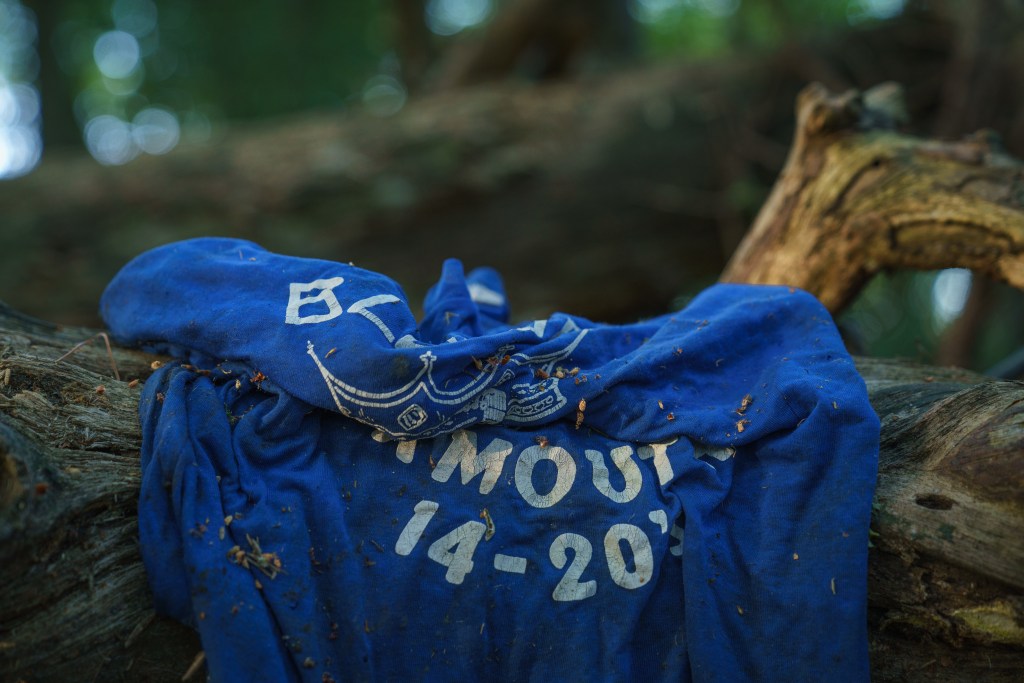
Leavings, what become for the artist ‘found objects’, are another favourite theme of my work, and indeed are things I have collected over the years. Unlike the dens, a ‘leaving’ suggests a need for its return to its owner as if it were a ‘phantom limb’. Leavings have not been abandoned but lost, forgotten and mislaid. They imply narratives and the people who left them there. Such things are, according to Margaret Gibson, ‘stranded objects’ (119) and according to Bowring ‘outside time and space’ which ‘prevent closure’. This image is the only one taken prior to the shoot, although only by a few days. It is a primary school leaver’s shirt, itself a poignant, melancholic object, communicating loss, transience and the uncertainty of the unknown. The sadness I felt in encountering it was tangibly real, and I hoped whoever had left it there did not miss it so very terribly. I felt a powerful yearning, itself a melancholy mood, to return it.
East Budleigh Common, 2020, Andy Thatcher.
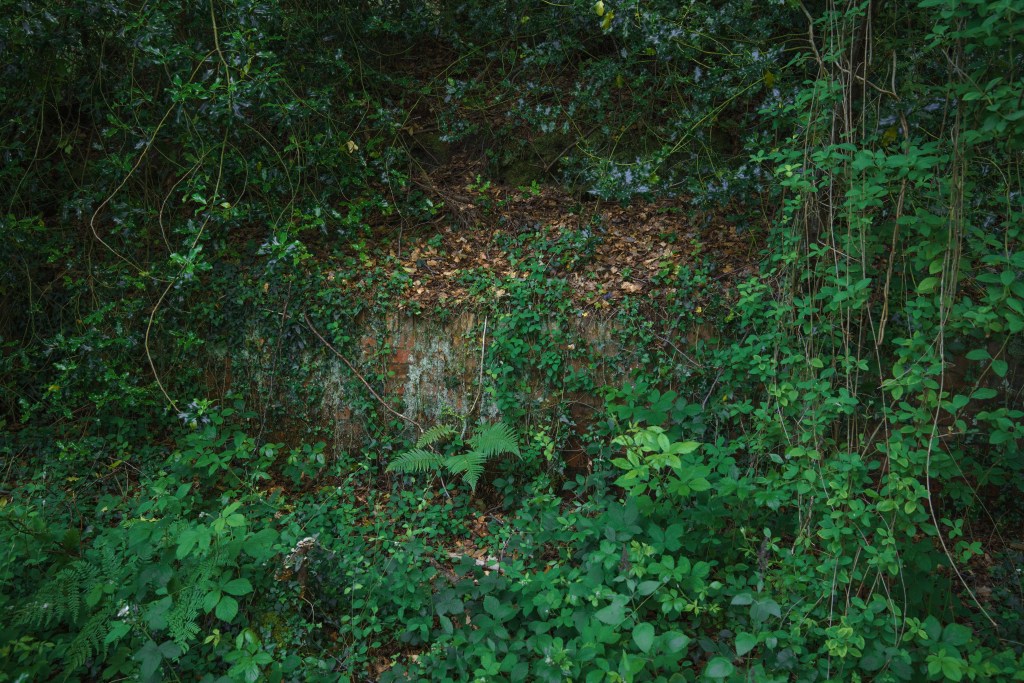
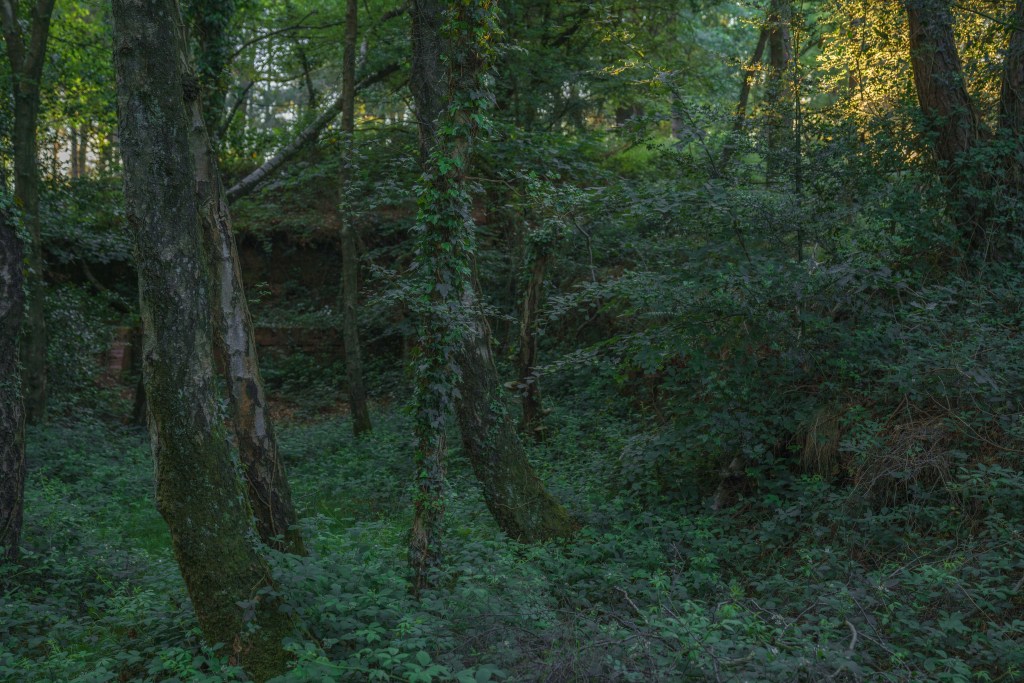
Submersion, whether by water, sand, plants or otherwise, is a liminal state of a particular order. It ‘confounds boundaries’ (137) and suggests the unstoppable forces which lead towards the extinction of all. This being so, submersion resonates with apocalyptic tropes. There’s an ambiguity to the World War II ruins at East Budleigh Common for, on the one hand they are a reminder of conflicts past, but on the other, are evidence of the transience of the man-made, and in particular of the masculine of which the military is emblamatic.
East Budleigh Common, 2020, Andy Thatcher.
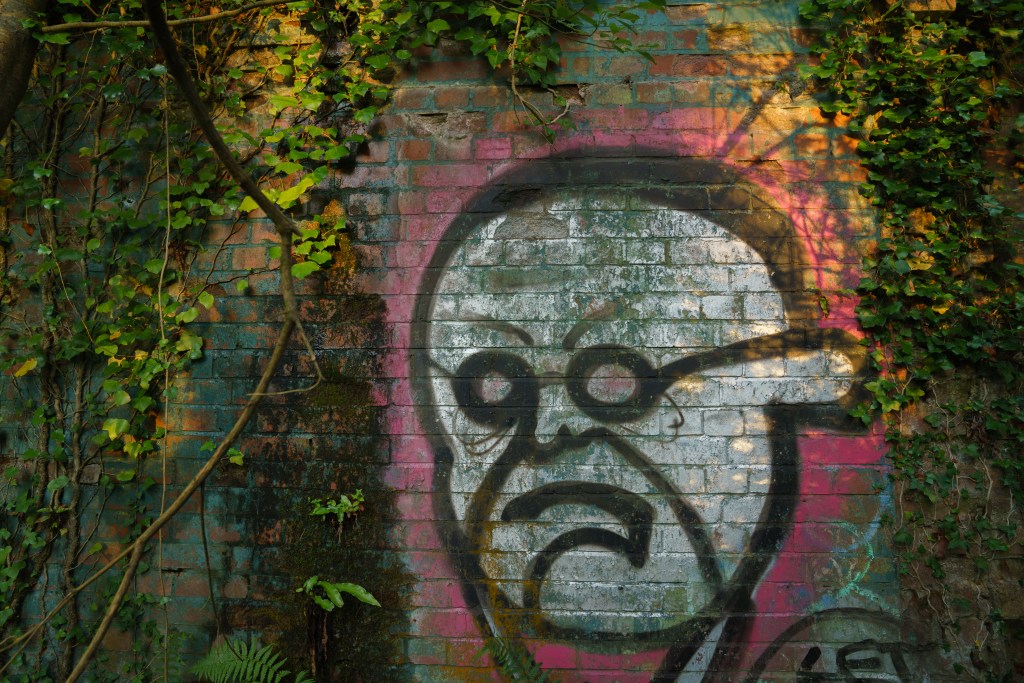
Weathering and patina are similar to, but quite different to fragmentation and submersion, for they retain intact the traces of what they once were and are in the process of erasure and becoming other; like memories, they are fading. Faded artwork lacks the Gothic overtones of the ruin, the apocalyptic of submersion, but rather theirs is the sadness of neglect, heavy with regret. I’ve been particularly drawn to the faded graffiti on the old bunkers, more so than the fresh, vibrant recent work. This artwork is not created to last, and indeed is often painted on top of other artwork, but nevertheless the lack of vitality suggests the decrepitude of old age rather than the death of submersion or ruin. Weathering reveals not a change of state but the object itself in the process of disintegration.
I am deepening an awareness of my subjective response to the Pebblebed Heaths in preparation for better learning about the subjective experiences of others. This process has been both surprising and productive, for it has connected this landscape to my sense of self and personal history in a profound way.
Bowring, J. 2017. Melancholy and the Landscape: Locating Sadness, Memory and Reflection in the Landscape. London: Routledge.
Fisher, M. 2016. The Weird and the Eerie. London: Repeater.
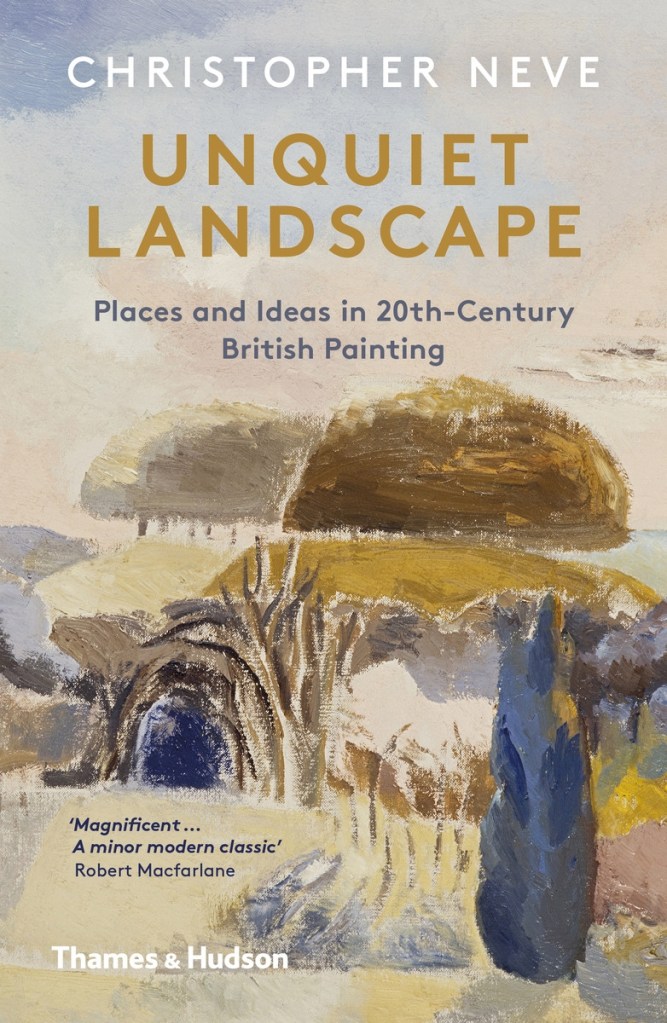
I read this book at the height of lockdown, recommended by a landscape photographer. This was a time when I ached for landscape to connect with, having briefly lost my own landscapes, both present and past, and so sought the landscapes available on foot from home. It’s a book about individual connections with landscape by mid-20th century British landscape painters, some very well-known like Paul Nash and Eric Ravilious, and some less celebrated. And it’s also a deeply philosophical and personal statement by Neve, a gallery owner who knew all the artists personally, concerning how artists in particular connect with landscapes, why they do it, and what effect this liberates.
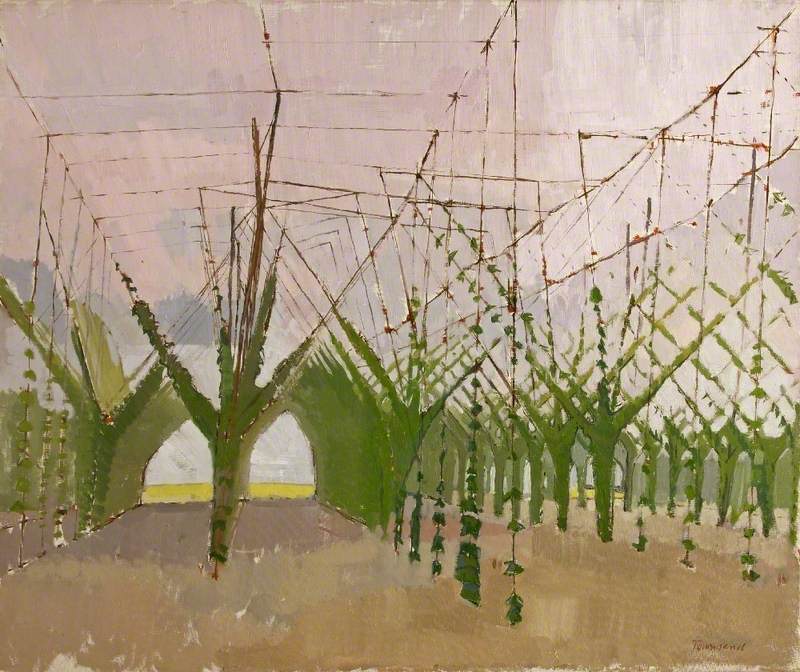
Neve advocates for an engaged but dispassionate – he uses the word ‘objective’, though not in the strictly scientific sense – observation, unclouded by sentiment or imposition, which allows for a set of feelings to arise which liberates an imaginative engagement. The painting arises from that engagement. Speaking of William Townsend, Neve says
‘Knowing how to see, how to approach the whole business of seeing, without prejudice or self-consciousness, can be the very basis on which to feel… Accurate observation arouses the imagination. To have these feelings, you do not observe countryside in a general way; you study it’. (136).
The Hop Garden, 1950, William Townsend.
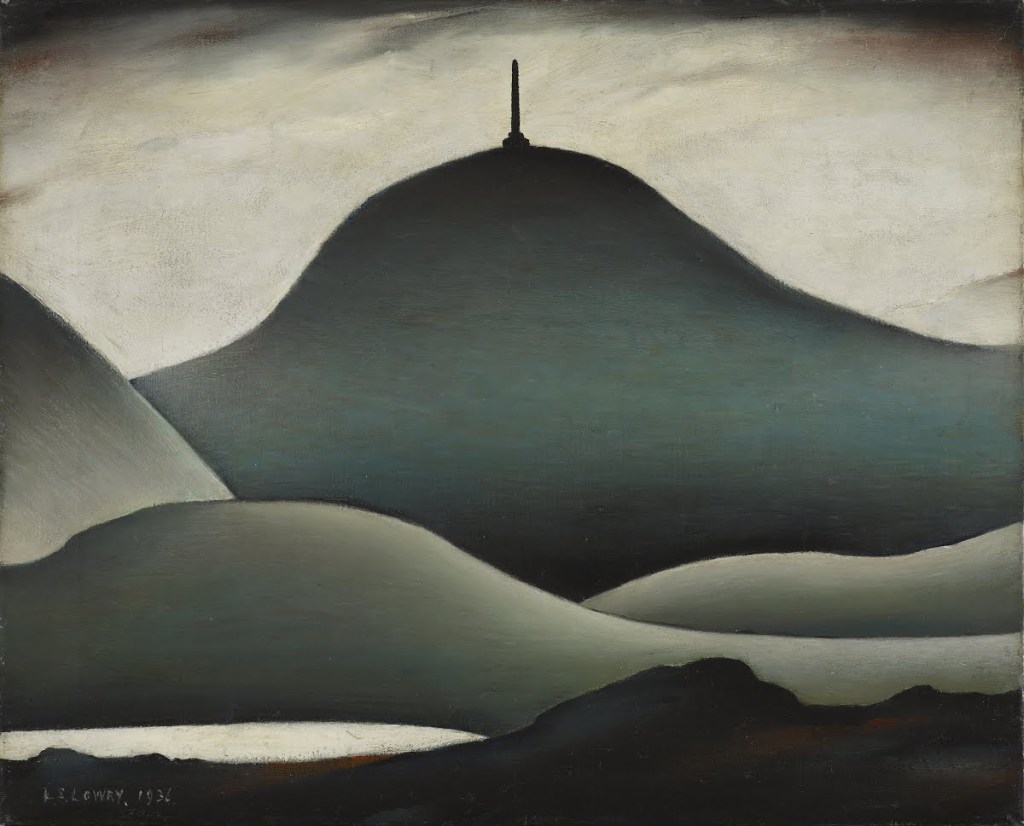
Each artist is motivated in doing so by their circumstances, personal histories and temperaments, and the feelings which arise are where self becomes entangled with landscape, is acted on by it. Speaking of L. S. Lowry, Neve comments…
‘You can always tell when a painter is in the business of artifice, of setting scenes instead of showing you what he really feels… To draw dramatic scenery as though it carries some meaning of its own is one thing: to sense its connection with your own terror of loneliness is another.’ (139-140).
The Landmark, 1936, L. S. Lowry.
In Eric Ravilious, he identifies a playful sense of geometry indistinguishable from his work in graphic design and textiles; in Stanley Spencer, a non-discriminating, ‘act of love’ through intense scrutiny which draws on a profound Christian faith; in Joan Eardley an elemental and pared-back solitude. To Neve, landscape has no specific ‘meaning’, but it finds expression by acting on the artist so long as they let it do so by stepping back and letting it work through them in such a way that the viewer may also engage with it – and through – the artist’s interpretation, in which we may find reflections of our own preferences and needs.
Here is not the place to discuss how this reflects my research into cultural geographers such as Wylie, Ingold and Massey, and anthropologist Tilley – doing this justice would run into many thousands of words – but it is enough for me to say that I see here the sense of entanglement and dwelling in the landscape which they refer to. I also see here reflected my previous experiences of artistic connections with landscapes. What is different here is that Neve is talking about a long-term, often life-long commitment to a landscape, something not really possible on five shoots spread out over months. And this is why it’s so timely, as Covid-19 has forced me into a position where I’m becoming as deeply immersed in a particular landscape – the Pebblebed Heaths – as are the ticks which I sometimes bring home.
Kettle Plantation, 2020, Andy Thatcher.
It’s also timely because, on the new module, Surfaces and Strategies, I’m more interested in a subjective, sensory, imaginative encounter with landscape, my own and those of others, and that’s why I’m increasingly asking myself the question: what does this landscape draw from me other than my interest? What am I drawn to and why? I’ve mentioned previously that I’m drawn to the weird and the eerie in landscape, and this is in no small measure because I’ve an active imagination and I love sci-fi and horror, but that doesn’t sufficiently explain why it’s the strange corners and valleys that interest me the most, the ruins and damage. I believe it’s a result of an unhappy and lonely childhood spent escaping into books; my encounter with landscape has always been exactly that kind of escape, a desire to find that same release and sense of possibility in the physical world ‘out there’, the affirmation that provides, and a space in which difficult feelings can find resolution.
Uphams Plantation, 2020, Andy Thatcher.
I’ve begun to speak of walking on the heaths at the end of the day as a ‘reverie’ and I think that’s more or less the kind of dispassionate observation Neve refers to. It’s certainly informed by an attention to detail and knowledge; it’s vital for me to understand why the landscape looks as it does, politically, historically, ecologically, culturally, but that, I now see, assists the reverie. I can know that the churring of the nightjars I hear is exactly what it is, but I can also enter into the otherworldly feelings those inspire in me and create work through imaginative engagement. During Informing Contexts, I asked ‘What are the Pebblebed Heaths?’ During Surfaces and Strategies, I’m asking ‘What are the Pebblebed Heaths to me?’
Neve, C. 2019. Unquiet Landscape: Places and Ideas in 20th-Century British Painting (2nd edition). London: Thames and Hudson.
I’ve a lifelong love of horror, ghost stories, sci-fi and fantasy, and though I’ve long been familiar with Freud’s notion of the unheimlich – weakly translated into English as the Uncanny – it’s never sat well with the work I prefer or the moods I sometimes seek out when photographing the landscape. Mark Fisher (2016) has done an excellent job of teasing apart three interrelated but distinct concepts – the uncanny, the weird, and the eerie – and this has helped provide a focus for my work over the past weeks as I’ve roamed in the weird and eerie moods and sensory encounters made possible by the long dusks as we approach the summer solstice.
Fisher argues that while all three are similar in their affect and in their defamiliarising effects, the uncanny is quite different to the other two, pointing to Freud’s original word, the unheimlich, as rooted in the domestic as the literal translation – the unhomely – suggests. The unheimlich, he argues, starts with the familiar and makes it strange from within whereas the weird and the eerie impose strangeness from the outside. Hence, for example, the automaton of Hoffman’s The Sandman, mentioned by Freud, is created out of ideas of the family. The unheimlich therefore requires a degree of retention of the homely to exert its unhomely effect.
Wyndham’s The Midwich Cuckoos, on the other hand, might similarly seem to be a tale of parenting turned monstrous, but there is nothing homely about its golden-eyed children from the outset; they are imposed from the outside. This is a good example of what Fisher describes as the weird as bringing ‘to the familiar something which ordinarily lies beyond it and which cannot be reconciled with the ‘homely” (10), particularly when two things are brought together that should not logically be, in this case a hyper-intelligent hive mind and biologically human children.
Of course it could be argued that, in the case of The Sandman, the wild science which makes possible the automaton is ‘beyond’ the homely, but I would counter this is only in a very limited way: it is the father’s job, keeping him within the orthodoxies of family structure, and it is also within the orthodoxies of contemporary culture through science, though only just. There is, to the weird, a contingent unknowability, and I might draw the distinction between two canonical doubles, the double often considered as de facto uncanny. The Mr. Hyde of The Strange case of Dr. Jekyl & Mr. Hyde is, like the automaton, a creation of the laboratory. He is monstrous, the science is extreme, but Mr. Hyde retains some of the familiar behaviours and traits of a gentleman; it is this latter that especially provides its deeply unsettling uncanny effects. There is nothing unknowable about Mr. Hyde’s existence – Stevenson saves his explorations of that for his psychological insights. The Portrait of Dorian Gray, on the other hand, is the result of a form of curse which (at least in the book) is never adequately explained. There is a clear intervention of something unknowable from the outside: how has this happened – and why? We are not told. The monstrous double in the painting is thus not homely at all and so cannot be considered unhomely: it is, rather, weird.
Fisher’s idea of the eerie is related but quite distinct: whereas with the weird, something exists where there should be nothing, or where nothing exists where there should be something. Hence, despite its iconic familiarity, the Tardis always retains a sense of the eerie wherever it crops up and hence the empty motorways at the height of lockdown were frequently referred to as eerie. In both cases, as with the weird, unknowability plays its part, though quite differently. The unknowability of the Tardis is the logic-defying otherness of time travel and its Doctor; this unknowability allows the Tardis to occupy tellingly liminal spaces in each storyline, spaces where there should typically be nothing. The empty motorways of March and April 2020, however, did have a logical, knowable cause – the application of government restrictions in response to a global pandemic. All the same, empty motorways are not a unique phenomenon and can be caused by serious accidents, road works, demonstrations, and do not then appear eerie. I would argue that a failure to fully accept, grasp and adapt to a reality that was continually shifting and unpredictable was behind this feeling of eerie more than any connection with apocalyptic cinema. One simply did not know when, if ever, the motorways would run again, and this demonstrates how an unknowable outside acts on the familiar to render it eerie.
So what has all this to do with my practice? First, one has to acknowledge the utter subjectivity to applying these modes. One has to experience a familiarity in something to experience the uncanny; one has to experience a lack of knowledge of what should or should not be to experience the weird and the eerie. The failing light of dusk helps to weaken certainty just as the purple hues accentuate strangeness. In such a state of mild reverie, it becomes easier to suspend what might otherwise be knowable and suggest less literal readings of the landscape.
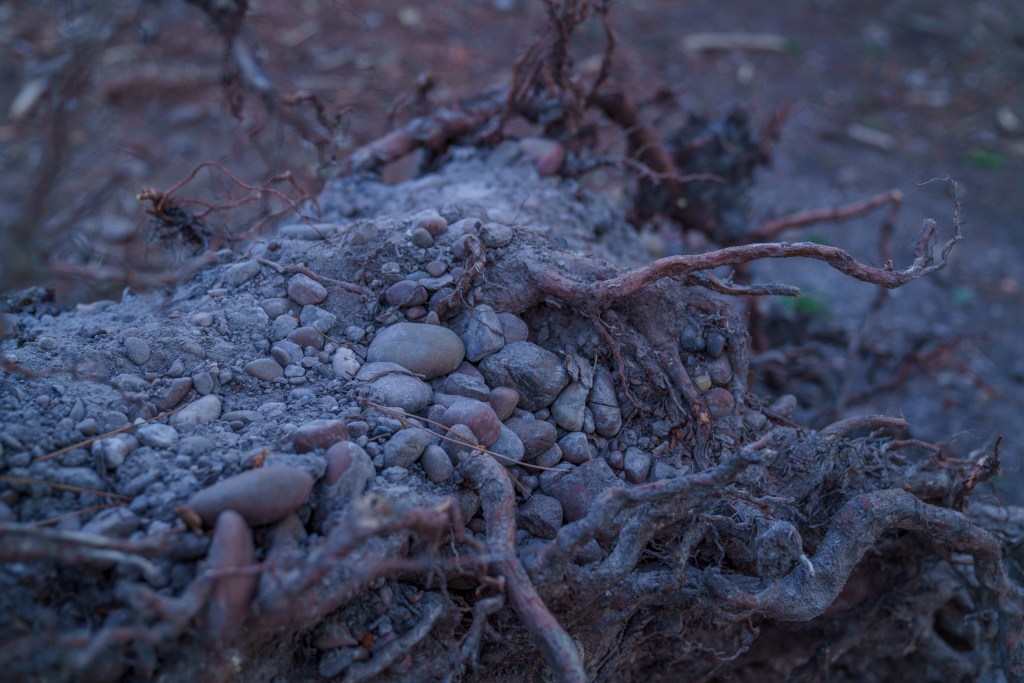
East Budleigh Common, 2020, Andy Thatcher.
Hence, the fallen and felled trees entangling roots and pebbles seem to become a single, Lovecraftian organic entity; what has caused this fusion of vegetal and mineral is unknowable; it becomes weird.
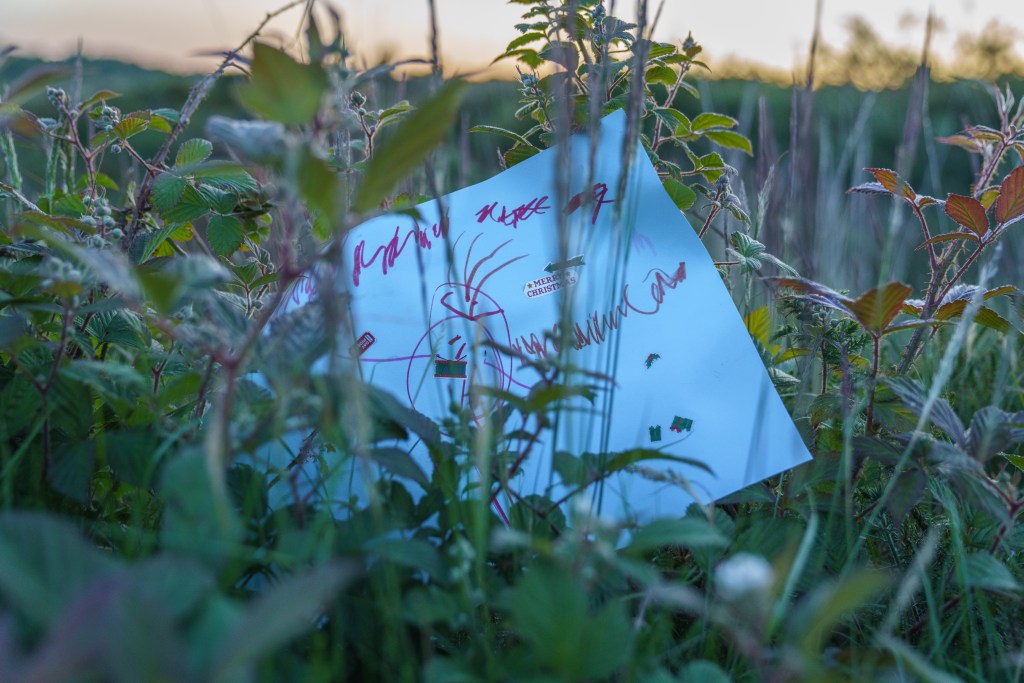
East Budleigh Common, 2020, Andy Thatcher.
Hence the child’s drawing which does not belong in the brambles of East Budleigh common sheds daylight’s familiar explanation of a family picnic and infers a family snatched by fanged monsters.
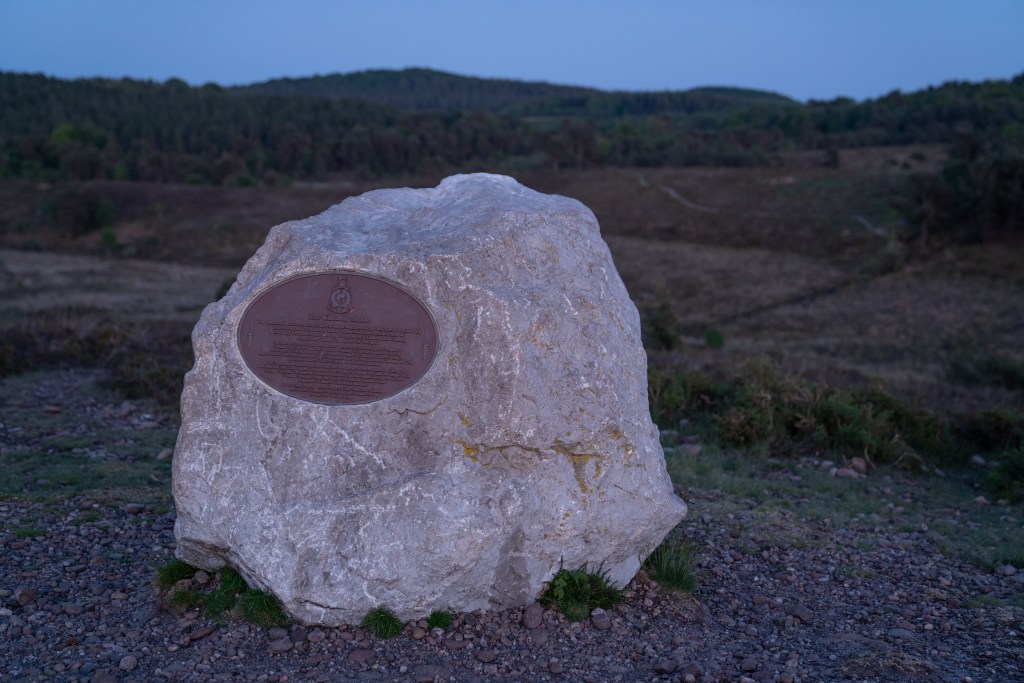
Woodbury Common, 2020, Andy Thatcher.
A chunk of the Rock of Gibraltar sits on a rise on Woodbury Common, a commemorative gift for the Royal Marines who first cut their teeth there. The rock is a pale blue and always looks out of place, but the dusk makes it shine purple against the dark heathland vegetation and its shape becomes a ghostly abstract. In the midst of this darkening landscape where there should be nothing, there is a palpable eerie something; perhaps the rock fulfils a darker purpose, perhaps some obscene evil lurks beneath it.
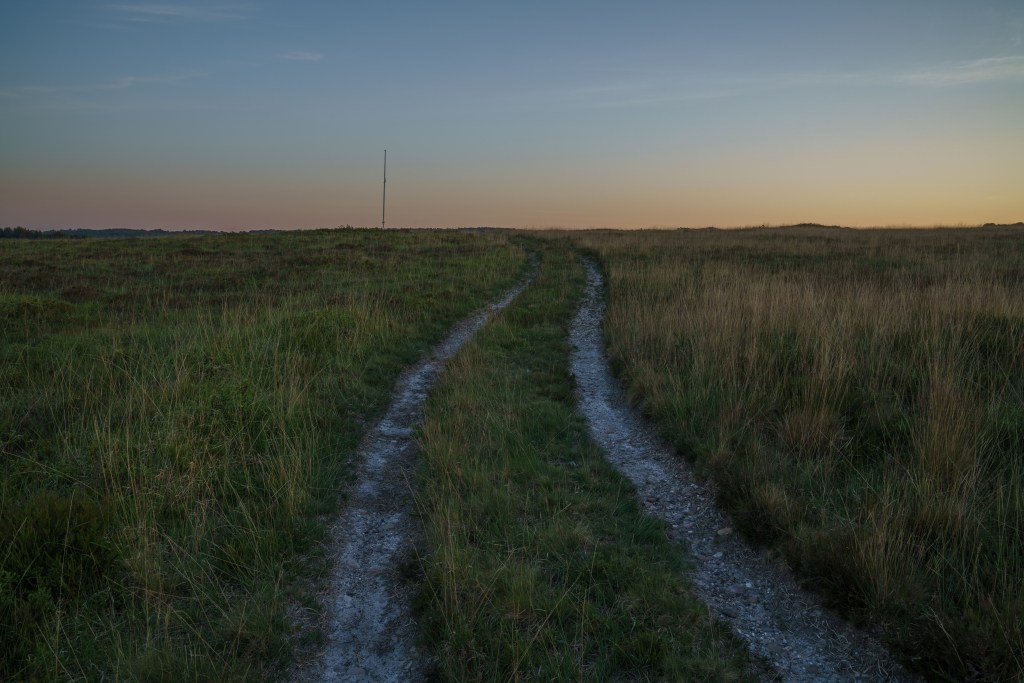
Colaton Raleigh Common, 2020, Andy Thatcher.
In the daytime, these army tracks lead to one of the flagpoles used to warn the public of the firing of live ammunition, but after sundown, the tracks and empty flagpole imply the absence of human activity, indeed the empty expansiveness of the heaths. Where has everyone gone? Will they ever return? It is easy to fall into such reveries without altering or fictionalising anything in front of the camera.
Commons are complex places, full of lost histories, silent wars of attrition and endless idiosyncrasies. Beyond being a place for picnics, dog-walking, den-building and mountain-biking, they are places of conflict and violent change, both political and environmental. The pebbles themselves are evidence of millions of years of violent climate change during the Triassic age, a long way from the comfortable beach pebbles one puts in one’s pocket. I have been searching for a way to incorporate this with the familiar and comforting way the heaths occur to most people. It may be that through deploying the weird and the eerie, sparingly perhaps, I might be able to achieve this reconciliation.
Fisher, M. 2016. The Weird and the Eerie. London: Repeater Books.
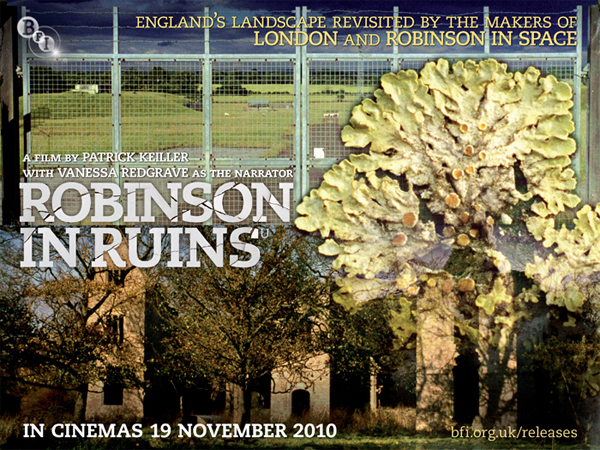
If my photography is a way of ‘thinking-through’ and expressing ideas about registered commons, and if I’m drawing on sensory research as a methodology to do so, then what is the theoretical basis for my evaluation? This is an ongoing question, one begun during my film Masters, when I drew heavily on environmental psychology. Sensory ethnography uses both film and photography as practice-based research, is deeply influenced by phenomenology, and takes as a central concern people’s relationships with space by making use of some key cultural geographers (Pink, 2015). I briefly engaged with this area of research in my Masters dissertation film, and am now deepening my knowledge of it, starting with the work of Doreen Massey, and will be continuing through the work of Tim Ingold and Yi Tu Fuan. Massey was herself involved in interdisciplinary work, including with filmmaker Patrick Keiller on his influential essay film, Robinson in Ruins (2010) which drew knowingly on the traditions of landscape painting and photography; this was one of the last projects she was involved with prior to her premature death.
Massey defines space and place as distinct but indivisibly connected concepts (2006). Space, she sees as ‘the product of interrelations’, ‘the sphere in which distinct trajectories coexist’ and ‘always under construction’; ‘relations’ here are ‘understood as embedded practices’. It is thus constantly unfolding, unpredictable and full of the unexpected. Her model is thus a fundamentally political one – describing ‘the realm of the configuration of potentially dissonant (or concordant) practices’. Massey also argues that time and space are only divisible in the abstract, that ‘time unfolds as change [and] space unfolds as interaction’, especially social interaction.
Place, on the other hand, is where the trajectories and interrelations become ‘thrown together’, and equally where they fail to do so, held together by sets of ongoingly contested rules resulting from the ‘throwntogetherness’ of these trajectories and interrelations. Place is also constantly unfolding, hence it is both temporal and spatial, hence one cannot return to exactly the same place; attempts to enclose place in order to render it static is the basis for dangerous conservatism, but also poses difficult questions for heritage and conservation organisations. Doing so necessarily arrests many of the trajectories which constitute place. Rather, place is a negotiation between trajectories which are ‘sometimes ridden with antagonism’, and socially ‘places pose in particular form the question of our living together…the central question of the political’. Place formation can also require a more or less rigidly constructed ‘we’ or sets of ‘we’.
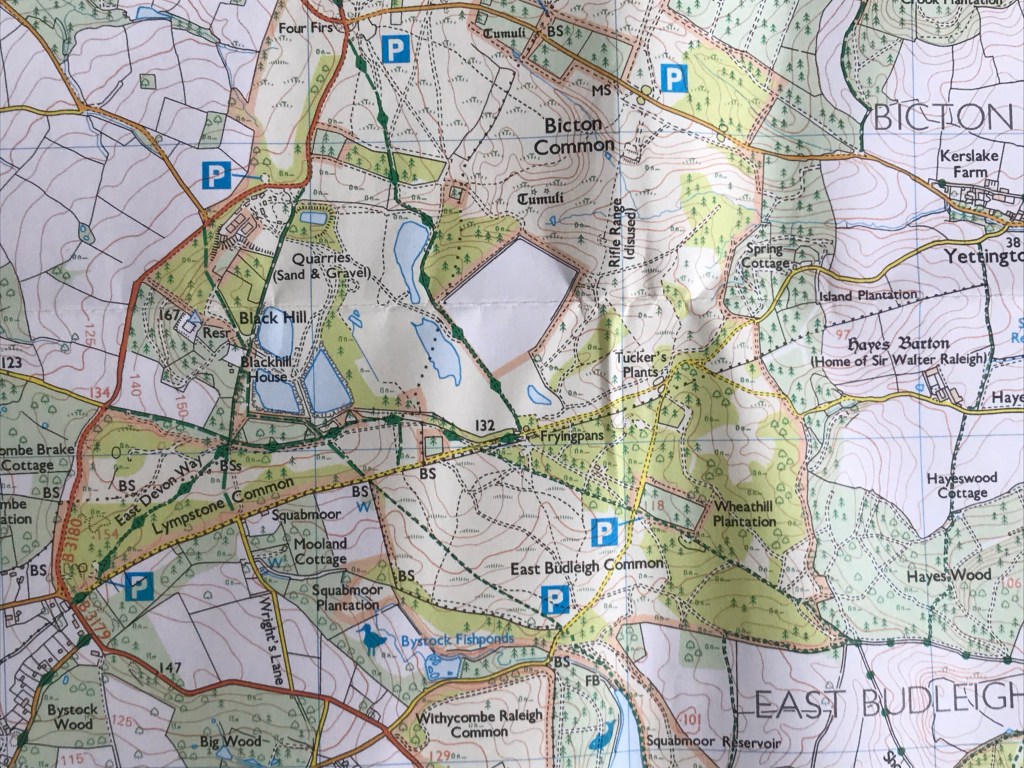
Ordnance Survey, 2015.
So what does this have to do with common knowledge? First, it describes perfectly the two ways I approach my practice, as ways of engaging with the Pebblebed Heaths as space and as place. The Pebblebed Heaths first became known to me as places. They are held together by sets of rules which name them, are written into law, are written onto maps. Commons are a particular type of place and when I first visited in 2008, I mapped my understanding of those rules, many of them unexamined and cultural, onto my experience of being there. I have chosen commons because I believe there is much to be learned about such rules and their physical, psychological and phenomenological manifestations, especially the historic and unfolding politics and conflicts which shape them via different constructions of ‘we’. These rules and conflicts – signs of enclosure, and of controlled burning, for example – are the markers, if you like, which plot any walk I take through the commons. My examination of the heaths as places, then, is akin to working as a hunter, or a farmer, with distinctly formed intentions informed by my understandings of the commons as places. By hunting evidence, or nurturing its eventual appearance through farming, of the various conflicts and rules which construct the heaths as places, I am experiencing and representing them as a ‘throwntogetherness’ of trajectories. I am seeking out evidence.
Andy Thatcher, East Budleigh Common, 2020.
On the other hand, to experience anywhere solely as place is limiting, and to interrogate it critically one must also consider it as space, to tease apart the trajectories which form it. Doing this requires a loosening of intent, an openness to the happenstance and unexpected, as described by Massey, and this is precisely what most of my shoots are like: impulsive, aimless wanderings chasing after momentary fascinations and whims, and embodied experience which lets me be led by aesthetic and emotional response rather than hard-nosed wishes to represent as Rancière (2014) might put it (more of this in another post). This is when I am a gleaner, that is to say, most of the time. It is in doing so that I encounter the multiplicity of trajectories, including those excluded from the commons as closed ‘place’ – the fly-tippers, and the graffiti artists – as well as the non-human trajectories of ecological change – the ceaseless passage of water, the willows in bloom. Rather than seeking out evidence for the heaths as a place, and thus dealing with place in the abstract, I am becoming entangled in the heaths as space, and thus dealing with them in the particular, physical and as embodied experience.
Andy Thatcher, East Budleigh Common, 2020.
Both approaches complement one another; a quick email to the site manager about a freshly-gleaned trajectory lets me examine it in light of it being included or excluded from the heaths as rule-bound places. An intentional set of rules about, for example, military exclusion areas, gives me an emplaced starting point from which to begin exploring space. While the writing for this project deals more with the heaths as places, freighted as they are with facts, they are loosened by the absence of hard context in many of the images; using text more playfully and spatially is, perhaps, something to explore further at a later date.
Andy Thatcher, Woodbury Common, 2020.
Deranty, J. 2014. Jacques Ranciere: Key Concepts. Abingdon, Oxon: Routledge.
Massey, D. 2006. For Space. London: Sage.
Pink, S. 2015. Doing Sensory Ethnography (second edition). London: Sage.
When I’m out shooting, I tend to make notes on my phone. I’d been waiting for some moment of revelation that tied them all together, but that isn’t going to be happening so it seems, so I’ll just have to leave them as bulletpoints to be woven into something some other time.
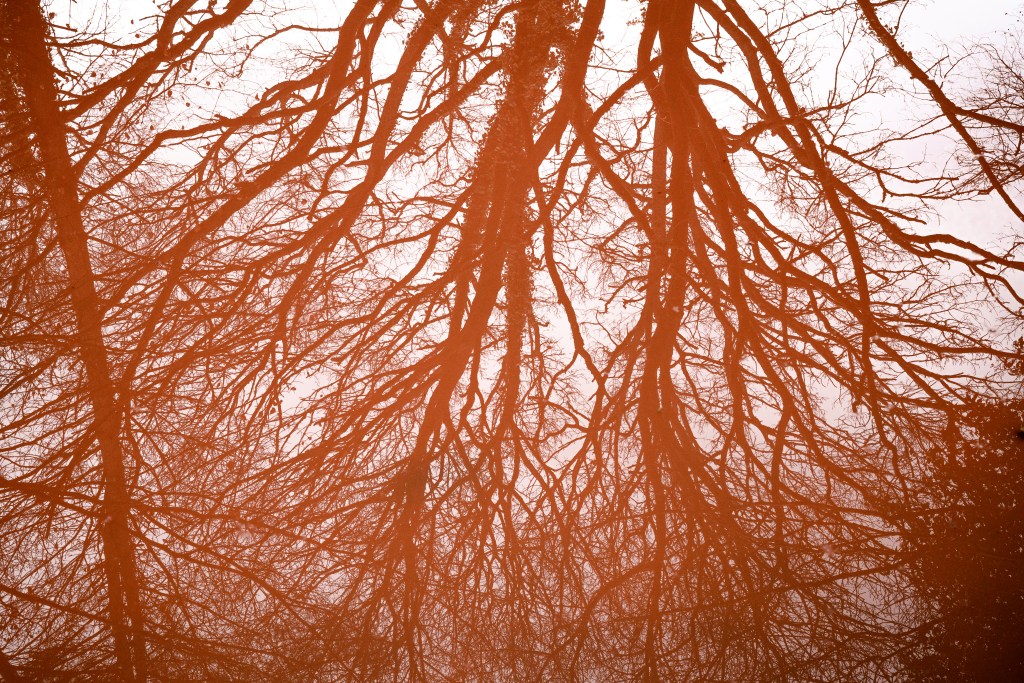
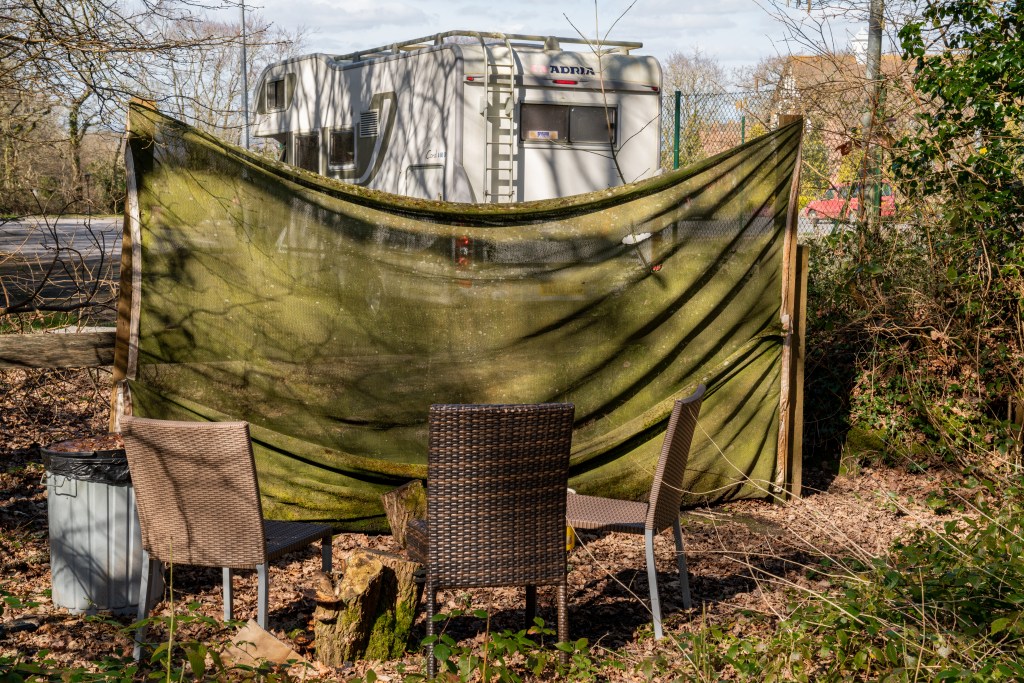
In addition to the hunter and the farmer, there needs to be the category of the gleaner, following Agnes Varda’s argument that art is a form of gleaning. By this, I mean, creating art from the things one comes across without specifically seeking them. So I go out shooting with a vague idea of what I’m looking for, but usually what I come back with is something entirely different – a reflection in a boggy mire, an abandoned caravan, frost on a path, fly-tipped waste, a stand of pines. Of course, this means coming back with a bit of a mess and endless contradictions. The vast majority of my images will be disregarded, but at some point, a coherence will start to form, and it’s in the editing and sequencing, the thinking through of the images, that things take shape. It’s an immersive, open response to place. It’s how I make films, too.
I take various types of shots. These fall into a variety of categories, which I could loosely call: Weird (as in the idiosyncratic and the atmospherically unsettling), archetypal (including objects and vistas), enchanted (a close relative of the picturesque), traces, abstracts, (these two are often pictures of the ground), and the political (sometimes actual things like enclosure banks, sometimes metaphorical).
An alternative to the gaze is interpellation – as in projecting one’s ideology onto the world, but as an act of testing out, and an act that is shaped by context, shaping one in turn.
Photography is understood popularly as a looking for something rather than just looking. I’m often asked what I’m photographing – once, when I said I was photographing a pylon because I like them, the person asking thought that must be what I photographed generally, as if I was creating some personal catalogue of the things. Last week, I was asked if it was insects. I always say I’m photographing whatever I find. This confuses people. It must be quite a radical approach, I’m thinking.
It’s OK taking different types of shots, but really, sometimes they just won’t work together – i.e. vista shots with abstracts. I recall this in books I’ve read – suddently coming across a ‘straight’ photograph of a place, even if there’s a very good reason for it, is often a bit of a disappointment.
A challenging, occasionally frustrating but often fun few days at Falmouth University’s Face to Face 2020 for distance learning MA students. Somewhat depleted in numbers due to the ongoing worries over coronavirus, but we still had students from Scotland, Vienna and Spain. It’s going to take a bit of time to unpick everything, but the two key learning outcomes for me were these.
Realising through my struggle to learn enough about film to operate a 5×4 camera, and a wonderful but hugely pricey digital medium format camera with its vast file sizes, that the most important thing with a photography practice is to start with myself rather than jump to any technology because I think it’s something I should be using. This is why I have a gimbal I never use. It’s why I bought a compact with a vast zoom I never used. My practice, if truth be told, is an extension of my walking. Any technology I use needs to leave me free to walk – hence only one camera, one lens, no tripod. At least, at the moment. Should I develop another way of photographing – like portraits, for example – then it’s worth thinking about. But my photography needs to start with me, be almost prosthesis. It needs to enhance not distract. And that means necessary compromise, but being weighed down with the physical and cognitive burden of kit has to be more benefit than cost. This realisation comes as somewhat of a relief. Maybe, some day, when there’s the opportunity to get tuition and support over a period of days I’ll go back to 5×4. But right now, it’s my Sony and my zoom.
One of my constant anxieties about my photography can be described succinctly as ‘Who fucking cares?’ Yeah, it’s a beautiful path. Yeah, it’s an eerie ruin. Yeah, it’s a madly abstract reflection. But WHO FUCKING CARES? My group portfolio reviews pretty much focussed on that without meaning to. It’s not enough to be formally excellent: an image has to communicate. I’ve long since had enough of writing that falls into this category – I loathe a clever but empty novel – and I’m very clear about photography that feels that way to me. What I need to do is have the bravery to detach myself from shots that I take that have seduced my through their formal composition. And that’s a hard thing to do. I guess that’s what it’s going to take for my photography to move on from images that are created mainly to please myself that, yes, I’ve composed something skilfully, to, yes, I have something to communicate that’s going to engage others. Asking myself Who Fucking Cares? when on a shoot doesn’t mean that I can’t engage with images I find striking in their weirdness of their beauty, but I need to ask myself, just as I think about the formal aspects of a frame, I need to consider their communicative elements as if this were indivisible from the lines and textures I take so much time over. Because they need to be. (Though of course, sequencing or text can also address this question – but really this should be a good place to start).
I need to get these thoughts down while they’re still in my mind – hence this post won’t be illustrated with images just yet.
I guess in response to this week’s topic, I’m thinking quite hard about just what my practice is, where it’s going, and where it needs refining. I’m starting to realise that going out shooting stills is actually a very different experience to shooting video, even if it’s on the same camera, even if the subject matter is identical. The really big difference isn’t out in the field – it’s what happens to those bits and pieces afterwards. Whatever strength stills photography has, in comparison with film, it lacks the immersive textual experience of the voiceover, it lacks the thematic and emotive games that can be played through sound, it lacks movement, both on screen and of the frame, and it lacks the sophistication of meaning made possible by editing. This isn’t to imply that photography is inferior – it’s absolutely not – but that I’m going to have to think carefully about how to translate the thematic and textual elements into a new medium.
As I go out shooting, I’m thinking. The shooting is part of that thinking, and this is why I settled on the essay film as the best match for my inclinations as a film form. My thinking can be expressed through choice of shot, choice of frame and focal length, sound, dissonant editing, duration, voiceover, music, on screen text.
In particular, as I shoot, I note down my thoughts and these form the basis of an accompanying text. This text is very important – as a writer, it’s of equal importance to the image. In my dissertation film, and my film about the M5 bridge at Exeter, this was worked up rigorously and was an integral part of the editing process. I realised today that there are things that I won’t be able to say through photographs, but that I want to say, as part of my commons project. These are personal reflections, moods and abstract ideas. I need to think about how to keep this as part of the project.
For example, walking amongst some of the really small patches of common land left – such as Manor Farm, which isn’t even signposted but is actually rather wonderful, and looking across the Otter valley towards Mutters Moor and Harpford Common, it’s like island-hopping between these extraodinary places. Islands in a land inundated with private owndership.
For example, it strikes me that the timelessness of the land is in its useage, in its history. There’s nothing timeless about heathland – it’s heavily managed – but people have been free to wonder on these little patches of land since there were people. In all that time, they have not been stopped, and if they have, they have fought back and won. There’s a dream inherent in the commons, and it’s a dream found in national parks, wildlife reserves, public parks. But common land is the origin of all this – and of course, many of these types of amenity ARE commons. To a certain extent, streets are also a kind of commons.
That was pretty much my train of thought. It’s something I want to develop – but I can only think of doing so in writing. So it’s time to stop messing around, and be including writing in what I’m doing.
As another note, it’s time to stop being so prissy about leaving things untouched. The pebbles on the commons look so much nicer when they’re wet. I need to start getting them wet to photograph them. To hell with authenticity.
And as one final note – one thing that I’m starting to do is understand my terrain, my own take on it. Starting to understand how best to photograph paths, birches, seeing the possibilities in kinds of land. In this, what I’m doing is no different to street photography.
I was out shooting yesterday at Mutters Moor, a sliver of common along an East Devon ridge, when I came across a shiny white Land Rover and a picnic table groaning with thermoses, bottled water and snacks. The table commanded a stunning view, new to me, up the coast towards Exmouth and on to Torbay. It’s a view so stunning, so I was told by the Land Rover’s keeper, it’s even got a name: The Queen’s View. The keeper explained he was awaiting a group of off-roaders in 4X4s off for a corporate day out – his business. After chatting a while, I took in the view and went my way.
This would have been a great photo op. It’s incongruous, political (considering the ongoing battles against off-roaders in the Lake District) and would have been aesthetically interesting. However, as I went my way, it occurred to me I never even thought to include what I’d stumbled across in my walk, in the way I’d included logging an hour or so earlier. This is partly because I’m still very shy of asking to take people’s photos, however much reassurance I might have had from people over the years. But I think there’s something else going on. I think, for what I’m trying to achieve, people are a distraction.
The influential theorist of film sound, Michel Chion, argues that whenever a human voice appears in a soundtrack, it without fail attracts attention to the extent where it instantaneously becomes predominant. I’ve argued previously, also referring to film, that the appearance of people into landscape has an analogous effect, and used this phenomenon in my film, Strands, by allowing the audience time to experience an unpeopled landscape before people enter the frame and after they leave it. This was intended to allow the audience both to ‘dwell’ in the landscape in sensory terms and to experience it as mediated by people connected with it in narrative terms.
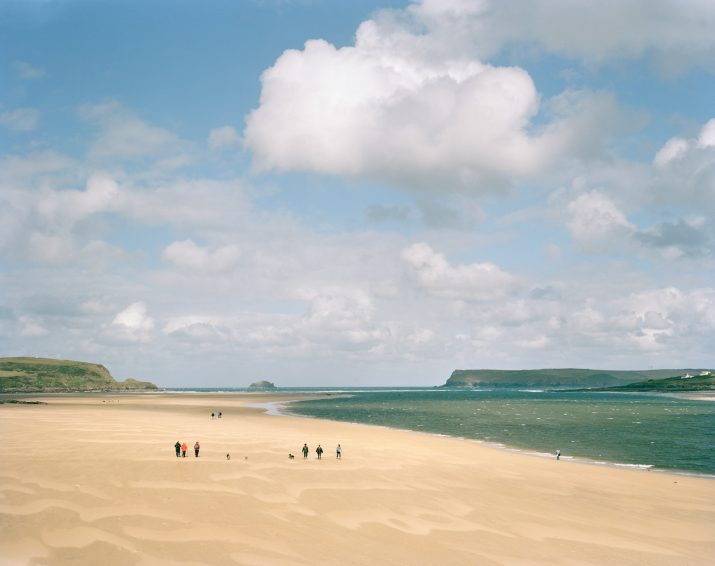
The temporally-fixed frame of stills photography does not allow for such flexibility, but neither does it make such flexibility impossible. The work of, for example, Simon Roberts, envisions landscape in a very human, narrative way by including activity, even when taking up a minute portion of the frame; it is about landscape, but it is even more about specific people’s relationship with their landscape, as demonstrated in series titles such as We English. When faced with his work, which I love, my initial response is to wonder who these people are and what they’re doing, before beginning to see their relationship with the rest of the image.
Camel Estuary, Padstow, Cornwall, 27 September 2007. Simon Roberts, 2009.
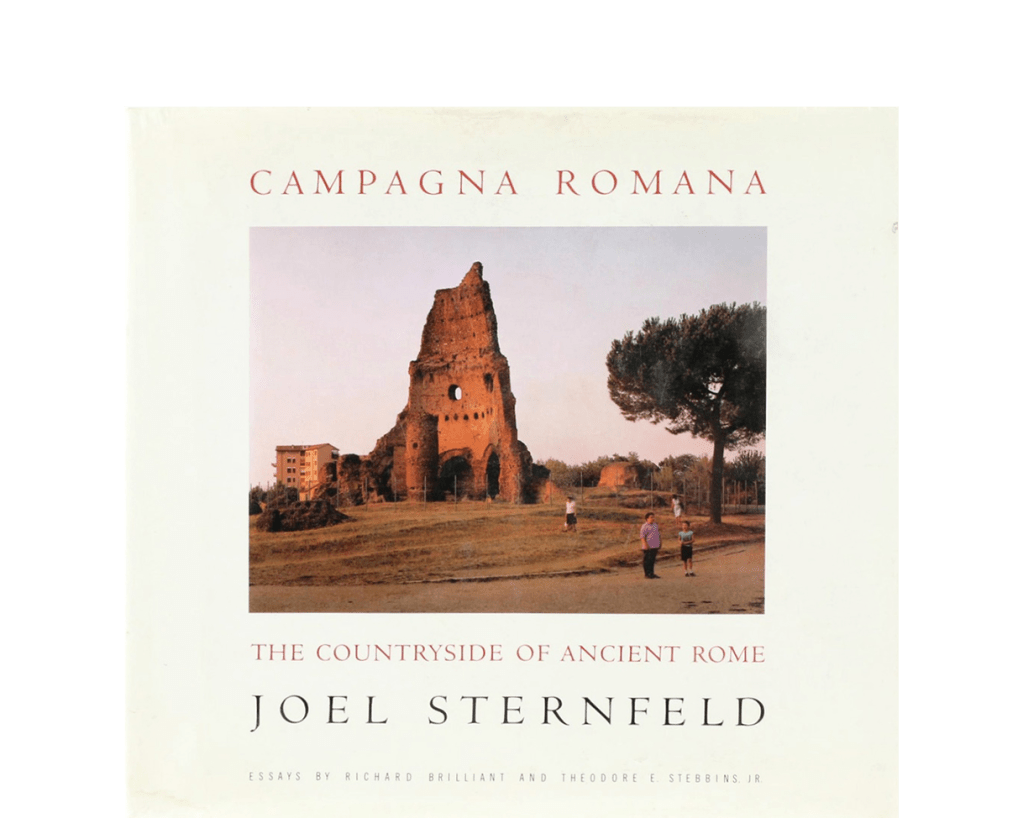
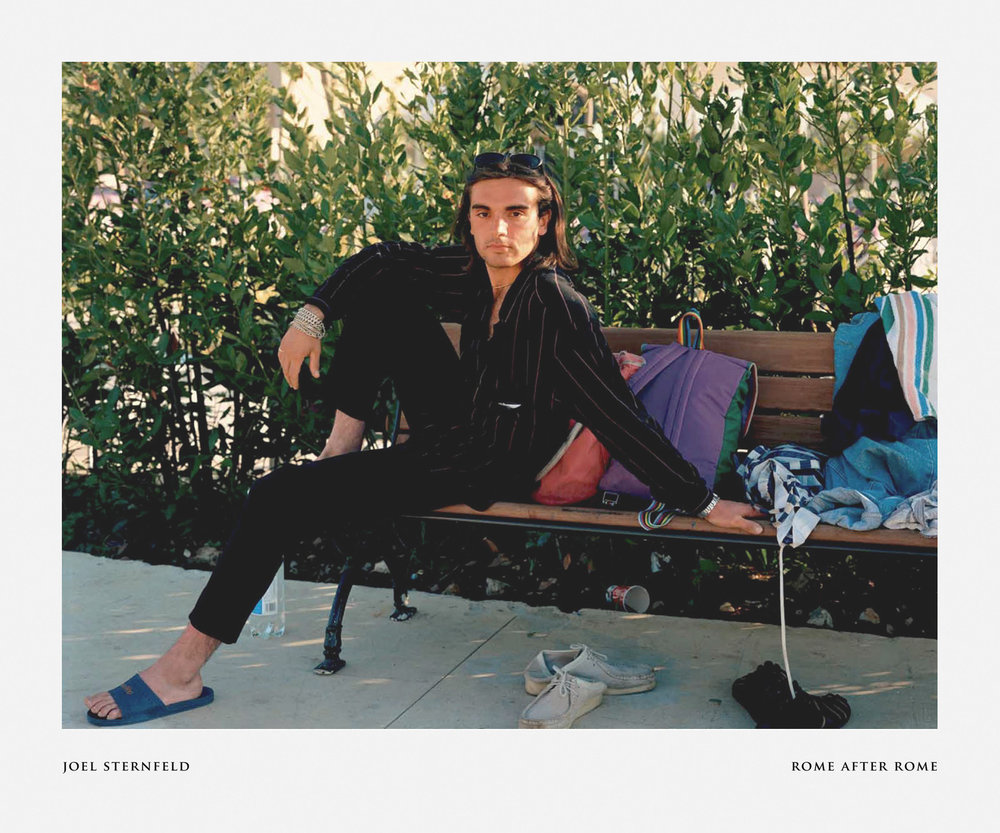
Another strategy is to interlace unpopulated landscape shots with portraits or documentary images. This was Joel Sternfeld’s approach in Campagna Romana, which has scant, slightly surreal but poignant portraits in amongst the shots of the remnants of ancient Rome taken over several years. It’s an exquisite series that allows for a sense of discovery of this extraordinary landscape that extends to a map at the back. Last year’s Rome after Romerevisits and reenvisions this series, richly updating its reproduction but also including far more portraits to the extent where portraits follow one another. The book is, deliberately, much more about the people: the landscape becomes theirs, rather than as previously, they appearing as a part of their landscape. While no less successful as a book, the sense of immersion is gone, and one gets the sense of peering around the portraits to see their landscapes. This difference is demonstrated effectively by their two different front covers.
People are very much a part of my commons project. Commons are given their characteristics by human agency, whether conservation, history, leisure or economic usage, or – especially – legal status. I want to explore these dimensions in my project, and I also want to explore the different sensory ways in which they can be experienced – what it feels like for people to be on a common. I want my project, as with Strands, to be an immersive experience. I want viewers to have a degree of agency, to be able to develop their own connections and explore the landscapes presented for themselves, partly to give them space to reflect on their own experience of commons, and I believe my intentions could be at odds if I included people visually in this project. So, had I included a portrait of the man with his Land Rover, or his assistant at the picnic table, even if relatively small in the frame against the magnificent backdrop of The Queen’s View, the image would become primarily about off-roading, and the meanings to be drawn from it, and about The Queen’s View as a cultural rather than sensory experience. Nothing wrong with that, of course, just not my intention.
It has long been my intention to include writing in my work, and through leaving the visual ‘channel’ unpopulated but populating the textual ‘channel’, I think a balance could be struck: ultimately, it’s the viewers choice how to interrelate text and image and all kinds of interrelationships can be explored through formatting, something I’m investigating presently. But that’s something to discuss on another occasion.
Chion, M. 1999. The Voice in Cinema. NYC: Columbia University Press.
Roberts, S. 2009. We English. London: Chris Boot.
Sternfeld, J. 1992. Campagna Romana.NYC: Alfred A. Knopf.
Sternfeld, J. 2019. Rome After Rome. Göttingen: Steidl.
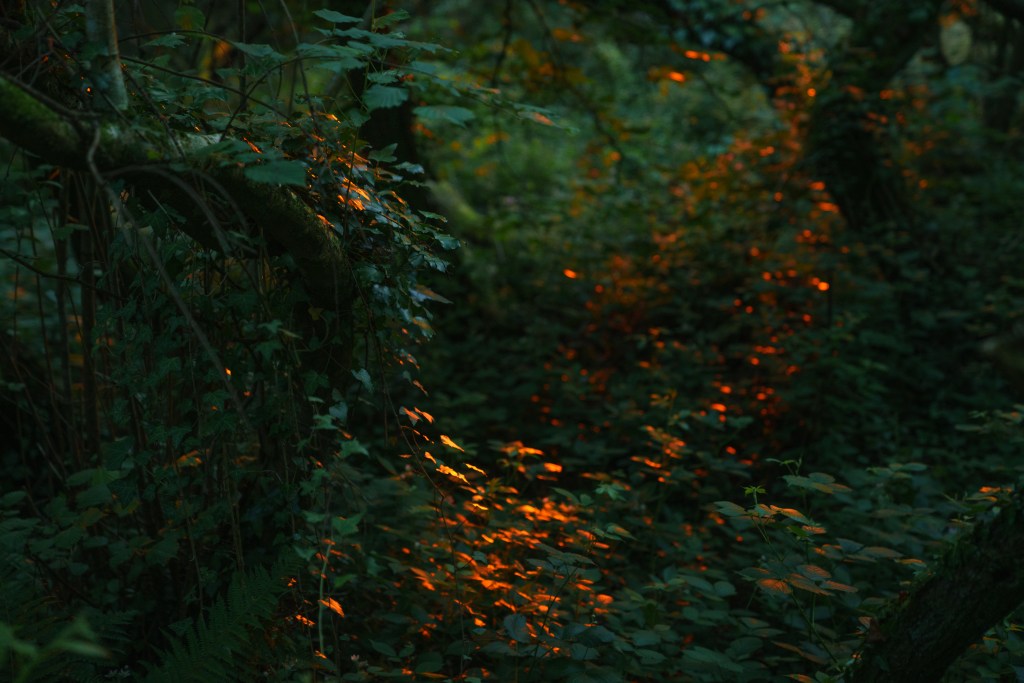
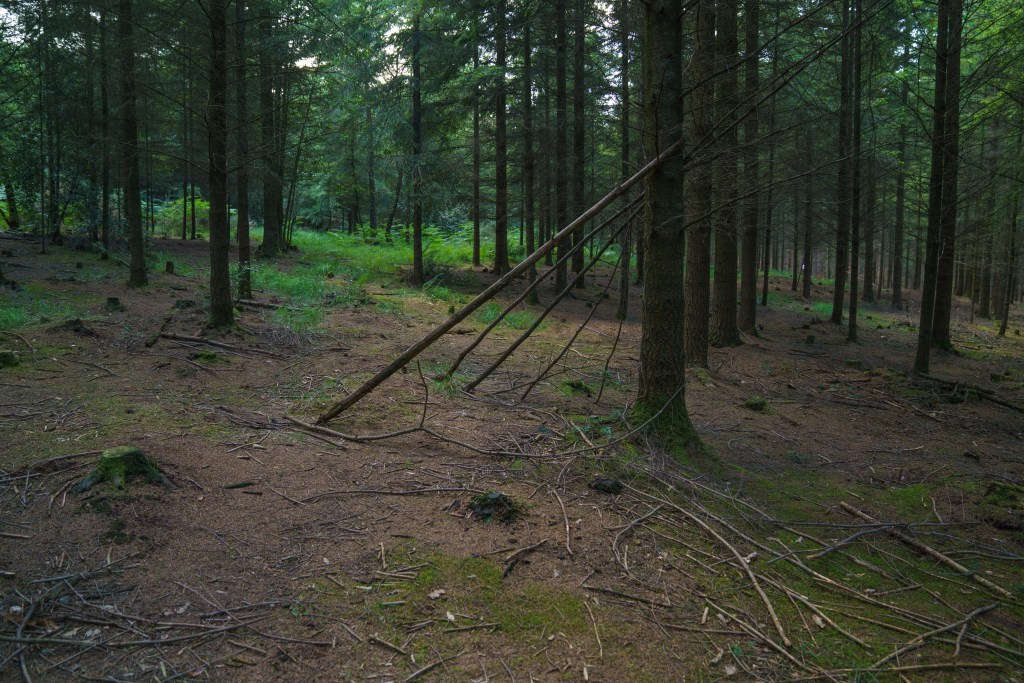
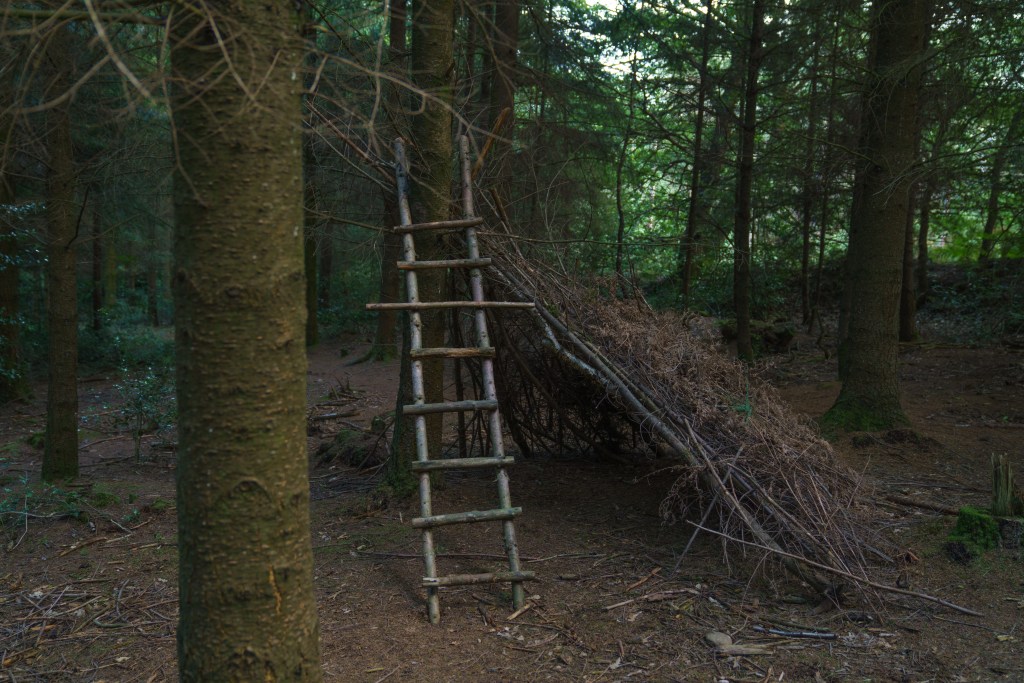
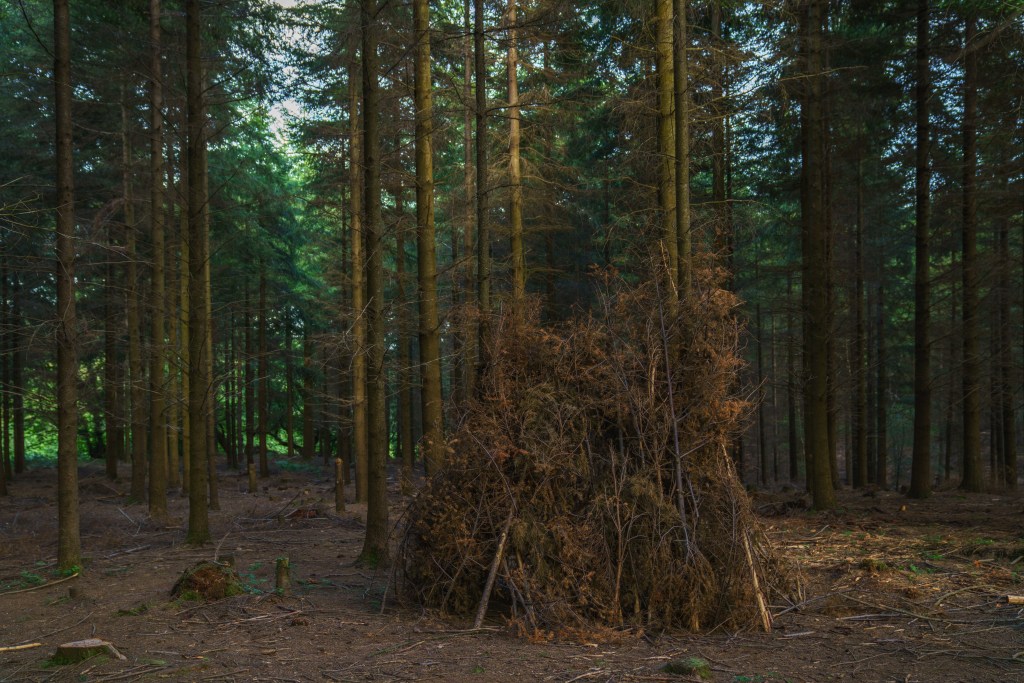

 out of the picture
You must be logged in to post a comment.