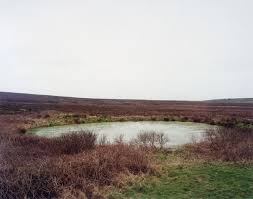
John Gossage has been one of my big discoveries during this course, recommended by one of the staff at the Martin Parr Foundation. His book The Pond appealed to me initially as it’s an intensive, evocative examination of a place that includes many elements also of interest to me – borders, misuse, traces. But what Gossage has really opened my eyes to is the possibility of texture – and specifically messiness, scruffiness.
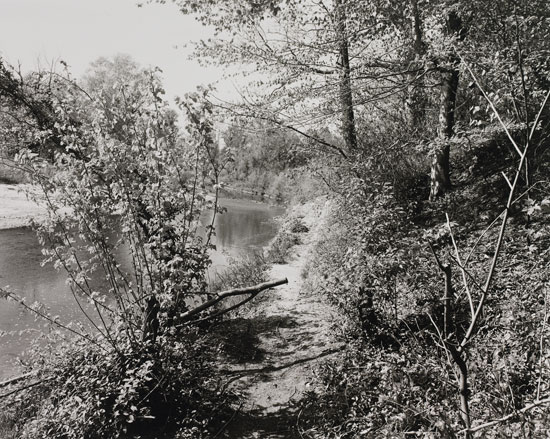
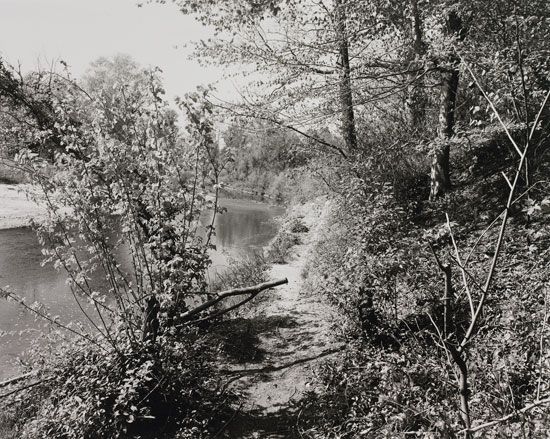
I’ve long been drawn to line over texture – as in my motorway bridges work, tree shadows, pylons, field patterns, and of course urban environments. But nature is messy, and that mess thwarts clean lines. Gossage embraces that mess – to an extent, so does Baltz – and yet elegant use of line emerges in a symbiotic relationship. This picture is an excellent example. The right third of the frame is a mess of leaves, and the left hand river bank, which would have given the right hand back’s curve emphasis, is hidden behind a small, scruffy tree. This undermines what could have been a picturesque river curve, but it also echoes the scruffy path running alongside it. The Pond demonstrates an unofficial, uncurated natural environment, its human paths more like animal tracks, as if somehow such an environment, with its litter and forgotten barbed wire, is closer to ‘nature’ than the carefully framed and composed places of more conventional landscape photography. Such unfussy human intrusion is present here in the sawn-off branch, an act of violence perhaps, that acts as counterpoint and subversion of the upright trees to the right of the photo and the very young tree in the foreground, the image’s only clean lines.
I’ve embraced mess and found form in texture since encountering Gossage. It’s been a revelation, and has also helped me rethink colour. As my commons project will include the messy landscapes of heath and birch woodland, this is just as well.
It’s wonderful when coming across a piece of writing that’s so timely, you want to grab the person nearest you and go – listen to this, no, really, LISTEN. Fortunately, I’m not given to doing this.
Such a piece of writing is David MacDougall’s Introduction to his collection Film, Ethnography and the Senses (2006), subtitled Meaning and Being. I’ve come across MacDougall in the context of documentary and for some reason it didn’t chime with me. I suspect, had I come across it again while making Strands, I would have had a similar response. MacDougall is an ethnographic filmmaker deeply embedded in questions of agency for the ethnographic subject, the role of filmmaker, and the distinctive function of film as a form of ethnographic research. In his introduction, MacDougall largely speaks of filmmaking, but speaks for the most part about the function of a camera in producing knowledge, and in this he often equates filmmaking with photography, while noting their very different qualities, especially with regards to time.
I’ve highlighted nearly the entire introduction, so summarising it and responding to it all is more than I’m prepared to do here as yet. What MacDougall explores so thoroughly is that knowledge is constituted not just by interpretative, categorical and analytical meaning, but by being, the immediacy of experience which is provided by the senses. He argues that academic study eschews the latter, despite its putative function of aggregating and developing knowledge. The camera is powerfully placed to provide both kinds of knowledge – even in photographs or films which are deeply analytical, such as those of Wall, a trace of being is retained such that meaning is always provisional and incomplete. Meaning, however self-consciously or unselfconsciously, can be created by framing, mise en scene, instance, colour and so on, but the camera always captures a surplus to any meaning, including the trace of the camera and the photographer or filmmaker’s being in the world (I’m assuming MacDougall is referring obliquely to Heidegger here). This surplus, he argues, is not incidental or accidental, but communicates a surplus of experience, the act of looking as well as what has been seen and utilised to create meaning. This tension between the two forms of knowledge is a strength for both media, as it is creative productive.
MacDougall goes on to argue that while disciplines such as anthropology make use of being-knowledge, they incorporate it into meaning-knowledge in the form of essays, papers and books, at a higher level of abstraction. They do not use it as a tool or form of expression. His understanding of looking is neither passive seeing nor concerted seeking, but aware and open observation, a form of thinking.
This is EXACTLY what I had been engaging with during the making of my last two films – using the lens as a form of analysis and engagement, informed by research but not enacting it as such, not looking for proof or evidence but what Rascaroli (2017) calls a ‘thinking-through’ found in the essay film. It’s really interesting that MacDougall equates film with photography, as that’s what I’d come to understand too, and it was important for me to leave that surplus in. It’s a specific kind of looking.
How this equates to sensory ethnography is something I’ll have to return to, but I look forward to reading this book further.
MacDougall, D. 2006. Film, Ethnography, and the senses. Princeton: Princeton University Press.
Rascaroli, L. 2017. How The Essay Film Thinks. Oxford: Oxford University Press.
I love going to the Martin Parr Foundation even more now I’ve found the river walk to get there, with all its industrial sites, graffiti, bridges and trees. The Japanese knotweed is particularly splendid this autumn.
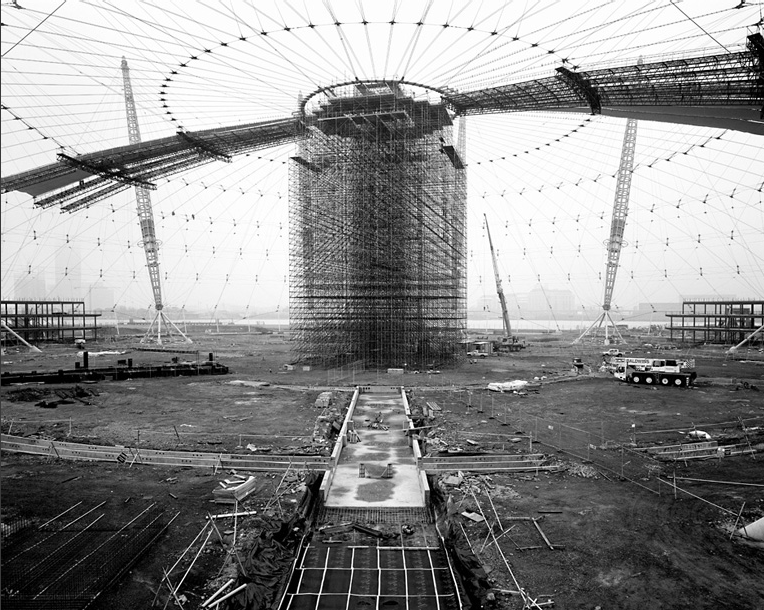
I looked out several books I’d wanted to find based on recommendations and Jesse Alexander’s Perspecitves on Place (2015). First up was Mark Power’s Superstructure (2000), which documents the construction of the Millennium Dome, now the O2 Arena.
I’m undecided about Mark Power, as sometimes he comes across like a more showy Stephen Shore, but some of his stuff I love. This is a magnificent book, not simply because it takes you into the heart of something you wouldn’t have seen otherwise – the early stages of construction are epic. I loved his sense of the absurd – workers in the newly openned McDonalds’, the off limits human body exhibit – but more how he intersperses the epic with the micro details of the work – racks of mugs, wood shavings.
It’s strange having few people throughout, in what must have been a very busy site. It makes it seem oddly quiet, which it wouldn’t have been, and that adds to the epic, cathedral feel of the images. Activity is filled in with the details, and where workers appear, they also seem like details – blurred, backs towards the camera, just their feet overhead. Not focussing on people keeps the attention on the structure, rather than the human stories involved in its making. The time scale is that of the building, with occasional contextualising historic details like brand names, papers and TV shows. Time is moving on, though – the ruins and rubbish of the area at the start, the trees lines up and awaiting planting. Only 1 image exists after the openning, distant, blurred, almost as if the whole thing was pointless and the construction was the main event. Given the problems of the dome in the following years, that assumption is accurate.
I looked through several of Jem Southam’s books. Red River (1989) is a river that flows in West Cornwall, and it’s scenery I know, like much of Southam’s. Very well, in the case of his Exe Valley work. Red River, created with poet DM Thomas, doesn’t aim for smoothness, and he draws on numerous styles, abstracts, animal shots, puns. Like Power, he shows community and place largely without portraits. The portraits do seem like interruptions, like speech in a speechless film. I like his contrasts – garden flowers and grotty farmyards and John Davies-ish industrial shots. I liked Rockfalls, Rivermouths and Ponds (1999) much better.
I can see what I’d been told about with typologies here – putting them together connects and creates a distinct effect. I wonder if the typologies of commons should be together, rather than the specific commons. There’s something particularly Becherish about the rivermouths and ponds. Southam seems largely to work in the early morning, before breakfast, again something I’d been told about and worth bearing in mind. Time is also really important – changing tides, seasons, and the cliff erosion – what Southam quotes as “creep” events – events on a really, really slow time scale. I should think about time in my project.
Isaac recommended I look at John Gossage’s The Pond (1985). This is great. He said you’re not really sure if it’s the same place or not in the book, but it feels as if it should be. Gossage has a fascination with paths, traces and borders as do I.
The landscape here is vague, unspecial, it’s an unofficial countryside, to quote Mabey (2010), and the aim is like an exploration and an evocation rather than a document.
The photography isn’t technically accomplished. It’s not smooth. But that fits the subject and there are fascinating effects used with depth of field, something I should consider. There’s a real sense of looking around, at the ground, through trees, overhead. He does some similar stuff with There & the Gone (1997), but that feels more strained.
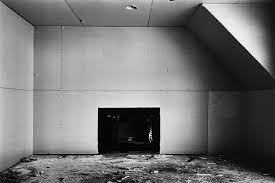
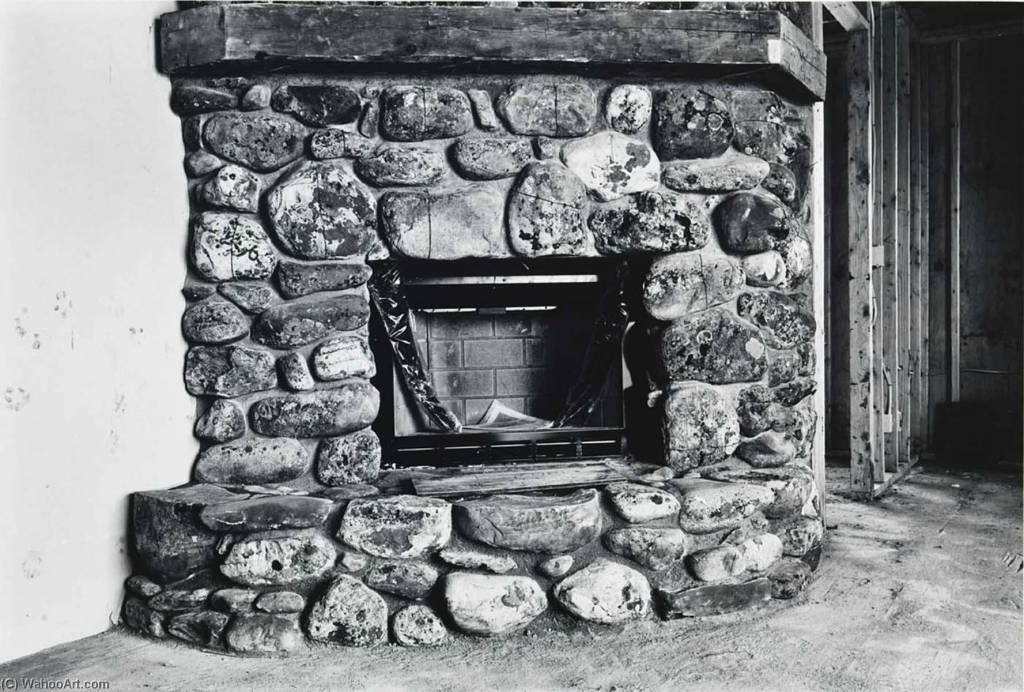
Isaac also recommended I look at Baltz. Park City (1981)is like a scruffy John Adams, much less beautiful and poised. More texture than line. Again, like Powers, busy building sites with absent activity. I loved Baltz’ use of typologies – waste heaps, unwired sockets, fireplaces, wood shavings.
There’s a sense of time moving with dust and fire, but also stillness. It’s unnerving, though less so than San Quentin Point (1986) which looks at litter as if it were found on the surface of the moon. I found this impenetrable and boring after a while, though I appreciate its defamiliarising effects which make the litter look genuinely horrifying rather than simply morally wrong.
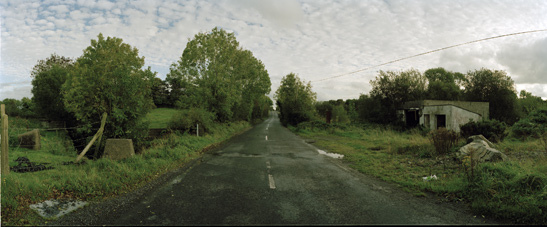
Borderlines (2008) is a book of interviews about The Troubles with people living at the Irish border – particularly poignant, upsettingly so, given current events.
The book was created in the wake of the Good Friday Agreement and both sides saw joint EU membership as a means to peace. Sad. The photos aren’t all great, but there’s a casual focus on the banality and casualness of horror – murders at crossroads, a dead fox on a fence, a caged CCTV camera, as if the photos contain hidden codes and latent violence. It was hard to see how they fitted with the interviews, though.
Gilligan’s DIY/ Underground Skateparks (2014) depicts skateparks around the world, and while there’s an interest in seeing the variety and sameness of them all, the interest wanes fast – the portraits are horribly contrived – and it felt like he needed to work harder somehow. The shots are too dissimilar – especially a few stunning ones in Germany – and a sudden leap to golden hour footage seemed amateurish.
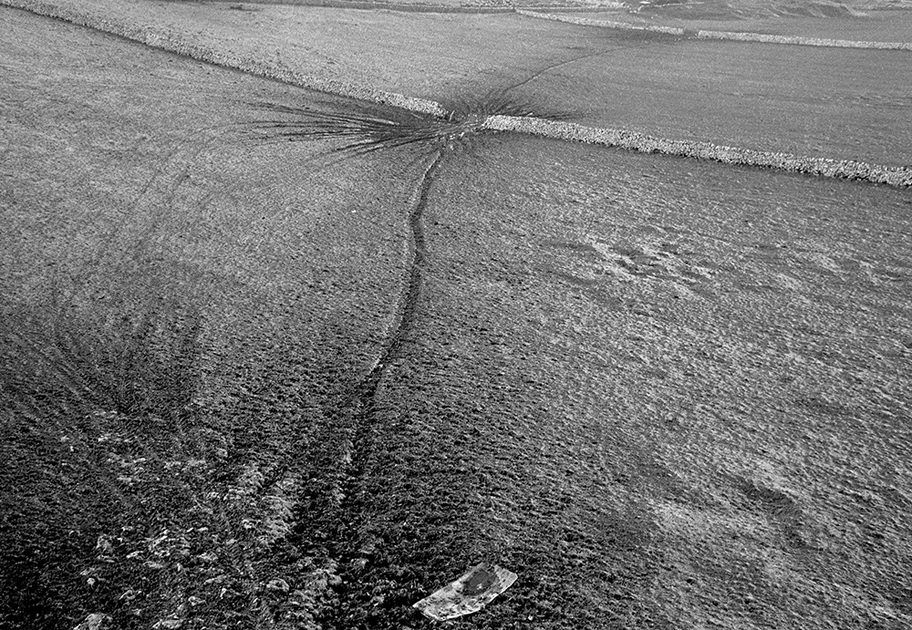
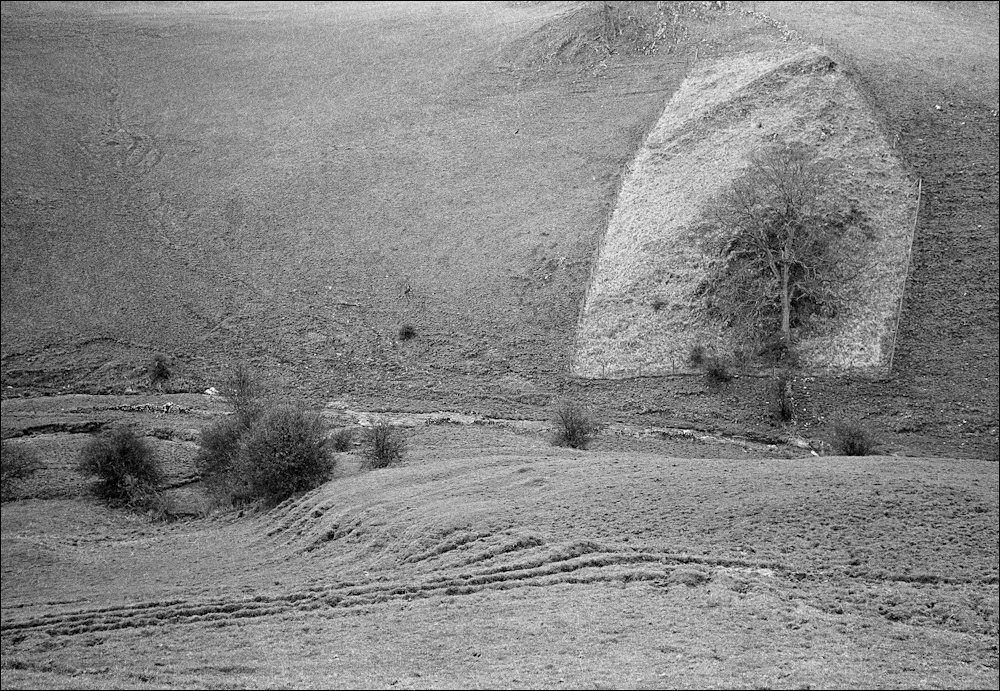
Paul Hill’s White Peak Dark Peak (1990) is a stunner. He’s fascinated with lines in the landscape, especially faint ones like badger tracks, and something that only works well in black and white, as I’ve found for myself. He has an eye for the surreal and macabre – the wallaby in vignetter, a rotting badger through the year – and typologies – mushroom circles, tussocks, dead trees.
Shots are repeated almost identically, some as places, but others as positioning for flowers, for example. Oddly, the exactness and repetition between seasons makes the landscape seem unchanging.
Alexander, J. A. P. 2015. Perspectives on Place: Theory and Practice in Landscape Photography. London: Bloomsbury.
Baltz, L. 1981. Park City. NYC: Aperture.
Baltz, L. 1986. San Quentin Point. NYC: Aperture.
Brady, T. et al. 2008. Borderlines: Personal Stories and Experiences from the Border Counties of the Island of Ireland. Gallery of Photography. Dublin: Gallery of Photography.
Gilligan, R. 2014. DIY/ Underground Skateparks. NYC: Prestel.
Gossage, J. 1985. The Pond. NYC: Aperture.
Gossage, J. 1997. There & Gone. Munich: Nazraeli Press.
Hill, Paul. 1990. White Peak, Dark Peak. Manchester: Cornerstone Publications.
Mabey, R. 2010. The Unofficial Countryside. Stanbridge, Dorset: Little Toller Books.
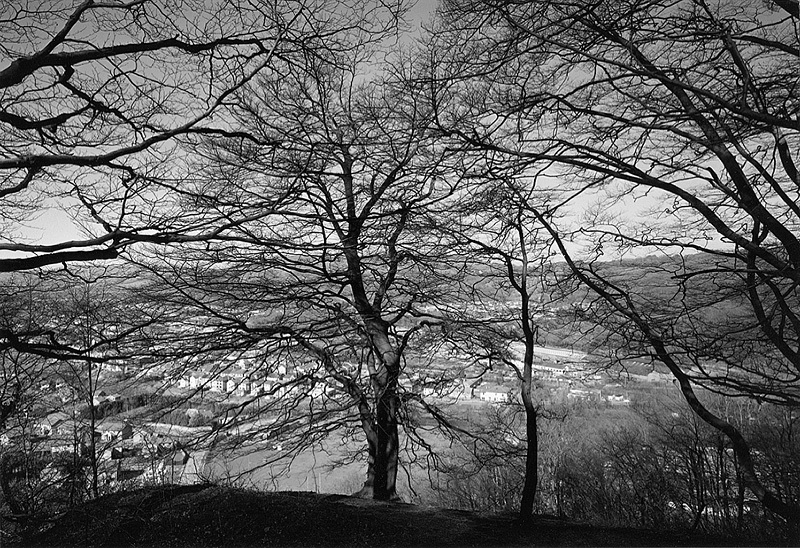
Garth Woods, Taffs Well, 1996. Sourced from johndavies.uk.com
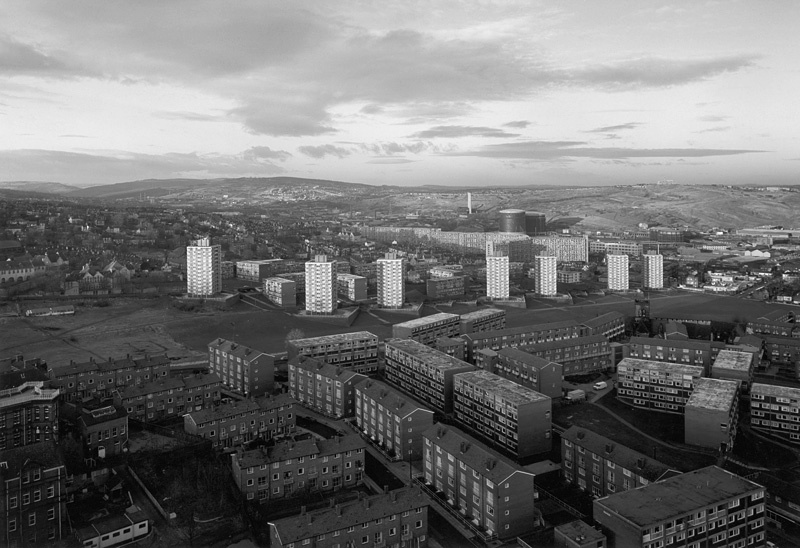
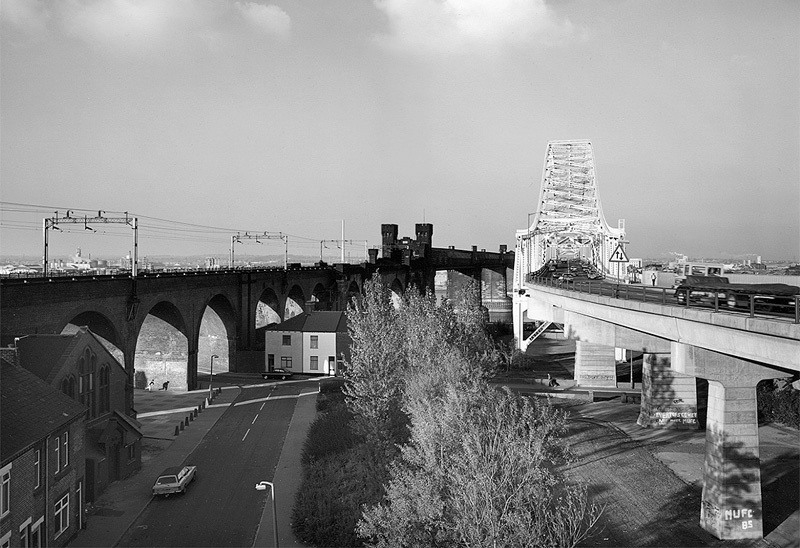
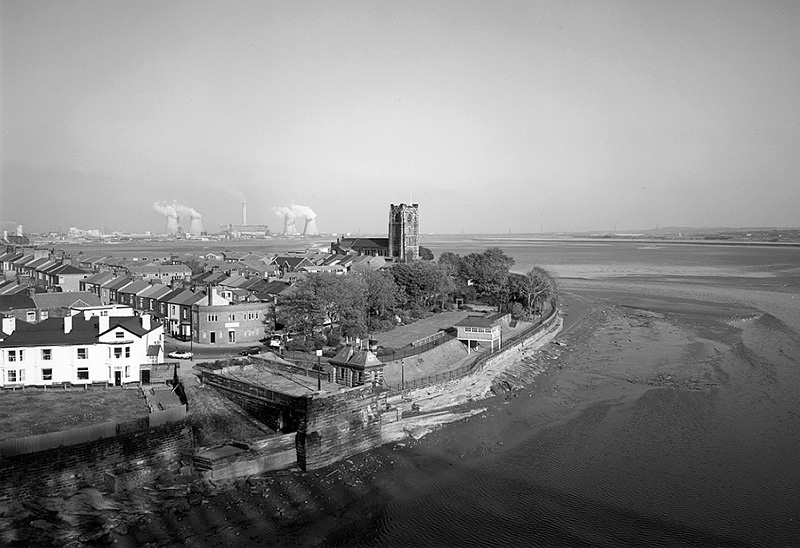
I’ve seen a couple of Davies’ images before, and have been keen to investigate further. There’s a studied melancholy but vitality to those I’ve seen, and his use of line and space and engagement with social and geographical history chime with my own interests. His work is deeply political inasmuch as it makes the viewer consider the politics embedded in the image, and is never didactic. It is critical of industry and power but nevertheless celebrates human endeavour and labour. He confronts nostalgia and the contradictions of a cultural love of the natural environment.
Looking through A Green & Pleasant Land (1987), I’m struck by the aesthetic as well as thematic interconnections. Largely shot, I imagine, large format, there’s a love of detail and an embrace of sky, even where it’s largely featureless. Sky is something I like but am anxious about in my own work, and which I began exploring as a part of an image this summer. Davies has typologies – bridges, brick, waterways, tall structures, railway and motorways, housing estate grids, recreational green space – that interconnect the photos, creating unity.
I’m willing to consider large format – eventually. Commons are often wide spaces and perhaps they are best depicted that way. I’m not sure about black and white – though I do enjoy it, and sometimes feel it’s the best match for a shot, I’m enjoying the colour available through my Sony, with the hyperreal touch it adds to my images in post-production. I think, however, that I’ll need to do further research and visit a lot more commons before I develop a typology. I’m getting there, though.
Davies, J., Wood, M., & Powell, R. 1987. A Green & Pleasant Land. Manchester: Cornerhouse Publications.
My first visit to the MPF library of 5000+ photobooks was a revelation. The staff were helpful, supportive, genuinely interested in my reason for visiting, and put some really key texts in front of me on the table. I was there for over two hours. Next time, it’ll be longer.
Simon Roberts’ We English (2009) explores the many ways that open space is used in the UK, from car boot sales to grouse hunting. He manages to work with both the micro and macro uses of space, and his full-frame images, with expansive skies or vast tracts of land taken from an elevated viewpoint, are ambitious and surprisingly tender. Ignoring the myriad practical reasons for not using this myself, it’s certainly one to have floating around in the background for big spaces as commons often are.
Susan Trangmar (2008) is a multi-media artist of long standing and her photobook A Play in Time uses stills from the AHRC-funded film that results from a year’s immersion in a Brighton path. These are sequenced chronologically and there’s a DVD of the film at the back of the book. The book also includes critical responses from 4 writers. The texts act as interludes.
Fay Godwin & Ted Hughes’ Remains of Elmet (1979) is another immersive text-photo fusion, Hughes’ poetry prompted by Godwin’s exploration of the Hebden Bridge/ Howarth area to record the last traces of their mills (and which includes a shot almost identical to one I took this summer). Writing and image work as a call and response.
Larry Sultan’s Pictures from Home (1992) shows Sultan to be as proficient a writer as a photographer. This is one to return to – it’s a photobook that needs to be read (although the photos themselves powerfully stand on their own merits). Text and image are interwoven and respond to one another, including both archival and project images. The writing is a memoir of family life. Exquisite
Aaron Schuman’s Slant (2019) is a quirky collection of American ephemera very much in the Walker Evans mould, interspersed with newspaper neighbourhood watch cuttings, some of which are laugh-out-loud funny. The joke does start to wane after a while, and there seems to be a lack of overall structure.
Paul Strand & Basil Davidon’s Tir A Mhurain (1962) is the result of a joint residency in Uist, each responding to investigations of people and place, tender and tough, high concept and deeply humane. Strand’s photographs range from documentary to landscape to abstract. Davidson’s text are typically factual, historically-based travel writing. Economic but poised. Images and text are like having two presenters complementing one another, focussed on the same subject, with a similar engagement, but very different forms of expression. Again, one to return to reading next time. The collaboration continued beyond this book.
Godwin, F., & Hughes, T. 1979. Remains of Elmet. London: Rainbow Press.
Roberts, S. 2009. We English. London: Chris Boot.
Schuman, A. 2019. Slant. London: Mack Books.
Strand, P., & Davidson, B. 1962. Tir A Mhurain. London: MacGibbon & Kee.
Sultan, S. 1992. Pictures From Home. New York: Harry N. Abrams.
Trangmar, S. 2008. A Play in Time. Brighton: Photoworks.

 out of the picture
You must be logged in to post a comment.