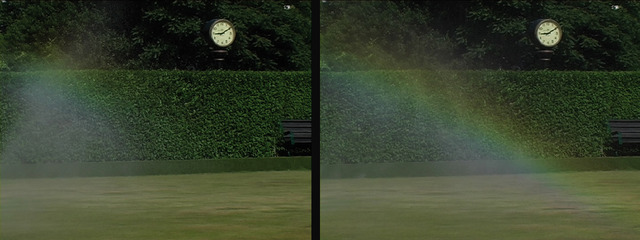
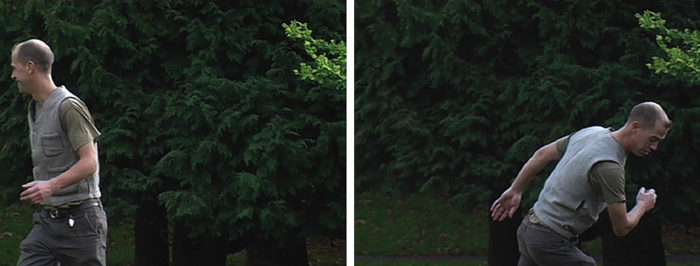
Susan Trangmar originally trained as a sculptor and has in time moved through still and into moving image work. A Play in Time is the result of a year’s residence, partnering with Photoworks and Brighton and Hove District Council, in St. Ann’s Well Gardens, a small formal municipal park. Trangmar worked with a digital camera fixed on a tripod, recording small details of plants, the activities of the users, the park’s built environment, as well as considerable sound archives. The result is a 25-minute film with one or two clips playing at any one time, and a book containing stills, essays and an interview with Trangmar.
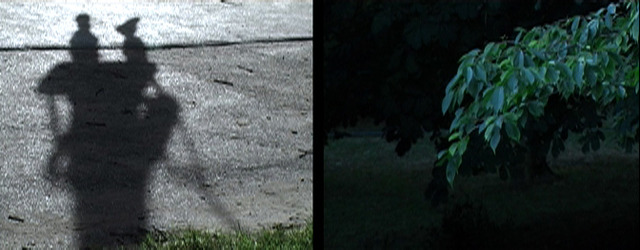
This is a work I can really relate to. It demonstrates a very deep immersion by the artist in a place, such that she becomes a part of it. The long take, fixed-frame format, taken from a tripod is exactly my preferred way of working, and Trangmar is likewise interested in the formal possibilities of the frame beyond the representational. Many shots are semi-abstract, and all are lovingly composed. Where Trangmar differs from my work is that she has not sought to ‘explain’ the park: there is no walking of the boundaries, no attempt to orientate the viewer, but rather it is as if we have been transported to the park and are looking around to discover it for ourselves. This is something I can learn from. Nor does she differentiate between semi-abstracts of the human and the non-human – park users are often headless, or just a pair of limbs, and their activities abstracted, such as the shadows of children on swings – again, more to provide a sense of place than a logical, linear document.
Trangmar has constructed space in a fascinating way. This is partly due to the split screen format, which gives both a sense of simultanaeity of events, rather than singling them out as a single screen would do, and it is also in her lavish use of sound, almost all of it off-screen, giving snippets of conversation, seagulls, traffic, and many sounds which can’t be easily identified. The bird song, like the traffic, is foregrounded to the point of exaggeration and this provides a considerable sense of the pastoral. The split screen also adds a disorienting sense of slippage where different moments of the same shot are side by side; this is partly intended to emphasise the slipperiness of memory, but for me it suggests the park as embedded in individual routines.
It’s also interesting that Trangmar has chosen not to delve into a key moment in the park’s history: in the late c.19th, it was the site of the second ever film studio, and a huge number of early films, many of them technically revolutionary, were made in St. Ann’s Well Gardens. Many filmmakers and artists would have taken this as an opportunity to ‘interrogate the medium’, but for Trangmar it appears to be sufficient that she is continuing a tradition, leaving the accompanying essays to flesh out this detail.
The accompanying book is also notable: it picks out stills from the film and resets them against the white of paper, hence the images resonate differently. It is a different and by no means inferior way of encountering the park which emphasises the images’ formal aspects. It also emphasises the importance of movement to the film.
There is much for me to learn here: returning to filmmaking after developing a stronger sense of how and why I make images the way I do, it’s interesting to see a work where formalism is both central but never overbearing. It’s also worth considering what can be achieved beyond a cinematic context, by the use of split screen and different media. I will be investigating Trangmar’s work more thoroughly in future.
Trangmar, S. 2008. A Play in Time. Brighton: Photoworks.
Given that the two filmmakers who’ve made the biggest impact on my own filmmaking – Agnes Varda and Gideon Koppel – have both worked on installation projects (prolifically, in Varda’s case), it’s a medium that should be relevant to me. In fact, I’ve often wondered whether this wouldn’t be a better place to put some of the very slow films I’ve made like Strands, which is surely too ponderous for a film festival screening. I find it also neatly straddles the divide between photography and film, both contextually and phenomenologically. To a certain extent, I want to create works in which to dwell, to rest oneself rather than be propelled along, and an installation strikes me as an excellent medium for providing such an opportunity.
My reason for taking this Masters had nothing to do with this interest. I had wanted to explore my visual sense, its cultural influences and – latterly – its autobiographical imperatives. I had also wanted to begin exploring how others connected with landscape visually and phenomenologically and to find ways of expressing this in my own work. I had also wanted to deepen my connection with the Pebblebed Heaths, and all of this has been in preparation for a film PhD. To a considerable extent, I’ve achieved much of what I set out to do, and in some ways even surpassed that. And so it’s little wonder that I have found myself floundering during this module. I just don’t know where to go next.
There have been further destabilising factors. As I’ve mentioned previously, the arrival of the Sony a7siii has completely thrown me, and this has been compounded by an ever-increasing abundance of film work. A recent trip to Bristol brought me to the buildings where I studied for my MA in film – a difficult experience, but the difficulties were practical, and I found myself absolutely flying in that context in a way I never have on this MA. And with all this general vagueness, the deliberate vagueness of this photography MA has just compounded things: right now, being asked to make a specific kind of film with a set length and specific objectives would be wonderful.
And so I have to set my own specific objectives: create some kind of video-based thing. I’ve the germ of a concept: base the work around the tiny enclosures on Colaton Raleigh Common, as these are weird places, places to dream and imagine, and so can extend the Hidden Corners ideas (perhaps referencing works like The Secret Garden, The Enchanted Castle and other examples of childhood magical trespassing) but also connecting this to the deep politics of enclosure (childhood as anarchy). Deliver both a sense of place, but an angle on that which draws on both the politics and the reverie.
But who to model what I’m doing on? I’ve had a few ‘video artists’ recommended to me, but for the most part I can’t stand this stuff. It feels – well, if I’m being honest, it feels horribly precious and pretentious. It feels like the kind of thing you could only ever connect with if you were from the same world as the person who made them – that fine art background, with all the attendant ‘criticality’. I’m sure if you know how to read her work that Helen Sear is really good, but I don’t and – frankly – I’m not interested to learn how to. I can see this is going to be a struggle, but I’m sure there will be fellow travellers. Likewise, though much ‘video art’ is performance based, even though work such as that of Bill Viola is stunningly good (that I’d never heard of him demonstrates how niche video art is, all but invisible to most), it’s not going to be useful to me to investigate that. I’m certainly not about to put myself in my work as I just don’t think I’m that interesting as a subject, and there, quite frankly, isn’t anyone else to work with.
Given his deep connection to the Parisian film scene of which Agnes Varda was a part, it’s perhaps little surprise that William Klein, a photographer/ filmmaker recommended to me, is one whose work resonates. His Broadway by Light, from 1958, is dazzlingly beautiful, both documentary and abstract, grabbing the gorgeousness and complexity of the world of actuality and building a montage piece that overwhelms in a way that is both aesthetically rich and highly political. I will be looking at his work further.
And then there’s Susan Trangmar, whose A Play in Time I encountered exactly a year ago at the Martin Parr Foundation, back when the world made rather more sense. Trangmar, I can see through her work and the way she talks about her work, is someone from who I can learn a great deal. I suspect the next post from me will be exactly about her.
So many questions. So many questions. And no one to answer them.
On Saturday, I walked past the building at Bristol Uni where I studied film. It was a really imperfect situation, but the problems were all practical – class sizes, a disengaged lecturer, a strike, not living in Bristol like the other students. As for the subject, I knew, instinctively, what I was doing. I flew. I could talk and just absorb everything around me. I got really great grades and was with people with who I shared a common language. The course was structured around chunks of knowledge, and there was choice to develop specific areas.
I wonder if it’s because I’m doing a course which is founded on a fine art pedagogy that I’m struggling. I’d heard you don’t really get tutored in skills, you don’t really talk about style, you just get prompted to think critically about what you do. I just cannot connect with this course and as time goes on, I feel more and more adrift from the other students who’ve been able more or less to follow what’s been provided.
I’ve been here before, when I studied for my creative writing MPhil. Then, too, there was a gap between what I was doing and what I was expected to be doing. Of course, this gap isn’t supposed to exist, and few will acknowledge its existence. In creative writing, the gap is about class and privilege – the only English white men who are allowed to write novels about having an ordinary life are from the professional classes, or from Oxbridge, or both. Otherwise, you have to find something exotic to write about, or are banished to genre or historic fiction. So I have been here before, and if I’d known that writing psychologically-insightful fiction about everyday, unglamorous middle class people was forbidden (which it’s not in Scotland, or the US, or Australia etc. etc.) then I’d never have even started down that road. So yet again, I’m feeling the gap, and I need to think about what’s missing.
I’m noticing more and more of my peers are working on autobiographical and self-referential work. I’m wondering if this is a currently common theme in photography, if it’s been like this for a while, or if it’s always been a big part of it. I wouldn’t know, because my knowledge of photography is quite specific. It’s a fine and noble thing to do, and goodness knows, enough great art, whether visual or not, is highly personal – but if you don’t find yourself or your life subject matter you want to work with – if your compulsion to create art is to escape rather than encounter yourself, then it always fills me with a certain amount of awkwardness and a great deal of jealousy as people mine their pasts, their families, their relationships, their inheritance. I’ve nothing to say about mine, frankly. It’s all terribly, terribly dull. Of course, you can never escape yourself, not entirely, and your point of departure will always determine the direction of your escape, but even so, even so.
I’m also entirely uninterested in interrogating the medium. Again, I guess it’s all about escape. When I photograph, I pour myself through the viewfinder, through the lens, and go about reinventing the world, rediscovering the world. A camera lets me perform an act of alchemy, lets me see the world afresh, lets me connect in a new way. That this little box does such a thing is nothing short of a miracle. I don’t want to think too much about how that happens. It would destroy the magic. Who needs to know the mechanisms by which vanilla acts on us? You just want that fragrant, sweet, mustiness. It might be interesting that vanilla is a kind of narcotic, but who really cares? That’s how I feel about taking a photo. Why is there such an obsession with the medium? I remember walking through the Tate Modern Shape of Light exhibition and coming to the final room which was drab and ugly and clever and I just walked through it, after being dazzled with all this play and transcendence in the previous rooms. Interrogating the medium. There’s only a point to that if you’re making work for someone who wants to interrogate the medium along with you. I’m so goddam bored of clever.
Cemre told me that what was lacking in my work was putting criticality in my practice. My ability to make pictures is fine. There’s nothing to be fixed there. The thing is, I don’t understand what that means. I don’t understand why there needs to be any criticality visible. When I look at photos, I’m not looking for criticality, and I don’t know how to read for it anyway. When I look at a photobook, I’m usually fairly oblivious to that sort of thing, and for the most part, I don’t see the narratives, or the visual language that’s being spoken. I just see images, and they act on me, and they draw responses from me.
This isn’t so with film. I know exactly what I’m doing there, exactly what can be achieved with an edit, with sound, with carefully written voiceover. I know what I want to say and I know how to say it. It’s informed by a huge amount of research and thought and it’s all there in the film. This doesn’t happen with my photography, as in it’s not there in the photographs: you need a bit of written context to support that. And without conversation, and thorough and regular feedback, I’m not going to be able to put the criticality in my work. These are not things that have been available to me on this course, and it’s not something that comes intuitively to me as it does with film.
And so, unsurprisingly, I’m back with video, remembering how I know exactly what I’m doing. And I wonder just how this is now going to work. I suspect that when I hear people talk about photographers also working in video, it’s actually, mostly, just a bit of an add-on, a side-show, just like photography is for filmmakers. Even if they get really good at it. Maybe this is why I’m struggling to get any advice. It’s all – yes, such and such also works in video. And that’s it.
It’s all driving me nuts, it really is. I’m hardly taking any photos. I just look out at the world and think, it’s all been taken before, it’s just another fucking tree, who cares, so what. WHERE’S THE GODDAM CRITICALITY IN THAT BARK????
It’s been a pretty painful few weeks. First, Jesse pointed out – well, someone had to – that my woodland project was, especially in the current circumstances, perhaps a bit ambitious within the timeframe. It’s a great idea, and something to work away at slowly, but letting go of that as the next hot thing for me was tough, especially in the absence of any coherent idea for this module.
Second, and this might sound ridiculous, but the arrival of the Sony A7siii has thrown me more than I could possibly have anticipated. Not the technical headaches it caused – £399 for a new memory card, £270 for an upgrade to my editing software, and all of this more or less worked out single handed. Nor specifically the anxiety caused by changing camera in the early stages of my first major commission. But the possibilities suddenly opening up. Because unlike my previous Sony, the A7siii shoots video to the same quality as my stills cameras. And this has thrown absolutely everything, finally broken down the wall between my film and photography worlds, and meant that I no longer need to work out if I’m a filmmaker or a photographer, but able to occupy and explore the middle ground.
I looked into the relationship between the moving and still photographic image during my Film Masters at Bristol, but not revisited this research, over two years ago. Likewise, I’ve been curious as to why it’s OK to work in video on a photography MA, and how video operates differently in this context – as it must for the sake of disciplinary coherence. And given that I’m hellbent on doing a film PhD with a supervisor from a fine art background, it makes sense to spend the coming module reconnecting with film in a fresh context.
So I’ve ordered a bunch of books, got a few recommendations, revisited some practitioners who work in both, begun asking around for recommendations and advice, and one of the things that occurs to me is how comfortable I feel occupying this middle ground, how much I’ve already thought this through, perhaps even without realising it, and how it maybe gives me a critical edge with my photography, in a contemporary context where awareness of the medium is so utterly central. This could be my niche.
So, today and earlier in the week, I’ve been out at Woodbury Common, tripod over my shoulder, filming. As a filmmaker, I work much more like landscape photographers who use large format and view cameras. Working with a tripod, shooting less, covering less ground, this is how I’ve always worked as a filmmaker. I really go in deep, interrogate details in a way I don’t with stills. And so I thought, if I’m to keep things at the heaths, rather than the great roaming explorations of the past year, I’d pick an idea, or a theme, and explore that. Keeping with commons, I thought enclosures would be good, especially given that the heaths have some odd little enclosed pockets which have their own distinctive sense of place.
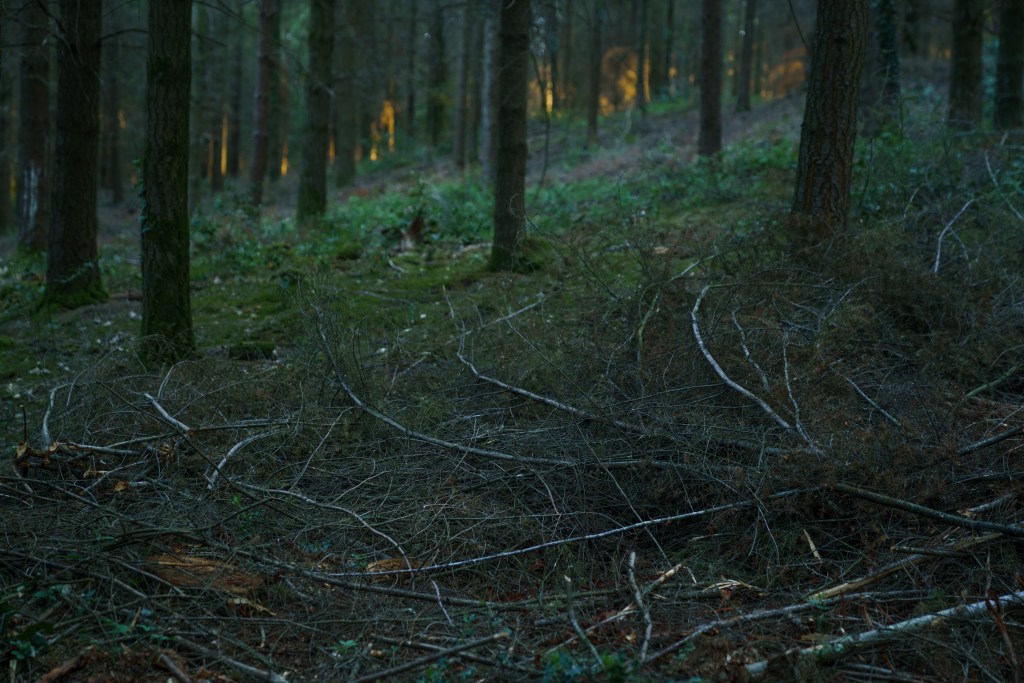
Today, I decided to explore what’s known as Diamond Plantation, a tiny rhomboid woodland on the bank of a valley mire which is surrounded by enclosure embankments. No particular agenda, just seeing what happened. I knew I wanted to express a sense of the place – so views from the rises around it, the sounds and vegetation to be found there. But what I didn’t expect was to come full circle with the Hidden Corners/ childhood idea: these odd little places have become places because they’re enclosed. They’ve become anomalous in the landscape by being enclosed and improved, developing a separate character, and that makes them magic kingdoms, with portals and potential. More, their very enclosure invites invasion, reminding me of breaking into forbidden places, especially gardens, when I was a child. And so I’m able to bring to these profoundly political, violently exploitative places, the imaginative anarchy of childhood. That’s pretty damned cool – and it’s also perfect that there are vestiges of all kinds of games here – dens, a smoke grenade, bike tracks. I found myself drawn to the fantastical – eerie wood shapes, a fly agaric, pitcher plants. My eye for the fantastic is undiminished, it turns out.
Around these places, I think I can work out everything I need to: deepen my understanding and connection with commons, and these commons in particular; expand on the childhood themes from hidden corners (one or two shots recall, deliberated, E.H. Shepard); give me the opportunity to interrogate the overlaps and divisions between still and motion photography through my own work and research; bring to bear on my filmmaking what I’ve learned about photography over the past year; consider how still and moving image can be combined into one body of work (the stills from this camera are excellent). I also remembered just how abstract light can become in video – watching sun sweep through a valley: you just can’t capture that the same way in stills.
I’m also thinking through the Wellcome Brief – focussing on the devilish figures in the burned gorse and the crucifixes in the dead trees emphasise the fantastical dimension of eco-anxiety. Likewise, keeping these in a very shallow DOF emphasises the narrowness of vision thinking like this entails. I think this will work.
I like to spend a while mulling things over before writing anything down, so the gap in this CRJ indicates significant mulling. In light of various constraints, discoveries and understandings, I’m now moving the focus of my work on this Masters away from registered commons to woodland. Of course, that’s not to say none of the images I’ll be making will be of registered commons, as significant woodland is often found in such places, but the social, cultural and historic fact of commons now assumes a lesser importance. It’s also worth mentioning – though in itself this merits a post all its own – that I can ‘see’ the project I’m about to discuss as a photography project, while my commons project I can ‘see’ more as a film; indeed, it will be the focus of my Phd.
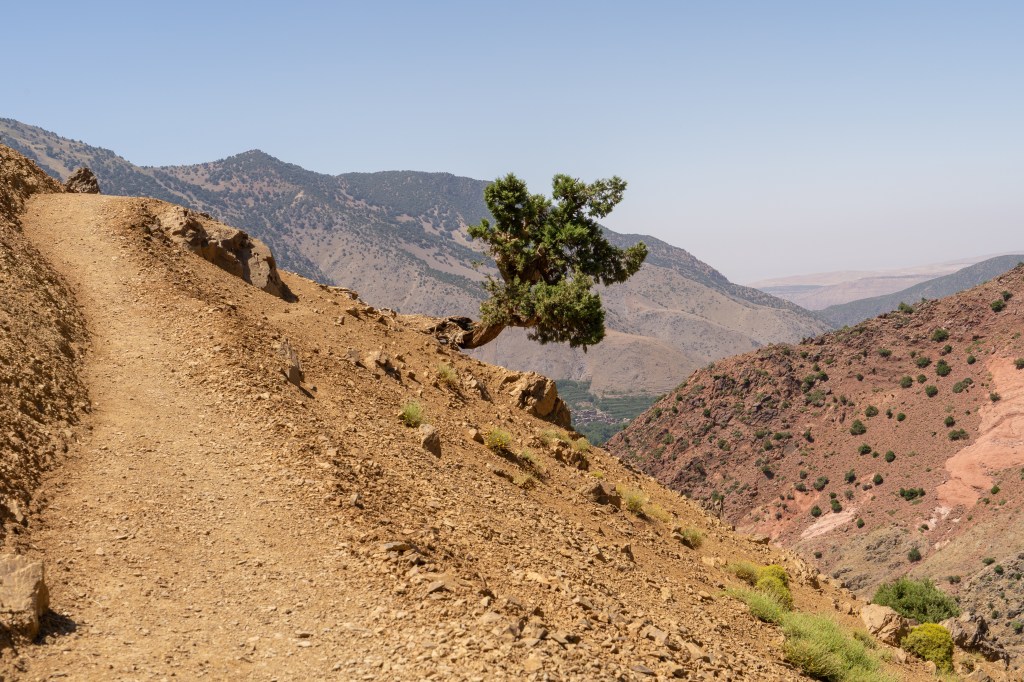
I’ve always taken pictures of trees. My two photos published by The Guardian were both of trees, and if you look at my Instagram feed, whatever the environment, be it coastal or urban or agricultural, there’s usually a tree somewhere in a starring role. When we visited Morocco in 2018, I was as fascinated with the walnut groves and juniper scrub as I was the Islamic architecture and ancient streets.
Nr. Tizi Oussem, 2018, Andy Thatcher
My Hidden Corners zine for the previous module’s Work in Progress Portfolio was entirely composed of woodland shots – mostly plantation woodland. My great take-home lesson from this project was how naturally I am drawn to hidden wooded corners in the landscape, and was able to identify this attraction with the books and films of my childhood, as well as the melancholy such places evoke as befits someone such as myself who has endured long stretches of serious depression. I had felt at the time, this work was a sidestep move, largely in response to the reduced ability to travel of lockdown, but rather than get back on with visiting the commons I’d meant to – Greenham Common, the Forest of Dean, Runnymede Meadow – I’m keen to pursue this line of inquiry.
Uphams Plantation, 2020, Andy Thatcher
I’m keen to create as my Final Masters Project a body of work studying woodland which appears in or has influenced well-loved children’s books. Having grown up close to the Ashdown Forest, better known as Winnie-the-Pooh’s Hundred Acre Wood, this keeps the project’s personal connection. But it’s also something I can see would have a broad appeal. To begin with, in response to the climate crisis, and intensifying during lockdown, local green space and nature across all media, are enjoying considerable public attention, and the destruction of woodland, whether for HS2 or at the hands of the Amazon’s illegal loggers, is a major concern for many. In addition, children’s literature enjoys considerable cultural prestige in the UK, which has produced many of the world’s best-loved works, and is deeply connected with a sense of landscape and nationhood. A book that gathers together, in words and images, woods that many have loved without ever visiting would seem a strong candidate for publication. I also have some quite useful connections to promote this, not least the novelist, reviewer of children’s books for broadsheets and nature-lover Amanda Craig, who I have in mind to write an introduction.
buckinghamtoday.co.uk, 2020
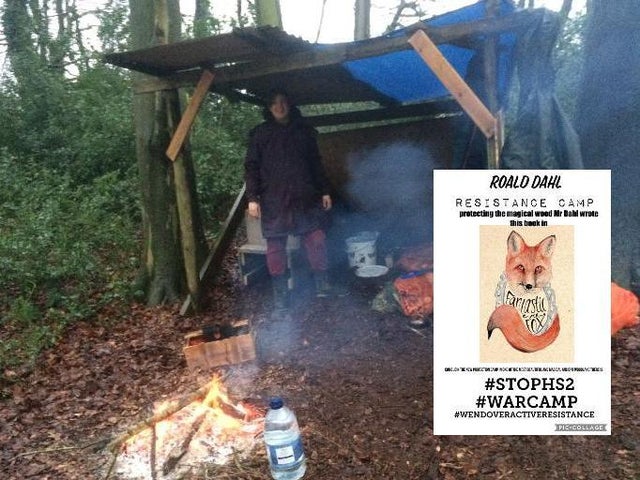
It’s important to me that the project collects a diversity of woodland from a diverse range of books. Hence I’m keen to track down the Gruffalo’s deep dark wood just as I am Enid Blyton’s Enchanted Forest. I also want to acknowledge the threats to woodland, already depicted in Colin Dann’s Animals of Farthing Wood (a housing estate in the middle of a book of woodland images would strike quite a strident note), and it’s fascinating, desperately sad and oddly fitting that half of the ancient Jones Hill Wood, which inspired Roald Dahl to write Fantastic Mr. Fox, is being destroyed to make way for HS2. Other woods already identified are Puzzlewood in the Forest of Dean (Tolkien’s Mirkwood AND Rowling’s Forbidden Forest), Wytham Woods (Horwood’s Duncton Wood), Bisham Woods (Graeme’s Wild Wood from The Wind in the Willows) and Hampstead Heath (the lampposts of which inspired Lewis to write The Lion, the Witch and the Wardrobe).
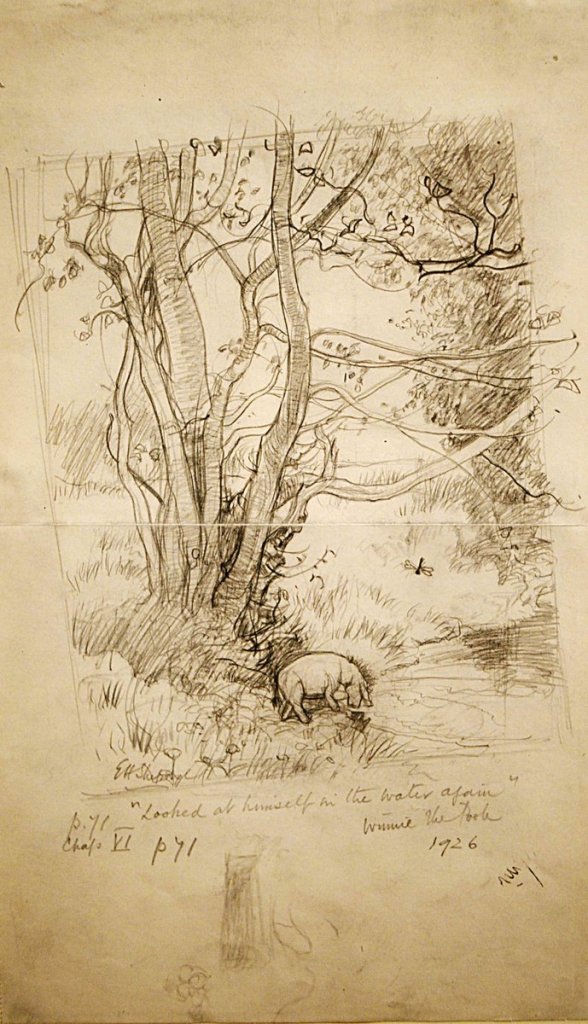
‘Looked at himself in the water again’, 1926, E. H. Shepard
It’s also important to acknowledge that many children’s books are beloved for their illustrations. Sheppard’s depictions of the Wild Wood and the Hundred Acre Wood take particular care with trees, which often dominate the frame, and I can identify something of my own style and preferences in Tolkien’s illustrations of Mirkwood and the strange and exotic woodland of Tove Jansson’s Moominland. Thus a question of style inevitably emerges. A project photographing places used for celebrated imaginings which presenting them in a documentary, objective style would, to me, miss the point. Anyone can track down these places via Google, after all. Rather, I would prefer to use both the places and the stories to which they are connected as the jumping off point for my own imaginings. We none of us read a story in quite the same way, and our own memories, experiences and temperaments find expression when we apply out imaginations to a work of fiction. I would thus create, essentially, my own illustrations for these works.
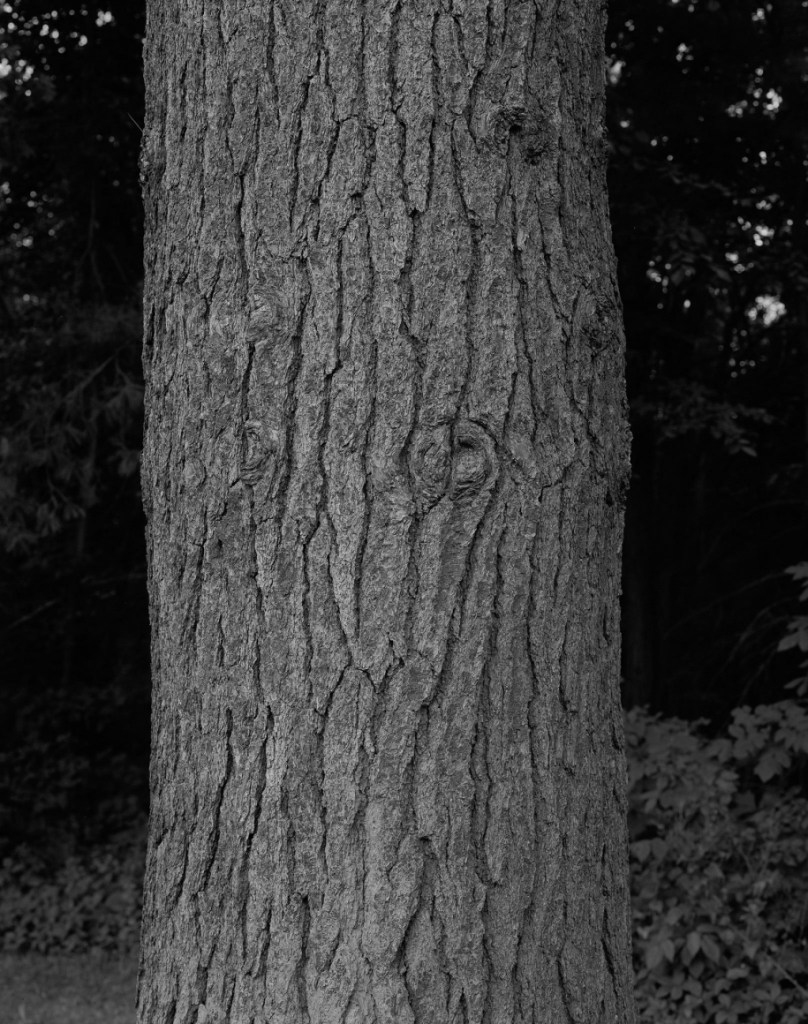
Untitled (tree), 1990, Stephen Shore
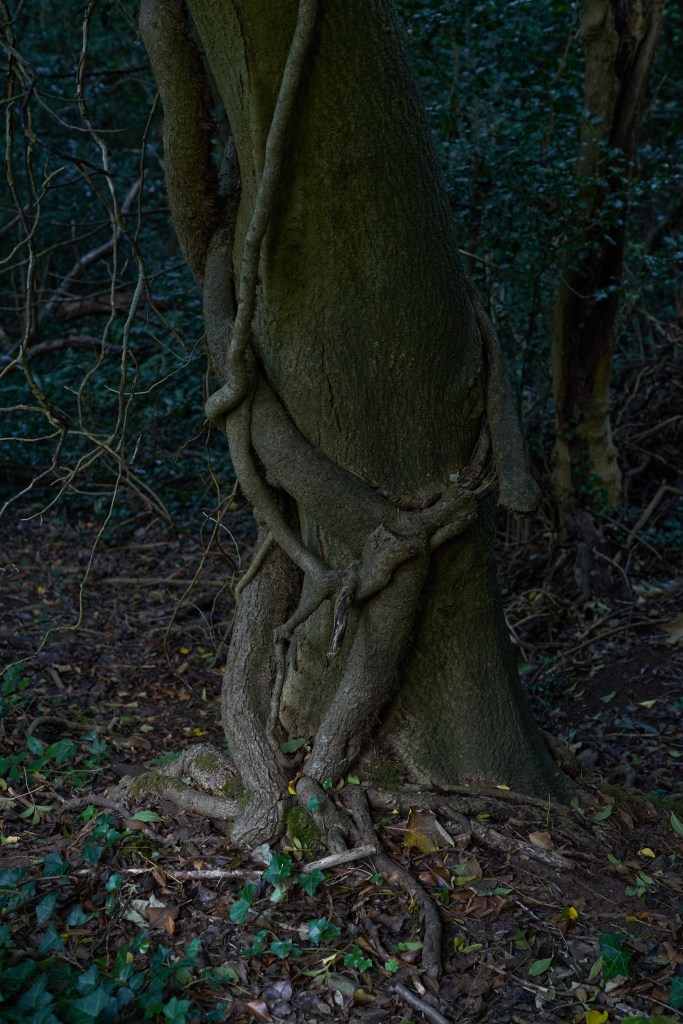
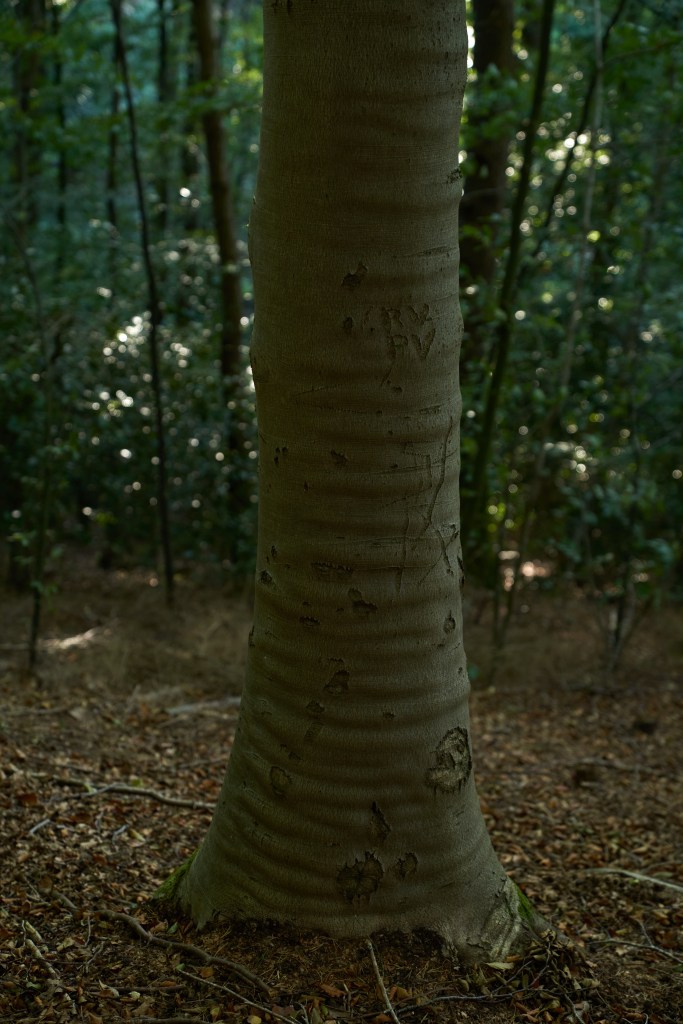
Different photographers see trees in different ways, and trees being such huge things, there are many ways of seeing them, from distant picturesque shots of a wooded ridge, to a close up abstract of bark. I increasingly find trees strange, alien things, and love them no less for that. Their bark can take on fleshy textures, as if they have appendages and orifices, and their relationship with other plants, whether parasitic or not, creates peculiar embraces and wrestling postures. The disturbed, but brilliant, imagination of HP Lovecraft has left its mark on me in this regard, and I find it hard not to relate to woodland as if it is not, in fact, responding to some alien intrusion, as does the woodland in his The Color Out Of Space. It is this strangeness which to some extent explains the enduring appeal of woodland in children’s literature – a world as foreign to children as the adult world for which it often prepares them – and so it makes sense to me to continue to capture this in my practice.
Clifton Downs, 2020, Andy Thatcher
There’s a political, post-human dimension, too. It is easy to view trees anthropomorphically: like us, they stand, are long-lived, and even their limbs appear to reflect outstretched arms. But this denies trees their autonomy, their fundamental difference, and lends itself to an infantilisation which undermines respect for them as beings in their own right, something Richard Mabey proposes in The Ash and the Beech (2013). Moreover, according to Wholleben (2017), there is increasing scientific evidence that trees are to some extent sentient, albeit in a radically different way to us. Thus it makes sense to me, not to attempt to capture, or not to seek to primarily capture, whole trees, or collections of whole trees, but details, especially where those details express what Mark Fisher describes (2016) as ‘the weird and the eerie’ (see earlier posts for more on this work). So if much conventional depiction of woodland seeks to emphasise the familiar, the comfortable, the nostalgic, the restorative, I would prefer to return to that overwhelmingly found in children’s literature: woodland as unknown and unknowable, forbidding and full of possibility. And over the course of this module, rather than explore a specific woodland – although I intend to visit Stoke Woods often, a few miles from my home – I want the trees themselves to be the subject of my practice.
Stoke Woods, 2020, Andy Thatcher
Fisher, Mark. 2016. The Weird and the Eerie. London: Repeater.
Mabey, R. 2013. The Ash and the Beech: The Drama of Woodland Change. London: Vintage.
Wholleben, P. 2017. The Hidden Life of Trees. London: William Collins.
I’ve felt, throughout this MA, that I don’t belong. I don’t speak the language of photography, I don’t connect with the criticism about it, and I don’t understand the fine art context of much contemporary photography. I often wonder by what sleight of hand I ended up here. I’ve rejected the majority of what I’ve been presented with; it reflects neither my background, nor what makes me take photos, nor how it feels for me to do so. But inasmuchas this course is all about positioning myself in relation to contemporary photography, I’m nevertheless doing exactly what is asked of me.
So, I know what I’m not, and what it’s pointless trying to become, and I’m fine with that. I know how my writing, my academic background, and my filmmaking have shaped my photography, and why that makes my work distinctive. But there’s not getting away from the idea that photography is art in a way that film just isn’t. So the question needs to be thought through carefully: if I’m in the business of making art, what kind of artist am I?
I was fascinated to come across Charles Russell’s Groundwaters: A Century of Art by Self-Taught and Outsider Artists. Just the title alone had me interested. Outsider and Self-Taught art is a well-researched and well-respected field, though seemingly little-known to the overwhelming majority of the public. Outsider artists are those who do not belong to the mainstream (not here used in any pejorative sense) of the word, especially those whose living circumstances make them outsiders to the mainstream of society; mediums, institutionalised schizophrenics, the homeless. While all of these are self-taught, the term self-taught artists also includes those who otherwise are part of society, often coming to create art as an expression of their profound religious feelings, or as an unheralded outpouring of creativity unleashed late in life. Like all terms, they are slippery – self-taught artists have to some extent been taught by their exposure to other artists. Outsider artists can continue to create work after critical recognition and with financial support – so are they outsider artists? Flawed terms, yes, but useful.
In many ways, such artists are, simply, artists. They take from and reconfigure the worlds around them, its art-objects, material manifestations. They frequently do so to externalise their interior lives. And while the intensity with which they do so is markedly different from the majority of artists working within the academy, such primal ferocity is found in, say, Bacon or Pollock, such intense illusions are found in Grayson Perry and Magritte, such obsessively prolific activity is found in Warhol. What marks outsider and self-taught artists out is that such elements are typical, even defining of this type of work, simply because such art is created not for the art crowd, or the critics, and often it is not created for anyone at all, but the art is first and foremost created for the self. There is no, or very little, dialogue with art as an idea; relationships with other art-objects are direct, personal responses rather than coolly critical contextualisations. It is not art about art, but art begat of art.
I recognise in this much of my passion for creating photography; I am similarly interested in finding reconciliation of difficult oppositions – nature and culture, self and other, rejection and acceptance. I am similarly interested in drawing on a hotchpotch of influences – Matisse, EH Sheppard, Chrystal Lebas, HP Lovecraft – to create illusions in which to escape. I am similarly more interested in my own direct responses to photography than elaborate philosophical contextualisations. I am similarly unconvinced in critical discourse’s claim – and that of photographers closely working in this register – to speak to the universal, seemingly unaware of its frequently solipsistic, closed loop of self-referencing.
It’s important, however, to recognise a key difference: until fairly recently, nearly all working photographers were self-taught, and many still are. And while photography, so it seems to me, is in the process of transitioning to the academy more and more firmly, it still embraces outsider photographers like Vivian Meier in a way that fine art still does not.
This is the beginning of a train of thought for me, one I will return to. Outsider art is a powerful means for me to understand my position as a misfit on this course not as a weakness, but as a strength. It will give me something on which to draw for confidence and for direction, to prevent me from hankering after ways of thinking and working that seem ‘correct’ but are ultimately alien to me.
Russell, C. 2011. Groundwaters: A Century of Art by Outsider and Self-Taught Artists. New York: Prestel.
I’m interested in people’s connection with places and the meanings places come to have. Through preventing me from restlessly visiting commons around Southern England, as for many of us, the 2020 pandemic has enforced a more subjective, introspective attitude towards the same subject. There came a point of realisation in May, when I was stumbling through mud and brambles in a neglected corner of Colaton Raleigh Common. I realised at this moment that I wasn’t blindly exploring, open to everything and to happenstance, but actively looking for a specific type of experience. I realised, suddenly, that at 47 I was doing exactly the same thing I’d been doing throughout my life – since childhood, in fact.
My more recent background is in writing fiction and filmmaking, and the kind of writing and filmmaking that’s always been most important to me is the weird and the eerie, as I’ve mentioned previously. There’s a psychological explanation for this, as I’ve also recently mentioned, linked to a very lonely and unhappy childhood and a no less easy adult life full of a repeating cycle of hope and disappointment which has led to a lifelong battle with dysthymia. My attraction to weird and eerie places is that such places more accurately reflect my inner states and, through my then being able to externalise them, I can find solace and approach them creatively, rather than trying to suppress or battle them.
It would, however, be foolish to reduce this interest entirely to my unhappiness. Such books and films are enormously popular and not everyone who loves them suffers depressive moods; in fact, many of their creators are full of joy and vitality, living lives full of event and people. And so in creating a zine from images of these places, I needed to decide whether to make the work introspective or more outward looking. As I don’t think my life, personal history or my character are of much interest, or at least as I’m insufficiently interested in them to make them the focus of my work, I decided it would be better to use the images as a started point to look beyond the circumstances that brought them about.
My daughter is, like me, someone driven by their imagination. She’s also drawn to the weird and the eerie – has, in fact, elected to read Mark Fisher’s The Weird and The Eerie over the summer. Though she’s had her ups and downs, they’ve not been more than one would expect for a sensitive child at a difficult time. Ruby is, like me, drawn to unsettling places, which she then fashions into artwork, teasing out stories, characters and moods.
I have likewise, over the years, had similar responses to places and these have appeared from time to time in my work. Initially, I’d thought to create a fictional narrative from the twilight images shot in May and June of this year, drawing on horror, dystopian sci-fi, disaster movies, and folk fantasy. I quickly felt uncomfortable in doing so; this was too contrived a response to the actual places, too abstracted from the lived experience of being there, smelling the damp, noticing the commons enclosures. It felt too removed from my more general interests in place and in commons in particular. It felt like a betrayal of my attention to and concern for context.
Instead, I wanted to communicate not what I was thinking, nor even really what I was feeling, being in the diminishing light in these strange places, but to somehow provide an experience for the viewer, such that a viewer might have their own experience of the place. This is something I’ve encountered in photobooks: I’m yet again going to mention John Gossage’s The Pond, but also W.P. Eckersley’s Dark City. It’s more common, however, for a photographer to curate the experience of place in some way, and there’s nothing whatsoever wrong with doing so: Joel Sternfeld’s Rome After Rome, for example. But with this particular engagement I’ve had with place, what I’ve found most interesting, and what I’ve particularly wanted to communicate is the uncertainty, the liminality, and the imaginative potential of the commons’ hidden corners. By either interrogating the autobiographical and psychological impulses which have drawn me to them, or imaginatively developing the images in the form of a narrative or world-building logic, I would be closing down that potential for the viewer and thus be unable to communicate it.
Instead, while there has been imaginative engagement in the WIP – the idea of unwittingly entering a parallel world draws on works like The Lion, the Witch and the Wardrobe or more recently numerous episodes of Black Mirror – the engagement is left unfinished, inviting completion by the viewer through asking questions rather than making statements. This inclusive engagement was something I began exploring in my Ruscha task at the start of this module, and was why the zine didn’t have a title or an explanation. Likewise, my Hidden Corners exhibition asks questions of its viewers, inviting them to seek out their own engagements with the places in which the images are found.
This is all a very, very different approach to the one I’d been taking up until this module. To some extent, it draws on previous film work, but is far more deliberately obscured in terms of meaning. Whether or not it’s an approach which will have a life beyond this module is difficult to say. However, in terms of exploring and communicating my own attachment to place, it’s been a novel, crucial and necessary step: how else could I possibly begin to examine and represent the attachments of others to place if I hadn’t put in considerable work to doing so?
The idea of narrative or story across the arts is one I’ve found increasingly overblown. This is perhaps surprising given that my earlier creative work was in writing short and long fiction for adults and children. When it comes to these explicitly narrative forms, and that includes film and graphic fiction, I’m very much a signed-up believer in the persistence of classic myth arcs, whether it’s The Tiger Who Came to Tea or Mrs. Dalloway, the work of Junji Ito or Jacques Tati. There are situations where I’m looking for and expecting to be told a story, and when I don’t get one, or the one I get is deficient in some way, it can be infuriating. However, there are numerous artistic encounters where I’m not expecting this. It’s not always at the forefront of my mind in an exhibition, nor when watching a documentary, and it certainly isn’t at the forefront of my mind when I pick up a photobook or a zine.
That’s not to say that narrative shouldn’t be incorporated. Mark Leckey’s 2019 retrospective exhibition O Magic Power of Bleakness blended immersive installation with theatre, folk myth and film. Documentary has long since powerfully drawn on fictional strategies to articulate complex ideas or drive home messages, from conventional works such as Morgan Spurlock’s Supersize Me to experimental ones such as Patrick Keiler’s Robinson in Ruins. John Gossage’s The Pond is perhaps my favourite photobook, and it teases the viewer as it takes them around a nondescript landscape. Jack Latham’s Sugar Paper Theories deftly takes the viewer through the labyrinthine story of a failed criminal prosecution.
But it seems to me there’s an overemphasis on narrative across the arts – and beyond, to PR and advertising – that’s been there for some considerable time. I think this is limiting, and I can equally point to favourite works to which narrative is irrelevant: Richard Misrach’s Desert Cantos, Simone Nieweg’s Landscapes and Gardens. The images of Gregory Crewdson’s Twilight might hint at narratives, but the book, from my own responses, is arranged for affect rather than logic.
It should be noted that in the case of Gossage and Latham, the works follow readymade narratives – a journey, a criminal case. There is a logical reason for adopting these. Of course, it could be that to the more tutored eye, narratives do emerge, to which I would argue that in such a case, they are of significantly lesser importance than those who created them or identify them might realise.
As I’m intending on creating a zine for my work in progress portfolio, I’ve been acquiring and evaluating a number which explore space in some way. The relationship between space and narrative is complex: narratives assume beginnings, crises and endings, whereas space is without such events. Exporting human narratives onto explorations of space would be to anthropomorphise it. Additionally, to impose narrative on space is to tidy it and simplify it. Space is complex and, especially when dealing with a maximum of 16 images, to impose narrative would be reductive. And, last, it is to curate it: what I intend, as with my film work, is to give viewers the possibility of their own experience of the space being represented.
It’s interesting just how few of the zines I’ve looked at have explicit narratives. The most overtly narrative is Nils Karlson’s Iceland, which takes the viewer from remote mountain to farmstead, town and to the ocean, also making use of the changing of seasons. In River to River, Stephen McCoy takes the viewer between the rivers Mersey and Douglas, with scant attention to continuity of light or season. But that’s it. Marc Vallee’s Down and Up in Paris is a visceral immersion in tagging that riffs on repetition and ubiquity, in keeping with its subject. Kyle McDougall constructs mini-journeys within snowbird around sites, but groups these together thematically, interspersing with diptychs chosen for their thematic or aesthetic relationships. Likewise, Alexis Maryon occasionally groups images thematically across several pages in Port of Newhaven, but there does not appear to be any narrative logic behind their arrangement, but rather a deft manipulation of affect, a progression that is more akin to music. Francesca deLuca’s extraordinary Cyan Sands begins with a logic of aesthetic repetition and variation, but eventually takes the viewer on a journey from the high desert mountains to sandscapes. I could discern no particular logic behind Nicholas J R White’s The Militarisation of Dartmoor – which at 23 images is the shortest of the zines here – but there is a sufficient degree of interest and aesthetic care for that not to matter. Grant Archer could well have used the journey up and down the rock of Gibraltar for his two-zine set Mons Calpe, but rather takes the viewer up and down at random; this confusion could be said to be reflective of the complexity and strangeness of his subject.
So where does this leave me? Narrative is something I can draw on, is something I enjoy, but if it does not appear to match the intentions of a work, I should consider other logics of organisation for my work. These could be the logic of artefact and repetition, of theme, of aesthetics, or of affect, or a combination of these. As I turn to make sense of the odd series of images I made at the end of June and which will form my portfolio, it is these I will be considering. Not narrative.
This week’s task has been a bit perplexing. Being asked to think outside the box about exhibitions when you don’t know anything about exhibitions requires less of a leap of the imagination for me than putting one on in a ‘white box’ would have needed. Actually, one of the reasons I’m studying at Falmouth is to learn more about such things, and I very much hope that at some point someone will pass on their knowledge about this.
What’s been useful in considering all this is helping consolidate how I see myself as a photographer – and an arts practitioner generally. I don’t come from a fine art background. I don’t have fine art friends. I didn’t study fine art or photography. I don’t work in either. So it’s probably unsurprising that I struggle to see my work ever being put on those hallowed white walls. I can’t see the circumstances which would lead up to it. I can’t see my work fitting in. And I have to say in many ways the hallowed hush of the white box feels to me somewhat exclusive, alien, and just a teensy bit pretentious if a work fails to live up to all that such reverence implies.
Many of my favourite contemporary artists create work outside the gallery. Andy Goldsworthy is one, Keith Haring is another, Grayson Petty yet another. I bounced on Jeremy Deller’s inflatable Stonehenge in my local park, and I was a part of Anthony Gormley’s One and Other, reading childrens’ fiction from the Fourth Plinth of Trafalgar Square. I like these artists because they work with rather than against the general public, and understand that for art to be broadly accessible means neither dumbing down nor preaching nor belittling. And that art can also be enormous fun. The filmmaker Agnes Varda is a perfect example of someone who knows how to do this.
The project I’m working on with the Pebblebed Heaths Conservation Trust is all about connecting with the artwork that untrained photographers make, looking for images that communicate affect rather than technical and aesthetic accomplishment – though without excluding those that do. I’d been reticent to then extract such work and transplant it somewhere I don’t think it belongs, but also been at a loss as to where exactly to place it. Similarly, I don’t want to position my practice above anyone, and I have to say, I’ve seen work in amateur camera clubs that has more about it than some of the most revered contemporary photographers. I’ll post later about my plans for Landings, but this week has given me the opportunity to reevaluate where my work sits, because it’s given me the chance to look hard at where it doesn’t. My work belongs in the thick of things. A gap does not need to be opened up, a break does not need to be made, a translation does not need to occur. Placing my work in a white box – perhaps, also, in a costly photobook – risks doing all of these things.
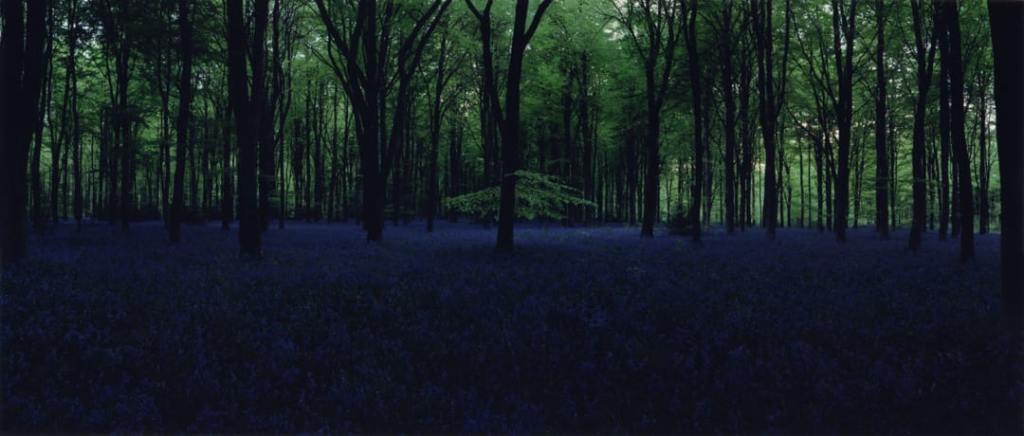
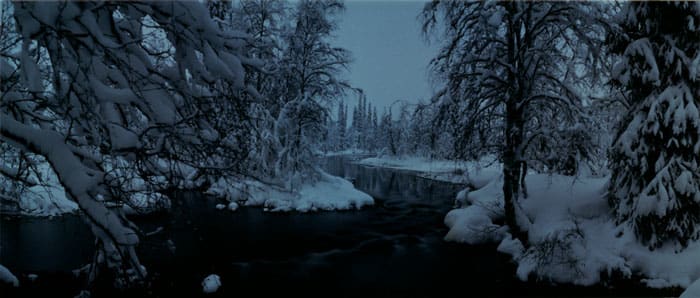
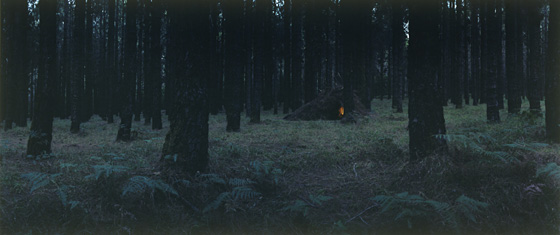
This small book is a little wonder. Despite its small size, Between Dog and Wolf (2006) provides an utterly immersive experience into the various twilights of Finland, England, Belgium and Japan. This isn’t just because Lebas’ chosen format is the panorama, nor that the images often take up their entire pages, but particularly due to Lebas’ unashamed, even brazen, embrace of black.
untitled #4, 2005, Chrystel Lebas
The series Blue Hour, included here, lingers in the same bluebell glade until only a few unidentifiable dots of colour break up the final shot. The viewer is made to strain, made to work, just as when faced with dying light. The known becomes abstract and slightly unsettling, the complexities of woodland reduced to vague structures.
untitled #9, 2005, Chrystel Lebas
Even where the trees’ shapes are more defined – as with the snow series Between Dog and Wolf (a French term for twilight) – the presence of large dark patches, or dark borders, implies an encroaching darkness. Lebas leaves much of the perception of this work to the viewer’s imagination, a perfect analogy of twilight’s cultural heritage.
untitled #1, 2003, Chrystel Lebas
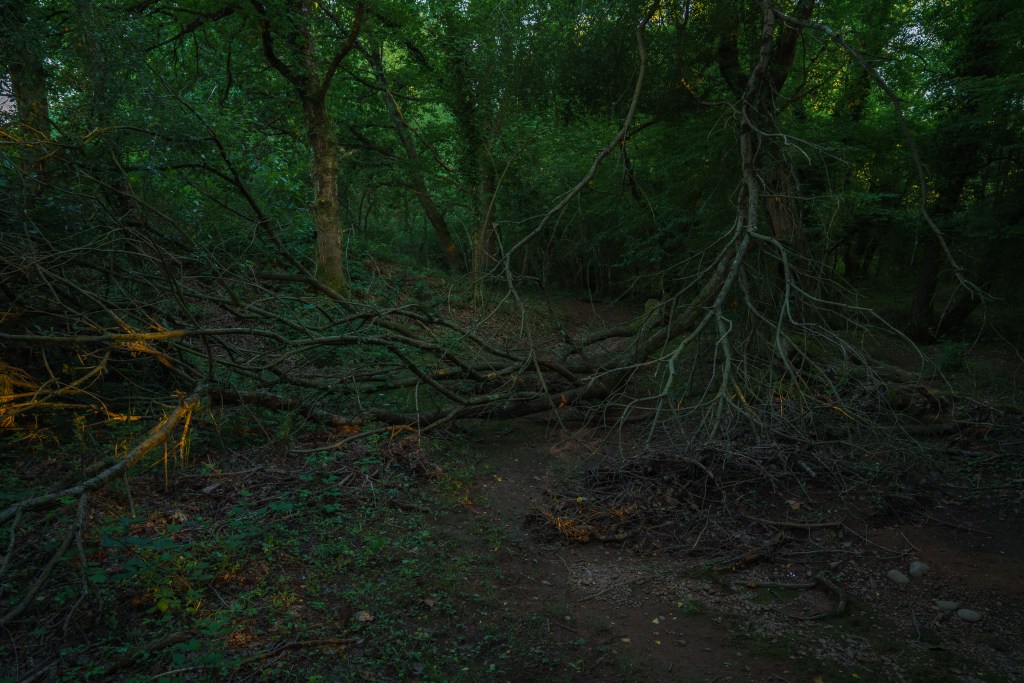
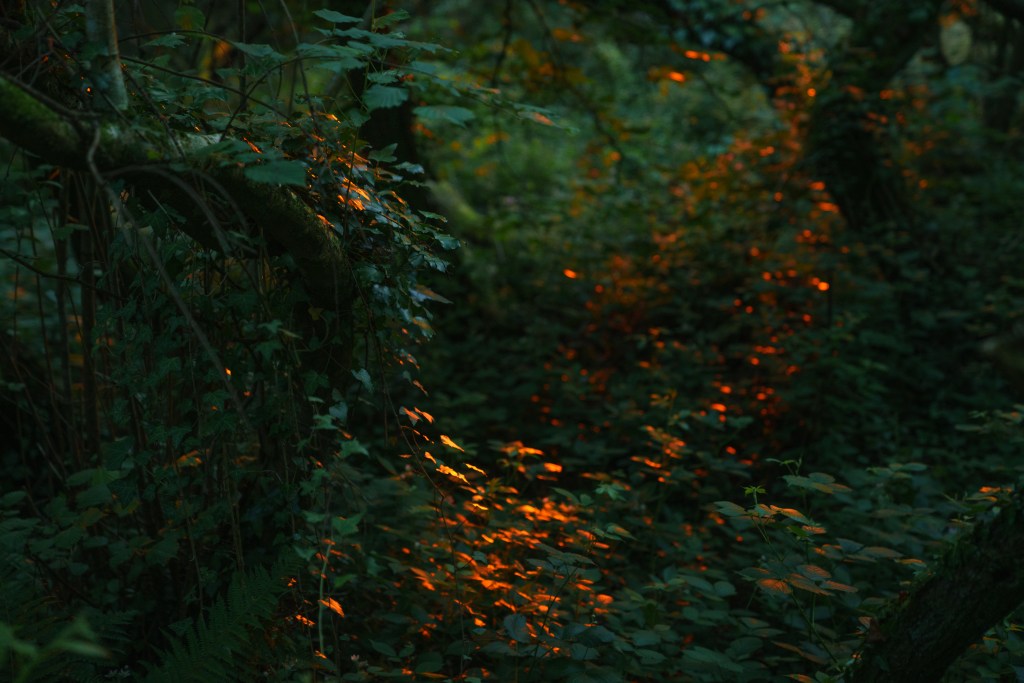
I have much to learn here. Digital photography permits an almost forensic analysis of light, details in the shadows unavailable to the naked eye unveiled through Lightroom. I often find this an irresistible temptation: to lift the leaves, bark and pebbles from obscurity is an act of discovery with a certain amount of childish delight attached to it. However, doing so does not necessarily make for images that communicate affect as effectively as Lebas fuzzy edges and jet black patches, and it’s affect that interests me the most – at least at present – working as I am with the end of the day. Just because my camera has recorded detail in the shadows should not dictate that I reveal it. I am already beginning to darken some images, plunging details back into obscurity and leaving sections of the images featureless for the viewer to make their own mind up about.
Harpford Common, 2020, Andy Thatcher
It’s also worth mentioning that I find high summer a difficult time for me to photograph. I’m drawn to geometric structures and the profusion of dark texture makes branches, paths, and streams complex and dense. Through plunging them back into darkness, the forms, paradoxically, begin to emerge once more, while new shapes emerge in the diminished points of light which have struggled through the foliage.
Woodbury Common, 2020, Andy Thatcher
Lebas, C. 2006. Between Dog and Wolf. London: Azure Publishing.

 out of the picture
You must be logged in to post a comment.