Melancholy is a neglected, maligned and misunderstood word. There’s something distinctly archaic about it, with a whiff of Byronic Romantic excess. It’s also collapsed with milder forms of depression and thus suffers the cultural fear of contagion which still, alas, accompanies conceptions of mental illness and fragility. It is, to some extent, both of these things, but is also much more than that. Melancholy is an innately pleasurable form of sadness – think of Allegri’s Miserere, Love’s Forever Changes, the paintings of Edward Hopper, the haiku of Shiki. It is a productive, not an overwhelming sadness, for in melancholy one can contemplate and begin to resolve difficult feelings, such as grief, loss, despair, loneliness, or simply the ultimate transience of that which is good. In a contemporary culture slavishly obsessed with happiness, whatever that might mean, the Melancholy is both devalued and conversely, given the rising rates of depression and anxiety, more necessary than ever.
Jacky Bowring’s Melancholy in the Landscape (2017) examines the different forms though which melancholy is expressed in landscape from the urban to the wilderness. While concentrating on landscape architecture, Bowring also addresses the visual arts, including photography. Her central argument is that melancholy needs to be considered alongside and interdependent with the Picturesque, the Beautiful and the Sublime as drawing on the same cultural and historic wellspring; in essence, she argues, we need to speak in terms of the Melancholy. It is crucial in parsing these terms to consider their affective differences, for while the Beautiful leans towards the joyful and transcendent, the Picturesque to a pleasing sense of worldly order, the Sublime to awe and terror, the Melancholy, according to Edmund Burke, in music emphasises ‘that melting, that sinking, that languor’. (28) The Melancholy thus, according to Karen Till (39) speaking of Holocaust memorials, carefully opens up a ‘wound’ to permit difficult emotions to emerge in a safe space; to this extent, it could therefore be said the Melancholy provides a valuable therapeutic function without proposing a cure. Speaking of Sontag’s discussion of the anaesthetising effects of overexposure to human suffering, Bowring also argues that the Melancholy, through its subtlety, engages and makes possible an empathetic engagement with the suffering of others (43).
Bowring sets out this argument eloquently and persuasively in Part 1; in Part 2, she sets out a taxonomy of expressions of the Melancholy. Bowring’s taxonomy overlaps to no small extent with Mark Fisher’s (2016) parsing of the Weird and the Eerie from the Uncanny (see earlier post on this). Certainly, all three make possible the Melancholy, and indeed the Uncanny is included here specifically. I have found Bowring’s taxonomy extraordinary with regards to my own practice, as here is set out the overwhelming majority of my stylistic, affective, and contextual drive as a photographer. This is to some extent unsurprising, as I have struggled with varying forms of anxiety and depression throughout my life since my mid-teens. I have sought out music, art, films, literature – and photography – which neither makes me confront the terrors of these emotions, nor escape them, but to permit me to dwell in them and thus find consolation and, to some extent, a resolution. It thus makes sense to address how I see this taxonomy reflected in my work, and to demonstrate this, I will make use of a single photo shoot, at East Budleigh Common, in the evening of June 14th of this year.
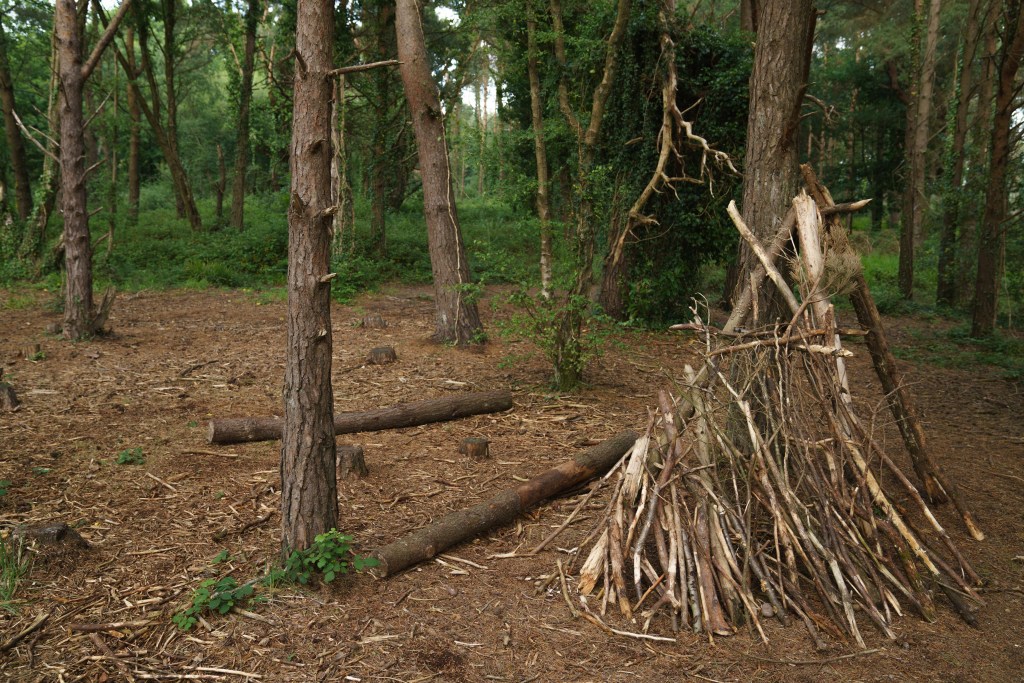
The Void implies an absence due to abandonment, and thus loss, and Bowring evaluates commemorative memorials which make use of empty chairs including scenic benches and an installation dedicated to the victims of the Christchurch earthquake of 2011. I have become fascinated with the many den structures found across the Pebblebed Heaths and photographed them often, though have largely been dissatisfied with the results. My interest is in part their interesting geometries, the angles and triangular shapes a deep contrast with the woodland around them, but it is also that they imply the hands which built them and the bodies which inhabited them. This is made all the more poignant for the dens’ connection with childhood and parenthood, a period of life itself characterised by transience and eventual loss.
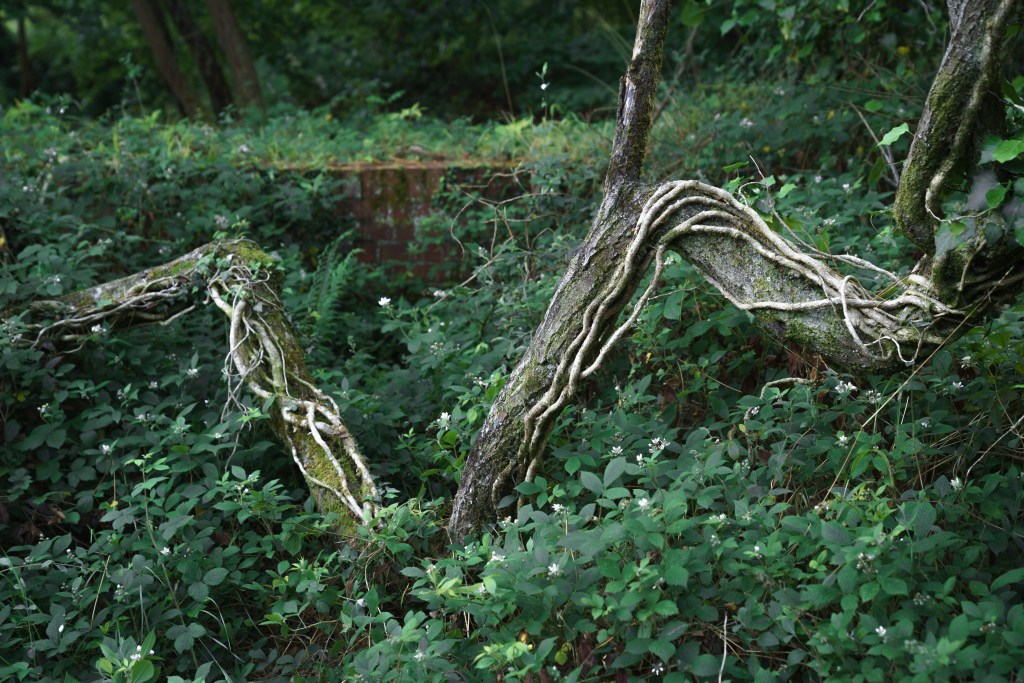
Bowring simplifies The Uncanny as making the familiar strange, with or without doubling, and this is something that informs much of my work. I have become a little obsessed with the strange, tentacular structures which parasitic vines leave on trees, and which remind me of horror writers such as H.P. Lovecraft and Spielberg’s derided but rather wonderful War of the Worlds. Woodland is, culturally and affectively, often a weird place, and this is part of its appeal. My recurrent shots of these vines reflect this; that woodlands, often considered life-giving and even therapeutic in the case of shinrin-yoku, might also be sinister, even hostile.
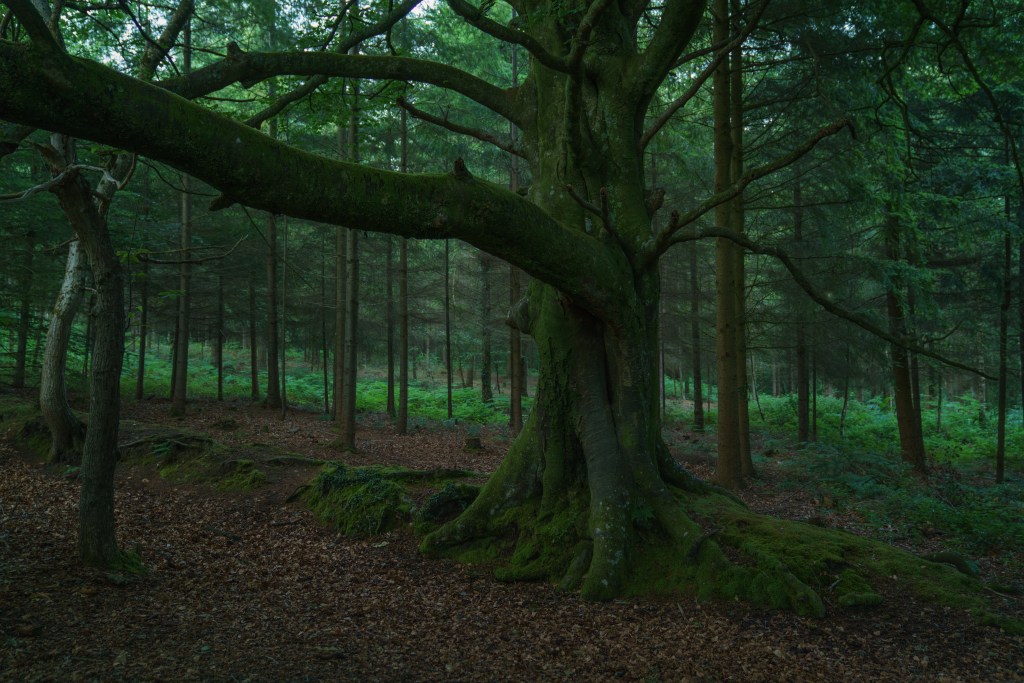
Shadows and darkness can be horrific in the sense of the Sublime, but they can also be merely threatening, or simply unsettling. They imply absence, defamiliarisation and the loss of certainty, of sensory competency, and of the things one holds dear. Metaphorically, they already signify melancholy and sadness – the darkening of mood, the dark pit of despair. In this shot of a beech tree, the tree is almost a silhouette, the absent lush, vibrant green of the leaves and moss almost teasingly suggested by the ferns behind, the darkened crevices of the trunk seemingly reptilian.
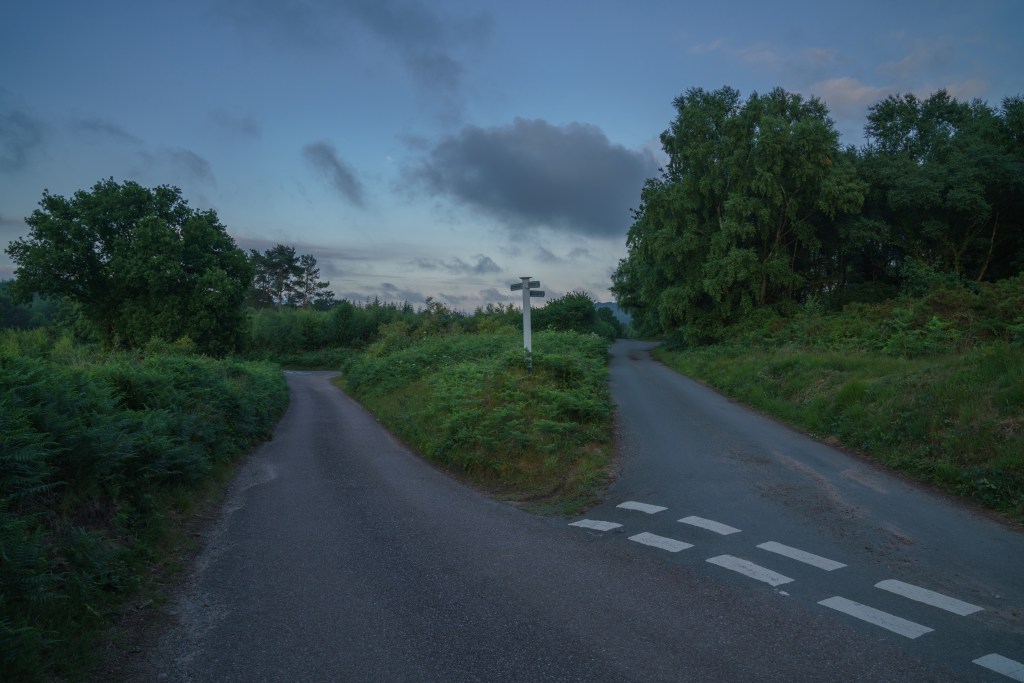
Liminality can be expressed in a variety of ways and liminal spaces have been the subject of previous work of mine. I’m interested in entranceways, meeting points, passages, and ‘edgeland’ areas, and gates and border areas continue to feature in my work on the commons. The passage from one state to another suggests transience and the anxiety of indeterminacy. In the case of twilight, this also suggests death and like darkness and shadows, this draws on deeply-ingrained cultural and mythological iterations. I’ve long been drawn to photograph over the long summer evenings, once the golden light reddens and especially in the otherworldly turquoises and purples following sunset. This image is itself a liminal space, a triangular road junction of unused land, at a liminal moment. The empty roads further accentuate the melancholy mood here.
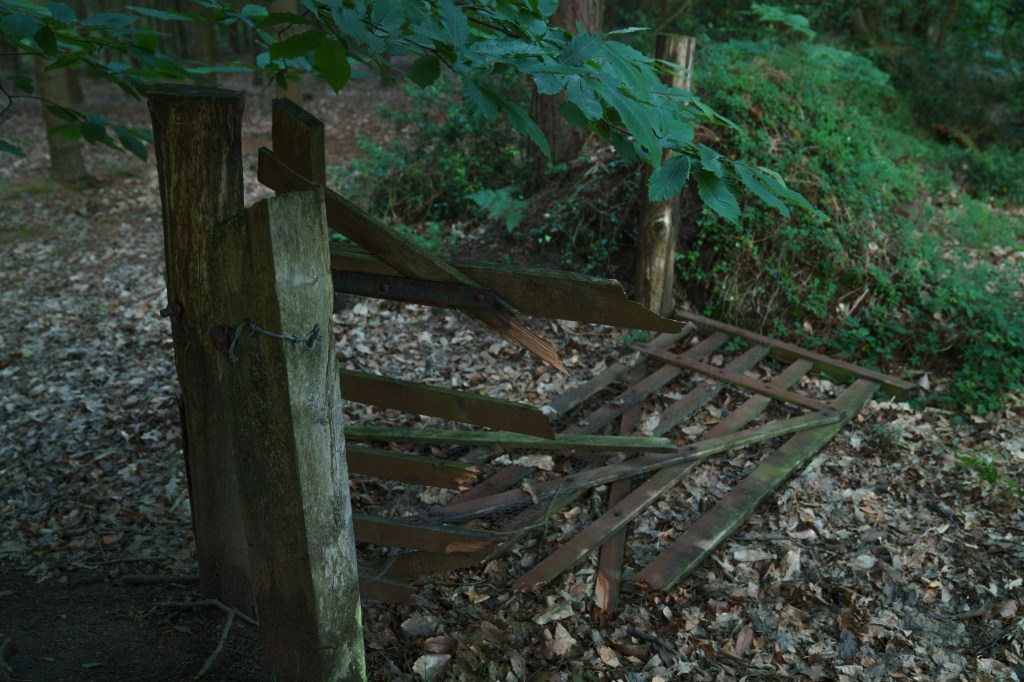
Fragments in the form of ruins are one of the most familiar features of Picturesque landscape paintings and are associated with Sublime forms such as the Gothic. They are themselves liminal, poised between a complete structure and their inevitable, eventual complete destruction, and this infers transience and loss. Cognitively, their incompletion prompts their imaginative reconstruction, and doing so suggests the limits of knowledge just as it does, by comparison, the sadness of their degraded state. All lives have their ruins – ruined marriages, ruined childhoods, ruined Christmases, ruined opportunities – and contemplating ruins outside of the Picturesque and the Sublime makes possible an empathic self-evaluation. This gate indicates a ruined intention, a failure to assert power.
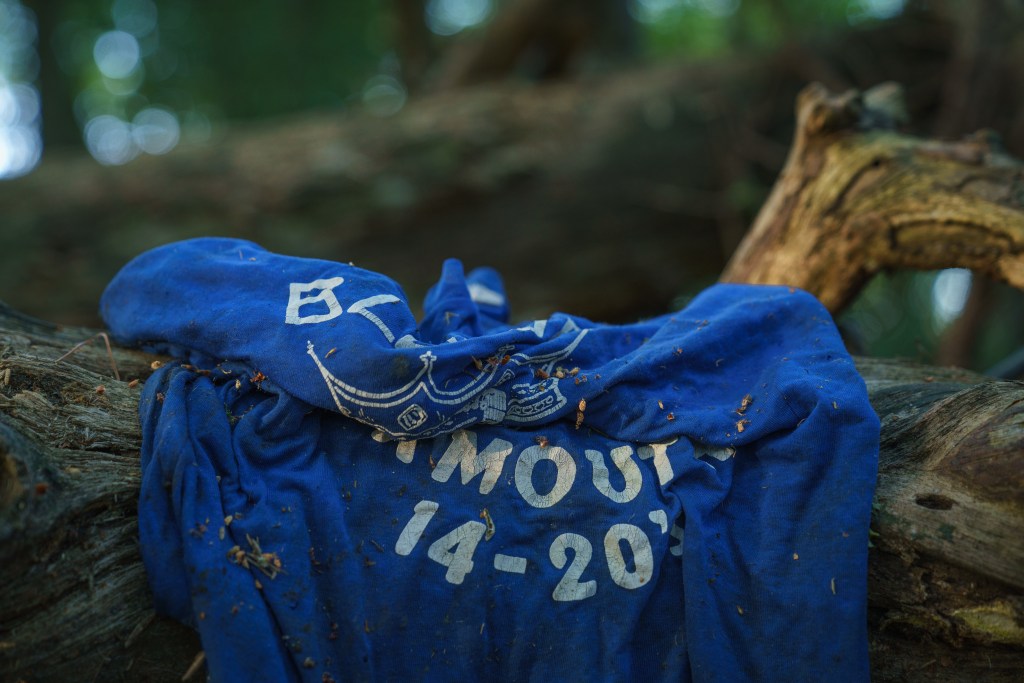
Leavings, what become for the artist ‘found objects’, are another favourite theme of my work, and indeed are things I have collected over the years. Unlike the dens, a ‘leaving’ suggests a need for its return to its owner as if it were a ‘phantom limb’. Leavings have not been abandoned but lost, forgotten and mislaid. They imply narratives and the people who left them there. Such things are, according to Margaret Gibson, ‘stranded objects’ (119) and according to Bowring ‘outside time and space’ which ‘prevent closure’. This image is the only one taken prior to the shoot, although only by a few days. It is a primary school leaver’s shirt, itself a poignant, melancholic object, communicating loss, transience and the uncertainty of the unknown. The sadness I felt in encountering it was tangibly real, and I hoped whoever had left it there did not miss it so very terribly. I felt a powerful yearning, itself a melancholy mood, to return it.
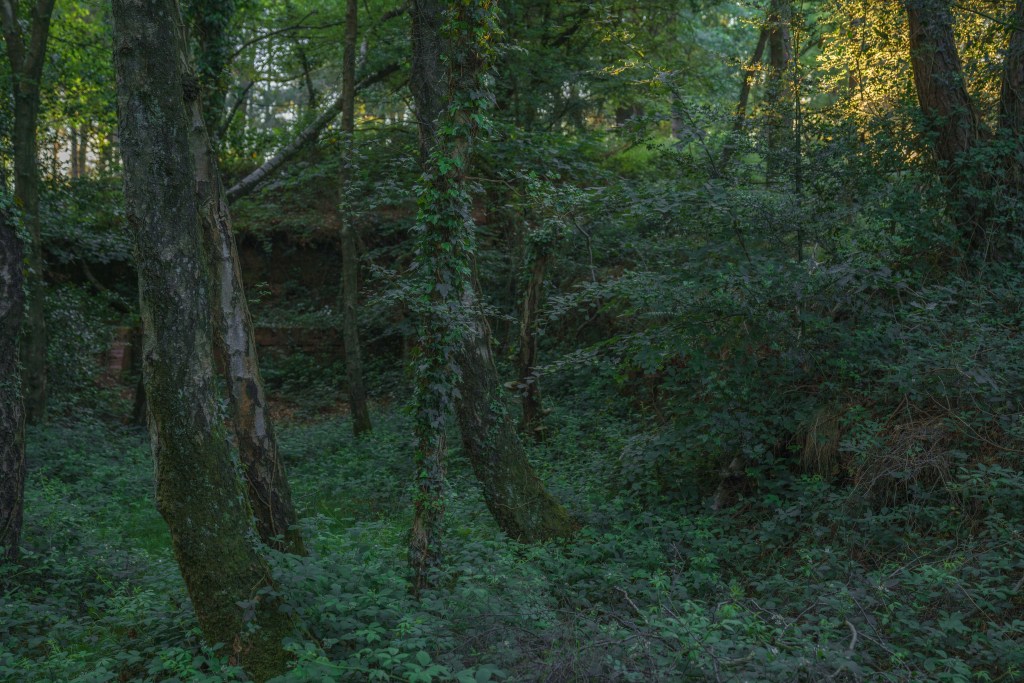
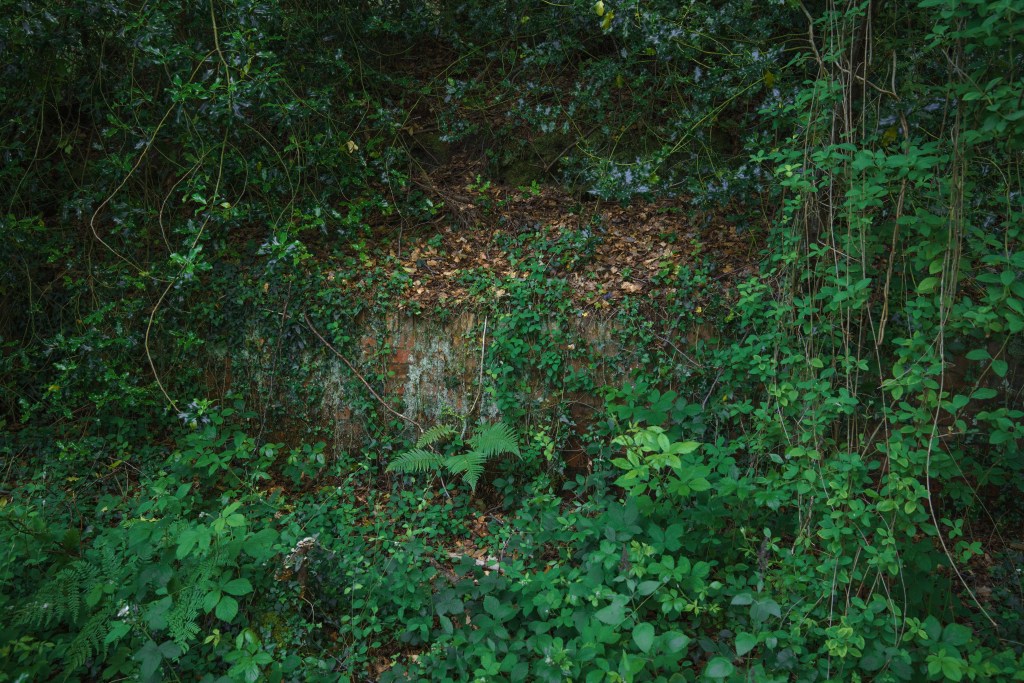
Submersion, whether by water, sand, plants or otherwise, is a liminal state of a particular order. It ‘confounds boundaries’ (137) and suggests the unstoppable forces which lead towards the extinction of all. This being so, submersion resonates with apocalyptic tropes. There’s an ambiguity to the World War II ruins at East Budleigh Common for, on the one hand they are a reminder of conflicts past, but on the other, are evidence of the transience of the man-made, and in particular of the masculine of which the military is emblamatic.
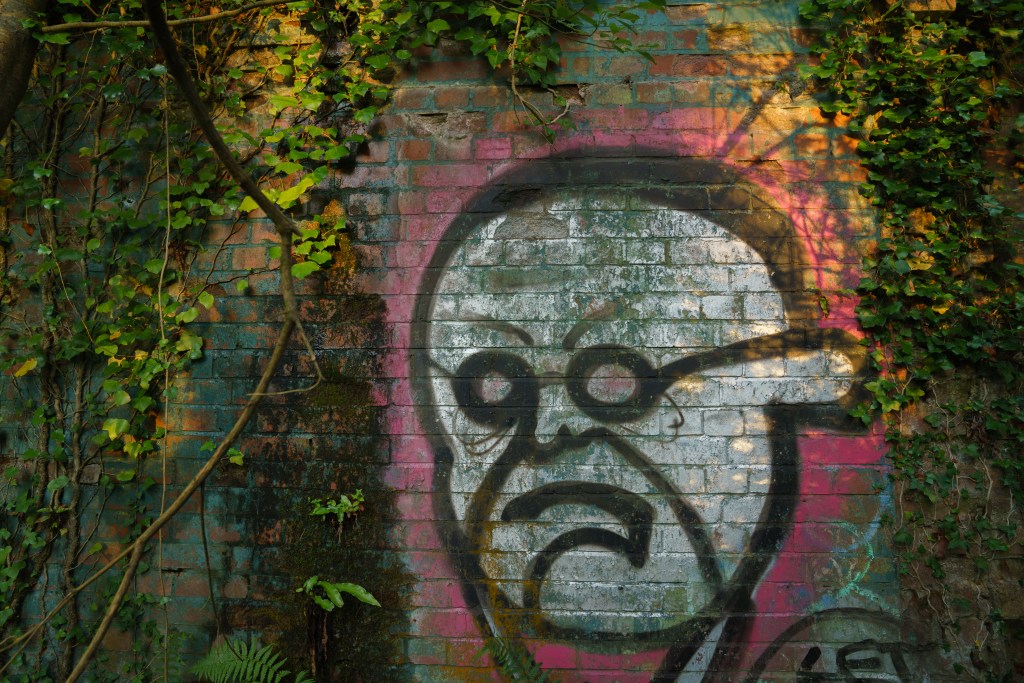
Weathering and patina are similar to, but quite different to fragmentation and submersion, for they retain intact the traces of what they once were and are in the process of erasure and becoming other; like memories, they are fading. Faded artwork lacks the Gothic overtones of the ruin, the apocalyptic of submersion, but rather theirs is the sadness of neglect, heavy with regret. I’ve been particularly drawn to the faded graffiti on the old bunkers, more so than the fresh, vibrant recent work. This artwork is not created to last, and indeed is often painted on top of other artwork, but nevertheless the lack of vitality suggests the decrepitude of old age rather than the death of submersion or ruin. Weathering reveals not a change of state but the object itself in the process of disintegration.
I am deepening an awareness of my subjective response to the Pebblebed Heaths in preparation for better learning about the subjective experiences of others. This process has been both surprising and productive, for it has connected this landscape to my sense of self and personal history in a profound way.
Bowring, J. 2017. Melancholy and the Landscape: Locating Sadness, Memory and Reflection in the Landscape. London: Routledge.
Fisher, M. 2016. The Weird and the Eerie. London: Repeater.
 out of the picture
You must be logged in to post a comment.