End of

I hate it when a blog just fizzles out, so here’s closure on this one. After a few weeks mulling it over, I quit the MA in Photography with Falmouth in early January. 

There are many, many reasons I quit, not least that it had been a tough experience from the earliest weeks. The focus, methodology and philosophy of the MA is fine art, which isn’t my background, and neither do I have a solid background in photography, which meant I was already at a disadvantage; I could have bridged that gap, but it would have meant putting in full time hours which I just didn’t have. I began to drift away from the teaching and content, although the things I discovered as a result were and continue to be hugely valuable. I also produced work I’m proud of, and made connections, both professionally and personally, that have continued. The MA has most definitely not been a waste of time, though neither was it particularly enjoyable for me, nor able to offer what I had wanted to learn. 

The pandemic meant, as for all of us, a massive change in direction and, for me, it started becoming a case of finding something to keep my interest going. Originally, I had a great idea for a project – exploring registered commons – that just wasn’t going to be possible with limitations on movement and human contact. For a while, I kept the idea and the passion going. The twilight photography I made in the early summer, and the photo trail I created at East Budleigh Common were hugely exciting, but it was hard to see where to go after that and my enthusiasm for photography fizzled out over the summer. I watched as my peers turned inwards through necessity, heightening their self-reflexivity, their use of conceptual ideas and a heightened interest in playing with definitions of what photography means. I had my own go at this, working in moving image, but the difference between film in a theatrical context, which is my background, and film in a gallery context, which is something I’ve never liked, made for a pretty uncomfortable experience and a rather ‘meh’ film that was neither film nor video art. 

Without the pandemic, I probably would have continued. I would have created a body of work drawn from visits to commons across Southern England and the people I encountered there. And from that would have naturally followed where to place the work, and it wouldn’t have needed to have anything to do with galleries or agencies or conceptual or self-reflexive work. I wouldn’t have needed to think of myself as an artist, but as a writer and researcher also working in photography. 

Anyway, that’s water under the bridge. Right now, I’m continuing my research into registered commons, and into the weird and the eerie which I’ve always sought out in my photography and I now know fits well with the ever-expanding field of hauntology. I’m looking once again at film and TV and I’ve stopped trying to find where I fit into contemporary photography – because I don’t. Put simply, with the kind of work I make, without shooting analogue, and preferably large format, I’m never going to get anywhere. And what’s the point investing in all that kit and the time I’d need to work in a completely different way? If I’m going to do that, I’m going to do so in a medium with which I’m completely comfortable – the moving image. 

In September, I begin a PhD in film supervised by one of my favourite directors, Gideon Koppel. I don’t expect that to be easy either, but at least I already speak the language. At least I already have a wealth of usable experience, and a certain degree of recognition. 

Over and out. 

Early FMP thoughts

I’ve been thinking back to the moment I turned my back on stills photography for this MA. It wasn’t actually the arrival of the A7siii – it was Jesse pointing out that what I’d thought about for my FMP wasn’t particularly workable, and wasn’t really landscape photography works – getting to know somewhere very, very well. I maintain my original idea – haring around the country taking photos of woods made famous in children’s literature – would be a great project, and would definitely attract interest. But given all the current restrictions, plus the restrictions of family, I can see he was right. So that little bubble burst, I really didn’t know where to go next. 

What’s particularly worth thinking about is why I came up with that project in the first place. Of course, it’s a fascinating subject, completely unexplored, and absolutely worth doing. But why a photography project? If I were to do it justice, it would be wordy, literary, rich with research. It could just as well be a book, or a film, in which photography would play a – minor – part. My interest in the subject leapt beyond photography, and expanded out in the way that my ideas tend to, annoyingly, but full of ADHD enthusiasm. And a project with a large scope seems to run contrary to the spirit of much contemporary photography: the detailed, the specific. 

The genesis of the project was very personal: I’d discovered the impact on my photography, and my love of place more generally, as deeply rooted in experiences of the landscapes of childhood literature. I wanted to explore that further. But what I’d done, what I think I always do, was turn outwards, leap away from myself. Because why? Because I’d not even considered that this powerful insight could be something I might stick with and use to deepen what I was already doing, developing a very personal experience of a landscape. That wasn’t enough, I think I assumed. I had to attach that to something else, hitch myself to some other star. And I don’t think that would work either to create the project I’d want – that’s a book or a film, surely – or to help develop my photography. I’ve identified just how personal my photography is, just how private. My film, and to a certain extent my writing, is outward-looking, but my photography isn’t, and it seems that’s a common factor to much photography. So it makes sense to use that insight and bring it back to focus it on the work I was already doing, on the hidden corners of the East Devon Pebblebed Heaths. It’s work people like. I like making it. It’s democratic in reach. And the Pebblebed Heaths, my experience of them, and my ability to make strong images are good enough to create a compelling piece of work. 

But work for who? That’s a question the course poses, and it’s one that’s driven me insane. My work doesn’t seem to fit anywhere. It’s not commercial enough. It’s not arty enough. I don’t shoot on analogue film (which obtains credit as a ‘serious’ photographer, just like shooting in black and white does). But maybe I haven’t explored this enough, lost in the mists of Barthes and gallery pitches and animal photography over the past three modules. Maybe I should just look fair and square at the images I like that I see on IG, see who makes them, where they sit, why they appeal. I should put thought into zines. 

I should also begin to embrace that maybe, actually, my audience isn’t photographers or those immersed in fine art contexts, that it’s more everyday people. I’m developing relationships locally with the Pebblebed Heaths Conservation Trust and with Devon Wildlife Trust, and work – paid work – is ongoing. If I can create a body of work on my terms for people who are going to enjoy it and buy it, then that really should be absolutely fine. If I can use that project to deepen my visual style – the abstracts, the shallow depth of field, the low light – then I will find doing so artistically satisfying. Almost 50 people have now seen the film I made for Sustainable Prospects. Those who look after where it was shot love it and have shared it widely. I can do this. I should do this.  

Reflections on Diamond

Diamond  is a short, immersive film depicting Diamond Plantation, a small enclosure on Woodbury Common. I chose to make a film about this place because I wanted to keep the canvas small while getting used to my new camera, and also because I wanted to see what would happen when I kept the location very tight. 

It’s proven the most difficult film I’ve ever made, not least because I’m unsure what it’s about or who it’s for. I’ve made immersive, place-based films before, with a strong focus on look and texture and an absence of dialogue – but even then, it was following documentaries like sleep furiously  and still created with a film festival or conference circuit in mind. Making a film as part of a photography MA raises the question of exhibition space, photography being a medium of the gallery, and some of the images deliberately taken for their abstraction. Certainly, every single person I’ve talked to about working with the moving image for this module assumed that what I’m making is video art, and that’s telling. 

So – maybe – this would work in a gallery space? I’ve certainly seen worse films in galleries, but I’m so very new to thinking this way, I’m feeling my way in the dark. With next to no experience, no art background at all, and little guidance, I feel I’ve come very little distance in understanding the moving image in a fine art context. Certainly, I find the overwhelming majority of what’s called video art to be alien and uninteresting – that’s to say, when I’m actually able to find my way to a complete work online – the digital walls around video art are frustrating to say the least and something that keeps it in its niche. 

That’s not to say I’m throwing in the towel with this direction. Far from it. It’s been a very busy few months and I haven’t had the chance to do this justice – certainly, I remain interested in the moving image in other contexts than the cinema, and note that several of my favourite directors are too. But if I’m going to work up a piece for a gallery context, it’s going to take a lot more thinking, experimenting and research. And definitely finding more practitioners whose lead I can follow. 

I swiftly abandoned voiceover for Diamond. This is most odd, as one of the reasons for the turn to moving image was to include words, but the subject was so subtle here that a voiceover would have completely dominated. Instead, I chose to make more use of sound to expand the space – the soundtrack is multi-layered, and often was recorded completely separately to the image. It’s far from perfect. Working on heathland means no protection from wind and my on-camera mic picked up too much wind, even with a fluffy. Many of the sounds are very subtle – rustling bracken, bird song, water, distant conversations – and so traffic and aircraft noise are far more intrusive than I’d like, even if they’re definitely part of the feel of the place and not to be omitted. Sound is something I want to work with more carefully next time and am planning to splash out on some decent kit in the coming months. 

One of the decisions I had to make was duration. Some of the shots are very long – one is over four minutes to allow for clouds to throw patterns behind trees. I didn’t feel that very long takes work in this film – though that’s perhaps timidity on my part. There are strong philosophical reasons for long static takes of nearly static scenes and the effects those create, but I didn’t feel I’d earned the right to do that here – I was very much aware of this being watched by peers and time-pressured tutors and impatience causing them to pay less, not more attention. I think in a gallery context, which is essentially a contract for attention, it would feel very different, and long takes on multiple screens would be great. But that’s a long, long way in the future before I can think more in terms of that. 

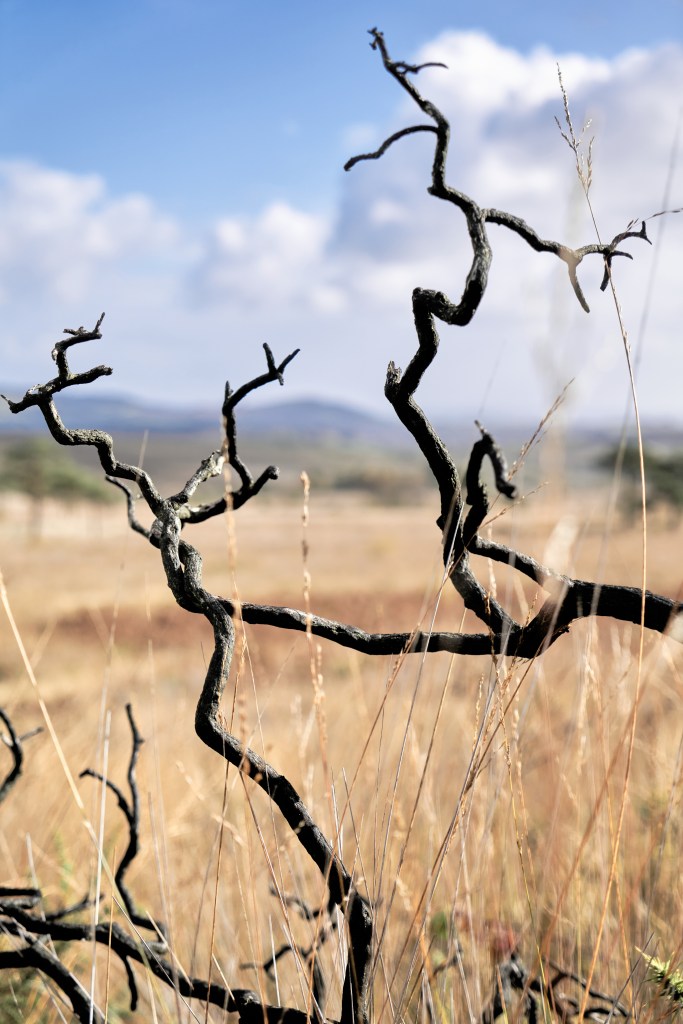
I know Colin didn’t like the shots with the static wood in the foreground and the barely-moving background. And I also know that Jesse doesn’t like me using very shallow depth of field. And I guess that’s where personal preference comes into play – this IS what interests me. I like the strangeness of those shots, as if they are both still and moving, as if manipulated, and I like how shallow depth of field replicated attention and thus subjectivity. I don’t believe I’ve a chance in hell of taking my photography anywhere beyond this course so I might as well make the work that I want to see. These shots might not work in the context of this film either – I’m prepared for that – but there’s such a strangeness and presence to them it was crucial I include them. It may be that in future film work – and by that I mean cinema – such shots can be used to punctuate my work, as cutaways, as interstices. They are precisely how my stills photography and my filmmaking intersect, which is exactly what interests me on this module. They are my style. My visual language. That thing we’re all supposed to be working on. 

Strands: a documentary at Lamplighter’s Marsh – Self-reflexive accompaniment

It will doubtless appear somewhat strange to include a previously written essay. Nevertheless, the points raised here are no less valid for my work now than they were over 18 months ago. This also demonstrates my academic writing, to me a natural part of the thinking-through process of a creative project and one which I have sorely missed.

I have a lifelong artistic commitment to exploring and representing geographical space. My first film, Walks of Life (2018), investigated the wellbeing functions of favourite walks and my second, Abridged (2019), investigated and developed my personal connection with the River Exe M5 bridge. I wanted Strands (2019) to combine the interpersonal engagement of the former with the essayistic, fixed-shot style of the latter, to examine Gideon Koppel’s sleep furiously (2008) as exemplary of this intention, and to explore critical frameworks to ground the film’s making in its location. I also wanted to strengthen my use of my camera, the Sony a7iii, doing so early on through a paid-for tutorial at dslrvideoshooter.com(Pike, 2018). 

Strands was shot at Lamplighter’s Marsh, a ribbon of land between the Portway arterial road, the River Avon, the M5 Avonmouth Bridge, and Station Road, Shirehampton. The site includes Bristol City Council-owned green space (Lamplighter’s Marsh and The Daisy Field Local Nature Reserve), Avon Sea Cadets, Portway Park and Ride, JP Crane Hire, a Wessex Water-owned tenanted boat yard, private residential housing, privately-owned untended marshland, and the Crown-owned strand, part of a Site of Special Scientific Interest with the second highest tidal variance globally. There are visible traces of post-Blitz landfill and railway sidings, the site is crossed by a rail line and a subterranean fuel pipe supplying Heathrow, and includes water pumping constructions and a gas warning siren which is tested monthly. Another Local Nature Reserve, Pill Foreshore, is directly across the river. The green spaces are well-used and Friends of Lamplighters Marsh (FOLM) are a highly active group who safeguard public access and animal and plant conservation, including a large badger sett and a nationally-unique moss. I first visited to photograph a nature walk as part of the Being Human Festival 2018, made of particular interest due to my connection with the M5. I was warmly welcomed by organisers and local community, and soon wanted to make a film there.

I have previously investigated pro-filmic landscapes using eco-critical theorists such as O’Brien (2018), and documentary relationships with participants using models of voice such as Bakhtin (1984) and Renov (2005). To interrogate my own relationship with landscape as a film-maker, I turned to phenomenological cultural geography, brevity requiring it is heavily-summarised here; I additionally found environmental psychology, which also uses phenomenology (Seamon, 2014), relevant to identifying themes common to my film’s participants. 

Wylie (2007) identifies in phenomenological cultural geography a complicated division between self and landscape, where landscape is an always-already physical actuality, pre-existing individual cognition and across which culture is ‘laid’. It can find expression through an artist’s ‘immersion’, which Wylie shows draws on what Heidegger, then Ponty, describe as ‘being-in-the-world’, permitting an embodied view within landscape that intertwines both. Personal meaning is found through a ‘togetherness’, formed by ‘dwelling’ in the landscape through practical activity, rather than cerebral activity – such as imposing a framed view. While a frame-imposing artform, film-making nevertheless has the simultaneous potential for artistic dwelling through immersion and foregrounding its practical and social activities in landscape; film-making thus becomes an embedded technological ‘mediation’ between person and landscape, as described by Tilley (2017), akin to trail biking or model plane flying. Tilley envisions the researcher as material ‘interface’ between inner (personal) and outer (material) landscape, a ‘fellow traveller’ amongst those physically, and emotionally, connected; psychologist Seamon (2014) identifies a similar dialectic and both identify useful dimensions of engagement, such as mediation, ‘conflict’, and ‘creation’, as seen later. 

Several phenomenological studies of film draw related conclusions about landscape. Lefebvre (2006) challenges the conventional interpretation of pro-filmic landscape as culturally framed by creating a fluid, subjective division: ‘setting’ (location being subservient to narrative, and viewer experience manipulated), and ‘landscape’ (beyond events, and the viewer having agency to look). Geographer Massey (2011) notes a strategy in Robinson in Ruins (Keiller, 2010), the work of her project collaborator, of complicating landscape rather than ‘smoothing’ it, preferring an ‘entanglement’ of loose ends which lets the viewer piece location together. She also notes that his fixed frames might infrequently carry narrative but are never static, recording landscape in the process of becoming and changing. 

When I came across Gideon Koppel’s sleep furiously in 2018, it resonated powerfully. Its pre-occupation with place echoes my own by representing people as located within, rather than dominating their landscapes, in sympathy with a worldview local to the Welsh community of Trefeurig where it was largely filmed (Koppel, 2007). It is unlike my films by doing so in part by absenting talking heads interviews and voiceover, but like Abridged in its reliance on fixed-camera long takes from which people often emerge. sleep furiously is not ‘about’ Trefeurig any more than Abridged is ‘about’ the M5 (Woods, 2014); both films seek to evoke landscape rather than accurately reproduce it (Newland, 2016). The long takes of the film’s mini-narratives – hay-baling, a garden contest – encourage viewer agency, and while each shot is framed with a meticulous aesthetic sense, these provide a ‘stage’ for change in landscape (Banville, 2009), including people connected with it, allowing the oscillation between Lefebvre’s binary division. This is not, however, observational film-making: the film-maker is the participants’ audience (Koppel, 2007), and Koppel has described his film-making as subjective immersion in landscape (Robinson, 2012). 

When approaching a documentary subject, I have previously drawn on my social science training, typically, albeit loosely, having a research aim, later constructing footage into a visual ‘argument’. It was in such a spirit that I drew up an interview guide before meeting participants selected for differing relationships to Lamplighter’s: those born locally, the long-term and newly locally-settled, those connected through work, and those travelling in to visit. Finding my questions less compelling than what participants wanted to tell me, this separation quickly felt disingenuous; rather than making a film about Lamplighter’s Marsh, it swiftly became a film at Lamplighter’s Marsh, documenting an immersive encounter. As fellow traveller, I was freed to become materially and emotionally involved in the film, an interface, my presence as filmmaker another situated social interaction, my practical activities joining the dog-walking and conservation work. Thus, Strands is strongly inflected with my own aesthetic interest in lines and textures, and incorporates my explorations of places not referred to by participants, such as the Pill Foreshore.

I explored Lamplighter’s in pre-production seeking to evoke activities and places that seemed key to the participants, and shots of these are integral to the film. To Renee, for example, the railway bridge was important as a ‘portal’ to the marsh, while to Richard, the many gates mark out conflicted ‘borders’, both identified in a foundational environmental psychology study (Altman & Chemers, 1980) as two dimensions by which understanding of ‘place’ is commonly ‘created’ (Seamon 2014). Lamplighter’s is a complex place to get to know, particularly when understanding the interrelationship of the various patches of land. Rather than coming up with a solidified perspective, requiring smoothing, I thought it better to immerse myself in complexity and conflict (another of Tilley’s (2017) key dimensions of landscape connectedness), recording components of Lamplighter’s as I encountered them. I increasingly envisioned the project as a mosaic, each piece – whether biographical, geophysical, economical and so on – distinct, and interrelated as a pattern by proximity rather than commonality. Expressing this intention is echoed in the pun Strands, evoking disparate, incomplete, but entangled threads which, like the landscape, materially pre-exists their organisation both by participants and myself.  

I scheduled three shoot days. The first coincided with the gas alarm test and included Renee and her husband’s short walk to ‘the lookout’, and Helen, an artist, looking for driftwood. The weather went from sunshine to drizzle in four hours, the resulting footage seemingly shot on different days. I discarded the radio mics as distracting, opting for my on-camera Røde mic, knowing that most speech would be inaudible. This was disappointing: sound is meticulous in sleep furiously and I wanted to likewise record people conversing with one another. However, not doing so located people within the landscape, speech neither more nor less important than birdsong or road noise; it also helped evoke being there, of straining to hear snippets of conversations, of guessing meaning. Not privileging the viewer with supernatural hearing keeps the view within the world, allowing for what Sobchack (1992) calls the ‘thickness of experience’ rather than striving for an artificial authenticity. 

I coincided the second shoot with the monthly FOLM work day so I could film practical activity and the landscape in the process of change; several participants had described Lamplighter’s in social and practical, rather than aesthetic, terms and this decisively changed my course from the more aesthetically-motivated Abridged. I also recorded traces of those who use Lamplighter’s for subcultural activity like drug-taking and bike-racing, hence shots of a woodland desire path and the remains of a riverside barbecue; doing so indicates alternative, conflicting forms of dwelling beyond the world of Strands and its participants, giving these voice and underlining the film project as an incomplete view of a slightly unknowable landscape. 

My final shoot coincided with the Nomads walking group. I have filmed walkers before, but this time made them part of the landscape, especially where filing into Lamplighter’s in their segment’s opening shot, a minute portion of the screen. I also filmed Richard and his dog; Richard is a contentious figure who lives at the boat yard, the only participant born locally, who some dislike, and for who Richard has a certain amount of contempt. Doubtless, some would rather he not appear in this film, but while Strands demonstrates conflict, I chose not to take sides; doing so would be smoothing. Lastly, from across the Avon at Pill Foreshore, I filmed Pippa walking her dogs along the strand at Lamplighter’s. Pippa, my first contact with Lamplighter’s, dislikes being filmed, and this extreme long shot was a suitable alternative. The penultimate shot of the film, it is alone in visually referencing sleep furiously – Pip’s walk to and from her husband’s grave, shot from across a valley. I wanted to show Lamplighter’s from afar (a landscape within a larger landscape, like Sobchack’s (1992) Russian doll analogy), and to provide a human sense of scale. I was ambiguous about the results; Pippa and her dogs are tiny in the frame, and the wind meant removing the Røde mic to avoid it shaking the camera too much. However, I believe this final shot inverts setting/landscape such that the mini-narrative of the dog walk emerges out of the non-narrative of landscape. The viewer is freed to piece together the mosaic of locations shown earlier and to observe ‘movement’ (Tilley, 2017); I hope that the longer the frame persists, the more its cerebral ordering function is handed over as a stage for change. I kept the loud in-camera mic wind noise as I believe it evokes the tactile experience of standing beneath the bridge; it would have been easy to source a better sound track, but I believe the distortion provides ‘thickness of experience’. Doing so, especially at the end of the film, additionally emphasises film-making as a practical activity, and the camera as mediating my connection with the landscape. 

Many post-production choices were thus grounded in technical circumstances and mishaps, something not uncommon for documentary. Just as with sleep furiously (Newland, 2016), the uncontrollable soundscape of air and road traffic, bird song, the rattling bridge was explored during editing and has been adapted for its capacity to evoke and contrast elements of infrastructure and biodiversity unavailable visually. The weather, another uncontrollable element, with its attendant variability in wind noise, contrast and white balance, suggested that sequences be composed of shots filmed at the same time. The film’s structure was thus composed of 11 of these, most following the route of a walk which suggests myself, and thus the film, as moving through landscape, emphasising it as an embodied, material view within Lamplighter’s. An argument could be made for allowing jarring juxtapositions, but I felt this would emphasize the cerebral rather than practical process of film-making, and reduce the film’s capacity to evoke. 

Experiencing the rapid and dramatic hourly changes in tidal level, a theme all participants mentioned, can be disorientating. I had considered ways of recording the tide – such as shooting from the same location between tides – but this was impractical. However, while I wanted to evoke Lamplighter’s as slightly unknowable, just as Trefeurig is slightly unknowable (Koppel, 2007), there is a major difference between a film that is meant to be disorientating and a film that is simply disorientating, and I felt any confusion would be worsened by what could be experienced as the film’s seemingly unstructured passage through the landscape. Carroll (2003) argues that the terms of documentary truth, to be assessed, need to be signalled, either inside or outside a documentary. I thus created the colour tiles primarily to signal a step away from narrative authenticity and towards abstraction, but also to divide up the sequences; both hopefully make the film easier to read. I have borrowed this in part from sleep furiously (the colours of its opening tiles mirror the town crier’s costume just as mine mirror leaden skies, gorse, the bus lane, tidal mud and so on), but through being stretched throughout the film, my tiles also function differently by describing film, landscape and my experience as a mosaic. The tiles do not form a regular pattern, but they are nevertheless comprehensible as one, describing Lamplighter’s as unknowable and abstract, pre-existing any attempts to impose order, but at the same time a lived, personal, physical thing, both inside and outside of the people who dwell in it. Reducing visual stimulus also gives viewers a chance for focussed listening.

Although I am happy with Strands, there are still technical skills for further development. Several shots of participants are marginally out of focus and while I can build a philosophical argument for this akin to that of indistinct speech, I think the film would have benefitted had this not been so. Similarly, although I have worked around not using radio mics, I will use a sound recordist for my dissertation project, to which speech is more important. I also feel I am now working at the limits of the a7iii in an outdoor setting; while using a small film crew would significantly change the experience of film-making, and thus the terms of engagement with subject, I would consider doing so carefully in future for the sake of a richer sensory range. 

Following Heidegger, Tilley (2017) briefly evaluates landscape as a ‘gathering’ of diverse elements such as “geologies…biographies…monuments…academic disciplines” (p.20) and this idea was especially useful in immersing myself in and then evoking Lamplighter’s Marsh. Doing so required a move away from narrative documentary and towards more experimental forms I had not anticipated. Likewise, it required I took a more spontaneous, looser approach to film-making. I will carry these invaluable experiences forward into future projects. 

Works cited.

Altman, I., & Chemers, M. 1980. Culture and Environment. Belmont, California: Wadsworth, Inc. 

Bakhtin, M. M. 1984. Problems of Dostoevsky’s Poetics. Translated by Caryl Emerson. Minneapolis: University of Minnesota Press.

Banville, J. 2009. sleep furiously: The hills are alive. Sight and Sound [online] June. Available at: http://old.bfi.org.uk/sightandsound/review/4958. [Accessed 13th May 2019].

Carroll, N. 2003. Engaging The Moving Image. Yale University Press. New Haven: Yale University Press. 

Koppel, G. 2007. Documentary – the evocation of a world. Journal of Media Practice, 8. pp. 305-323.

Lefebvre, M. 2006. Between setting and landscape in the cinema. In Lefebvre (ed.) Landscape and Film. pp. 19-60

Massey, D. 2011. Landscape/space/politics: an essay. The Future of Landscape and the Moving Image [online] April. 

Available at: https://thefutureoflandscape.wordpress.com/landscapespacepolitics-an-essay/ [Accessed 13th May 2019].

Newland, P. 2016. sleep furiously: interview with Gideon Koppel. In Newland (ed.) British Rural Landscapes on Film. Manchester: Manchester University Press. pp. 180-189.

O’Brien. 2018. Film and the Natural Environment: Elements and Atmospheres. London: Wallflower. 

Pike, Cabel. 2018. Sony A7III Video Guide. [online]. Available at: https://academy.dslrvideoshooter.com/courses/sony-a73-video-guide. [Accessed 13th May 2019].

Renov, M. 2005. Towards a Poetics of Documentary. In M. Renov (ed.) Theorizing Documentary. New York: Routledge. pp. 12-36. 

Robinson, G. 2012. ‘Belonging To The Land’. The New York Jewish Week [online] 7 March. Available at: https://jewishweek.timesofisrael.com/belonging-to-the-land/ [Accessed 13th May 2019].

Seamon, D. 2014. Place Attachment and Phenomenology: The Synergistic Dynamism of Place. In Manzo & Devine-Wright (eds.) Place Attachment: Advances in Theory, Methods and Applications. London: Routledge. pp. 11-22. 

Sobchack, V. 1992. The Address of the Eye: A Phenomenology of Film Experience. Princeton: Princeton University Press. 

Tilley, C & Cameron, K. 2017. An Anthropology of Landscape: The Extraordinary in the Ordinary. London: UCL Press.

Wood, J. 2014. Gideon Koppel. In Wood (ed.) Last Words: Considering Contemporary Cinema. New York: Wallflower Press. pp. 60-65.

Wylie, J. Landscape. 2007. London: Routledge.

Audiovisual works. 

Abridged. [short film] Dir. Andy Thatcher. UK. 2019. 9 mins. 

Robinson in Ruins. [feature film] Dir. Patrick Keiller. 2010. BFI. UK. 101 mins. 

sleep furiously. [feature film] Dir. Gideon Koppel. Bard Entertainments, Van Films. UK. 2009. 94 mins.

Strands. [short film]. Dir. Andy Thatcher. UK. 2019. 20 mins.

Walks of Life. [short film]. Dir. Andy Thatcher. UK. 2018. 4 mins. 
Four books about slow cinema

I was into slow cinema before I was into slow cinema. The first essays I wrote on my film Masters were on Antonioni, Jarmusch’s Dead Man and Kelly Reichard’s Meek’s Cutoff, respectively considered one of the godfathers of slow, and two directors using slow for their features. Gideon Koppel’s documentary sleep furiouslyblew me away when I came across it (and I’m still astonished he likes my work enough to want to supervise my PhD project) and includes a mesmerizingly-beautiful 4-minute shot of sheep being herded through filthy weather across a Welsh hillside. I’ve explored elsewhere how the long take and the slow film are used to communicate landscape through anti-narrative surplus, allowing the eye to wander across a scene to alight on the incidental and the peripheral, lending a form of agency to the non-anthropocentric elements of film. However, I’ve not faced the phenomenon of slow cinema head-on until recently. I’ve looked at four books – their introductions so far, but over time I will read them all. Two focus generally on slow cinema, while the others focus on crucial facets of it – the long take and stillness/ stasis. 

Drawing on many of the same theorists and filmmakers as Campany (2007), in their introduction to their edited collection de Tuca and Jorge (2015) describe slow cinema as a reaction to ‘the accelerated tempo of late capitalism’ (p.3) and to the assumption that cinema needs to be a narrative form by including ‘dead time’ up to the exclusion of any form of narrative. They argue that doing so makes time noticeable – Chantal Akerman says much the same thing of her own work. Duration is thus accentuated, rather than action, but stillness – or ‘silence’ – is also central, as slow cinema is not defined by the long take – hence Ozu’s static camera, slow pace and use of filmed still life compositions make him an important precursor to contemporary directors working this way. 

By eschewing the rapidity of most filmmaking, a space is opened up for the spectator to reflect on what is before them by the creation of a type of what Deleuze famously describes as the ‘time image’ (Deleuze is a common connection in all discussions of slow cinema). This radical rejection of what Campany calls the ‘dehumanizing, repetitive and monotonous’ world of the accelerated image led to ‘slowness, the deliberate refusing of speed, becom[ing] central in vanguard art and culture’ (p. 9), a form that has been made more practicable through digital video recording which has allowed for a global explosion of such types of filmmaking, a hybrid form that inhabits both cinema and gallery and the grey area between both (slow cinema filmmakers such as Koppel, Ackerman and Kairostami also exhibit in galleries). 

The authors dismiss claims that slow cinema is a nostalgic flight from the contemporary, arguing that on the contrary it permits a reflection on and confrontation of the contemporary in a manner not afforded by more conventional film. In particular, it challenges the attentional dominance of the internet, which threatens to leave all moments occupied, squeezing what Crary calls ‘daydream or…any mode of absent-minded introspection that would otherwise occur in intervals of slow and vacant time’ (p. 16). 

Jaffre’s Slow Movies(2014) similarly notes the importance of stillness and duration, connecting slow cinema to a wider artistic tradition in which ‘nothing is happening’ and includes the paintings of Barnett Newman and the plays of Samuel Beckett. He also points to a wider ‘slow movement’ such as Slow Food and Slow Medicine which can readily be seen as a reaction against consumerism and the time poverty brought about by consumer lifestyles. 

Jaffre goes further than de Tuca and Jorge in dismissing the understanding of slow cinema as nostalgic by arguing that much slow cinema is bleak, empty and desolate. He also points to the importance of peripheral, liminal settings, such spaces being central to the creation of Deleuze’ time-image through more easily hosting the ‘halting of time’ and also to the activation of Bellour’s pensive spectator. Jaffre also demonstrates that slow is a quality that can be subsumed by more active elements – My Dinner with Andremight never move from a restaurant but its conversational fireworks are anything but slow, while The Russian Ark’s single shot nevertheless encompasses a vast array of characters and stories. 

In Motion(less) Pictures (2015), Remes describes watching Larry Gottheim’s Fog Line, which opens on 11 minutes of a fixed frame of almost entirely fog-shrouded landscape and in which the only movements are the very, very slow retreat of the fog and the occasional easy-to-miss silhouettes of horses. Remes speaks of this in terms of a photograph, or a painting, but through its duration experiencing these very, very subtle movements; this blurring of boundaries between media is, he argues, a foundational quality of these ‘cinemas of stasis’ in which movement may only be perceptible outside of the frame through sound. 

As with other, previously discussed writers on the subject, Remes demonstrates that while moving becamethe defining quality of movingpictures, not only is this illusory (the moving image gives the impression of movement through technological trickery playing on our flawed cognitive machinery), but hardly a quality inherent to what film and later video capture any more than sound or colour. Nevertheless, so integral is movement to the general perception of what the moving image is for, that capturing an absence of movement becomes radical, subversive, perverse. ‘What is the point?’ exclaims Carroll, ever the contrarian (p.9). Like Campany, he argues that the defining quality of the moving image is not movementbut duration, and this is certainly suggested by the fine art concept of time-based mediawhich includes film. 

The philosopher Bergson is central to Remes’ – and others’ – discussion of the moving image. Bergson believed not only that motion is indivisible (and thus one cannot say that Muybridge’s series are in any sense a precursor to ‘moving’ images) and that absolute stasis is impossible (even a still photograph is in the process of decay, albeit incredibly slowly), but that the human imagination is, for some reason, ill equipped to animate thought. (This has been used as an account of the memory/ dream dichotomy of the still/ moving images). So is Roland Barthes, who, Remes argues, was unable to lose himself in the moving image which excluded him from pensiveness(p.20). It is interesting, as a side note, that here is another example of fans and practitioners of each form thinkingin fundamentally different ways and this leads me to wonder whether the difficulty I have in developing a visual language through photography and my antipathy towards Barthes might be not simply an effect of personal history but more fundamentally grounded in my cognitive machinery. 

Remes denies the existence of the cinema of stasis as a distinct genre as it is expressed across too many structural formats, exhibition styles and primary subjects of interest. Nevertheless, he argues that all such works promote an immersive, meditative experience that very subtly brings about introspection through undermining the cultural expectations which are unavoidably brought to experiencing the moving image. 

While Koepnick’s Long Take (2017) often strays close to polemic, it is compelling in its passion and makes its central argument well: the long take nurtures and makes possible a sense of wonder. Koepnick describes the philosophical basis of wonder, tracing it back to Homer and on through Descartes (while at the same time demonstrating the long take to directly challenge the individual rationalism which Descartes ushered in to the Western mind, to mixed results). Like Remes, Koepnick sees the long take as occupying ‘the gray zone between black box and white cube’ (p.1), the ‘border between film and photography’ (p.4.) and like de Tuca and Jorge, he sees it as sharpening attention in reaction to cultural – and especially digital – acceleration and by frustrating the hungry expectations of the contemporary viewer. He sees the long take as making possible the sudden, unbidden reflex of wonder, which permits a rupturing of accepted reality and provokes deep curiosity. A long take can test one’s endurance and through surrendering to it, one becomes aware not of the modern and post-modern subjects of identity, culture and medium, but the biological and affective processes involved in cognitive perception: one becomes aware not just of one’s self, one’s cultural milieu, and the mechanisms interceding between the two, but one becomes aware of one’s mind. Having a background and a long, personal interest in cognitive psychology, I find this way of looking at the moving image exciting and enlivening – even where it is not as well argued as it might be and where it veers too uncritically towards Romantic spiritualism. There is certainly something somewhat Blakean in Remes’ belief that the wonder available through the long take can move the viewer beyond reason and self-reflexivity and towards seeing the world anew and as it is (as opposed to the flights of reverie, not the kind of wonder he is arguing for here). This, he argues, is exactly Bellour’spensive spectator

This is not an essay but a summary. My engagement with these works remains at a very superficial level, as I’ve yet to read them in their entirety. Nevertheless, the ideas will be drawn on extensively as I come to edit my work in progress submission, as I will be detailing next week. 

Campany, D. 2007. The Cinematic. London: Whitechapel Gallery.

Jaffre, I. 2014. Slow Movies: Countering the Cinema of Action. New York: Columbia University Press. 

Kopenick, L. 2017. The Long Take: Art Cinema and the Wondrous. Minneapolis: University of Minnesota Press. 

Luca, T. de., & Jorge, N. B. (eds.) 2015. Slow Cinema. Edinburgh: Edinburgh University Press. 

Remes, J. 2015. Motion (less) Pictures: the Cinema of Stasis. New York: Columbia University Press. 

David Campany (ed.): The Cinematic.

The David Campany-edited book The Cinematic (2007) looks at the many varied examples of and ideas about instances where stills photography and the moving image come into contact with one another. It includes writing and writers I’ve come across many times – Deleuze, Varda and Peter Wollen’s influential Fire and Ice– as well as work that’s completely new to me. While for the most part, the collection coheres around a set of relatively complimentary ideas, some writers present starkly different arguments (I would personally like to pick a fight with Stimson’s belief that the film cannot be essayistic, not least for his apparent ignorance of the essay film). 

Campany’s introduction sets out the rationale of the collection with a quote from Deleuze, describing disciplines. That he does so immediately set me at ease, having previously struggled to accept what some, naively, believe that the two forms are practically one, a belief made all the more convincing now that stills and moving images are now typically recorded on the same device, at least up to a semi-professional level (i.e. by nearly everyone). Having studied both at postgraduate level, the disciplines of photography and film are, in fact, even more dissimilar than I had thought, making me consider, as does Crewdson, that a fundamentally different way of thinking is at play – it is for this reason that he has decided not to work in film. Deleuze’s quote is worth including at this point: 

‘The encounter between two disciplines doesn’t take place when one begins to reflect on another, but when one discipline realizes that it has to resolve, for itself and by its own means, a problem similar to one confronted by the other’. (p10). 

Penley describes the two forms as having completely different objectives and qualities from the outset, pointing to the common misperception of Muybridge as the ‘godfather’ of the moving image. In fact, she argues, Muybridge’s intention was the complete opposite of the moving image: to arrest movement such that it could be studied, to the point that his artistic reference was more indebted to sculpture than even to photography. This confirms what I have long believe about Muybridge’s work – that it becomes ‘animated’ as a by-product and only at the labour of the viewer and Metz has pointed out that the role of stroboscopy in the birth of cinema is almost wholly overlooked when one speaks of cinema as a form of photography by using technological arguments.

David argues that the schism, if such a schism exists, occurred in the 1920s, with the industrialisation of cinema putting it out of reach of those who had previously experimented with both forms. Pasolini, however, sees the schism as occurring through montage or editing: the long take being the primordial photograph which becomes utterly transformed (film becomes cinema) through this process, echoing Agnes Varda’s belief (though not quoted in this collection) that filming is documentary while editing is fiction. 

Pasolini also mentions that the experience of time changes once editing enters the frame (so to speak). In a single long-take, there is an illusion of presentness and while this is preserved once editing is involved, this intervention makes it become ‘a historic present’ 

In reference to ‘late photography’, Campany argues that this difference in perceptions of time is cultural rather than inherent: film and TV have used the still photograph to represent the past, and memory in particular, for so long that we accept this to be so without question. In fact, says Penley, the moving image itself created the idea of ‘still’ photography – which often itself bears the traces of movement and cannot wholly be described as such – as before it was, simply, just ‘photography’. 

Other writers see the schism as being essentially social. Metz describes the film as – largely – a collective activity and photography as – largely – a private one. While examples abound of the practices of lone filmmakers (such as myself) and team photographers – such as Crewdson, who does not in fact press the shutter himself – nevertheless the influence of this division is unavoidable, either as viewer or practitioner. 

It is reassuring to me that Campany begins to talk about slow cinema almost immediately in his introduction – though perhaps no surprise given that Campany’s Photography and Cinemadeals with this in great depth. Slow cinema and long-take video art, he argues, are resistances to the fast-paced modernity of which the Hollywood film is the ultimate expression; these forms work with a more photographic quality of ‘stillness’ to a point where, argues Jeff Wall, they risk becoming the cliched calling-card for ‘artiness’. Such a strategy is not without risk, as Wenders points out: ‘When people think they’ve seen enough of something, but there’s more, and no change of shot, then they react in a curiously livid way’ (p.11). Ackerman points out that such slowness allows for an experience of time as a dimension in her films: ‘With me, you see the time pass. And feel it pass’ (p.197). She achieves this through the long take by holding a shot for long enough for it to become abstracted, and then allowing the viewer to come back to the ‘concrete’. A long take, like a long gaze at a photo, permits the ‘noticing’ that Wenders finds more important in his filmmaking than ‘getting over some kind of message’ (p. 88). Slow cinema is thus not, it needs to be said, cinema that is so slow it becomes a still at 25 fps, however closely it might appear that way. The choice of a motionless, fixed frame shot is deliberate, as Deleuze demonstrates in Ozu’s use of static still life shots throughout his oeuvre: they are part of an ontological pattern, phenomenologically and affectively, if visually scarcely noticeably, distinct from a still photograph. Argues Deleuze, ‘[a]t the point where the cinematographic image most directly confronts the photo, it also becomes most radically distinct from it’ (p. 64). I have completed some background reading into slow cinema and the long take and will report back on these in more depth in a subsequent post.

If film and photography were not so completely different, then the impact of hybridity and proximity would be less remarkable, as Deleuze argues. Bellour describes how the intrusion of a still image into a film demonstrates a still’s remarkable assertive power, while making the viewer more aware of the activity of film-watching, engaging them more critically and turning them into a ‘pensive spectator’. The fact that seamless editing, easy to achieve in film with practice, is almost impossible when sequencing still photography is what gives still photography a highly developed and distinctive allusive, tangential visual language that rarely works when attempted using the moving image.

Campany, D. 2007. The Cinematic. London: Whitechapel Gallery. 

And breathe…

Hawkerland Common, November 2020.

First time out shooting stills intensively in two months, and there being a three month gap before then. Those last two times out felt strained – Bristol’s Clifton Downs and Exeter’s Stoke Woods. I wasn’t there for me – I wasn’t just strolling around seeing what was going to happen. I was trying to plug a hole which I felt to be at the heart of my work: my photos had to be ABOUT something. It was a constant – yeah, very nice, but who cares about nice – WHAT IS THIS ABOUT??? WHERE’S THE CRITICALITY IN THIS IMAGE??? And in the wake of that screaming voice, I managed a few images that I would’ve taken anyway, and really didn’t have too much of a good time. 

Stoke Woods, September 2020.

So now I’ve let go of my photography being more than a personal interest. The skills I hoped I would acquire on this course, I have not, and I am learning to OK with my work having a very limited life. After all, my film work is moving ahead, and it makes sense to put my attention where it is valued. Of course, there’s a cross-fertilisation between the two – what I learn through taking photos directly affects my film work and vice versa – and photographing sometimes feels like I’m sketching in preparation for the more intensive work of filmmaking. 

Colaton Raleigh Common, November 2020.

I really enjoyed yesterday out on the heaths. I made images just because I liked the way things looked through the viewfinder, as I always do. I made images because I came across something beautiful, something atmospheric, and I wanted to remember it and maybe do something with it some time. I made images not FOR anything, not ABOUT anything, but as an integral part of being out and enjoying the final gasp of autumn. I made images because it’s an excuse to get out of the house and go exploring – and I made a bee-line for some new hidden corners I’d not got to in the summer. Ultimately, my photography is a very private thing and isn’t ABOUT anything else. Nor does it need to be. 

Harpford Common, November 2020.

Of course it’s possible that, should I do the FMP, there might be an opportunity to think through all this work on the heaths, find a way of drawing it together, promoting it. Rather than creating new work, that could actually be the most valuable use of my time. 

Harpford Common, November 2020.

The still and the moving – an autobiographical approach

I’ve not considered how autobiographical features have shaped my connection to film and photography and my practice of these. It’s really important, I now see, and it cuts right to the heart of why my feelings about my photography on this course are declining and my feelings about my film are strengthening. 

I’ve taken photographs since I was about nine. It’s always been a very private affair. The photos I’ve taken have been for my own enjoyment, and are personal experiments; I’ve only three times been asked to take photos for others, and only once been asked to do so for money. The majority of my photos have been taken as I go along in life. They’re generally not part of the things I’m doing, the people I’m with. They’re a conversation with myself, a puzzle to solve through aesthetics – and the creating of an aesthetic or affective object is, for me, the goal. They’re like the glances out of a train window, the fleeting things you grasp, the things that grab your attention. They’re often an escape from the boredom of my everyday life – which is often crushingly dull, crushingly lonely, and as such they are driven by novelty and adventure. I cannot take photos when I’m bored of what I’m doing or what I’m looking at, and this is one major factor in my currently dwindling interest in photography – I’m bored of Exeter, bored of my home, bored of what I’m doing. Put me in a context where I can explore something new, and I’ll start photographing again. It’s not really a practice, and that’s why I think I’ve struggled so much with trying to turn it into one on this course. Rather, it’s a by-product of other things that are happening – unless it’s a formalised occasion to take photographs. 

I’ve been making films for just over two years. Learning how to make film and then making film has always been a very social affair. I’ve sought and received training and feedback throughout. My films are made with their eventual viewers in mind – they are a conversation with the world, not just myself. The first film I ever made was funded, the second for a PhD application, the third made with a community organisation and for an academic conference as part of a panel about a specific place, the fourth was made with another community organisation and with a range of contacts. I’m currently making films for Devon Wildlife Trust and about to make another for the Pebblebed Heaths Conservation Trust. My films, in other words, are an event, a purpose. My filmmaking IS a practice. 

I realise these things are not inherent in the medium. Photography takes place in the throes of the most intensely social activities and is largely focussed on its viewers. Filmmaking can be deeply personal, private. And that’s not to say these things are fixed: should luck strike and let me work with others using photography, it would become more social, and there have been times of filmmaking inactivity when I didn’t feel like a filmmaker at all. Recognition has a significant part to play. But this is what the activities have come to mean to me. I think nothing of setting up a camera and filming an interview with someone I’ve just met. I am overcome with awkwardness taking someone’s portrait, even if I’ve known them forever. When I photograph, I feel like I’m taking, prying. When I film, I feel like I’m giving, connecting. 

But there are other personal differences beyond how I relate to each as a social (or anti-social) activity. I’ve always photographed one image at a time. For me, each photograph is its own world, even if I’m getting shots of the same thing. I’m not thinking about how each photograph is going to work with others. It’s just this one moment, within this one frame, very spontaneous and that makes it exciting for me. But with film, I’m aware that I’m gathering material, even if I’m not sure what I’m going to be doing with it all. I’m looking for a kind of balance between elements, looking for range and diversity, continuity and structure. I’m slower, more thoughtful, more considered. This is perhaps partly technical – I can keep photographing handheld forever, but when I’m filming, the slowness of setting up a tripod (though I’m starting to work more handheld now) and further limited by the knowledge that I’ve only so much free memory (just over an hour if I’m shooting the highest quality files equates to the maximum 140G memory card). But it’s also autobiographical: from the first time I ever filmed, and on through the training I had in filming, each shot was part of a whole, not its own world. 

This reverberates on through the difficulties I’ve had studying for this MA and the astonishing ease with which I’ve taken to filmmaking. I have taught myself to become adept at making single images on the basis of affect and aesthetics. Until beginning this MA, I didn’t see that as an issue. However, I now appreciate that for the purposes of this course, and much in photography besides, images need to form a whole, a body of work, a project, and as such they need to interrelate. This interrelation needs to occur in part through the making of the work – something that doesn’t come naturally to me – else the images are disjointed, and also through the structuring of the work on a page, as a sequence, on a gallery wall, in an installation. Again, this doesn’t come naturally to me. Finally, crucially, something contextual, something critical should be communicated through the images and their sequencing, and it’s this that, as I’ve mentioned previously, I just don’t get. 

But why should filmmaking, which is so much more recent an activity, offer me a facility for criticality which in photography is elusive? I’ve not had any visual training beyond the explorations of my own looking, but until 2017, I knew nothing of editing film. I think it’s because I picked up soft skills elsewhere. When I began editing, it reminded me instantly of electronic music software – Protools, specifically. And it also reminded me to editing essays and novels. So it’s not the ability to use words alone that makes film more appealing. It’s something that’s fundamental to the two media. 

Photography and film are – at least by photographers – referred to as ‘lens-based media’. Their incredibly close technologies are undeniable, but what is the difference? It’s not movement either, as I’ve mentioned before – and as several critics argue, such as Peter Wollen in his foundational Fire and Ice essay of 1984. But there is another way of looking at photography and film as entirely different: whereas photography is largely two-dimensional (height and width, occasionally depth when virtual technologies or novel printing strategies are used) film is three-dimensional – to height and width, it adds duration. Film, as an art form, is thus sometimes described as belonging to time-based media. Although this term applies to gallery-oriented art forms, one might equally say that music or literature are time-based: however one plays or hears or reads these art forms, time is always a component of them. And it’s this deep experience of time, speed, pauses which I’ve acquired over years and years of writing fiction, poetry and music. What I’ve never really done, even domestically, is developed a deep understanding of spatial communication. So when it comes to working beyond the creation of individual images, something I’m pretty competent with, I just don’t have the soft skills on which to draw. And it’s my belief, whether or not anyone on the course has studied photography or not, there’s an unvoiced, possibly even unconscious assumption, that you will have acquired those soft skills somewhere or other. I’ve always though it’s curious that the photographs one makes equate to just 20% of the mark on this MA. I think that says an awful lot about where contemporary photography is at, where the gaps in my knowledge are, and just why I’ve found the experience so tough. 

Wollen, P. 1984. Fire and Ice. In Photographies, 4. pp.118-120.

Wellcome Trust live brief: another nail in the coffin

I’ve really enjoyed working with the team on the Wellcome Trust live brief. The brief was to create, as a group, a series of personal responses to the theme ‘Climate and Health’. As we’re all very different, both as people and as photographers, we chose eco-anxiety as that meant we could keep things personal, manageable (i.e. covid-friendly). I’m happy with the image that I made and, given some team problems and a real lack of time, we did the best with what we had. 

First a word about group dynamics. Our team kept things friendly, co-operative, accepting and non-confrontational. It was always enjoyable working together. I have a temperament which often means it falls to me to become the leader, and as much as there was a team leader, I guess it was me – though Tanya and Jasmine also steered and arranged things. I spotted issues in the way we were approaching the brief, and I also felt we needed to be putting more work into our images, but I didn’t say anything about that. It’s more than likely that other team members were also holding their tongues – including about what I was myself overlooking and misunderstanding. This lack of pushing for what we wanted was picked up by Peta, and that was interesting. My reason for not becoming more of a leader, and speaking my mind more is, purely and simply, because I know so, so much less about photography than anyone in the group and there’d be absolutely no point in being more assertive – only to get things wrong again, and again, and again.

Second, a word about Peta’s feedback, both before and after the pitch. Peta had talked about making things more urgent, more personal, though she didn’t say which images she felt needed to be developed. This cuts right to the heart of why it’s pointless for me to pursue stills photography – if her comment was directed towards my image, which is quite possible, then it echoes Cemre’s feedback that my work lacks criticality – the image does not stand on its own, does not communicate by itself everything that needs communicating. When added to her – and Charlie’s – comment that my introduction was too wordy, this demonstrates that I’m just not understanding what photography – at least contemporary photography – is supposed to do: communicate using a visual language. 

I can go still further with this. It’s wholly possible that there’s one fundamental reason that I struggle with engaging with this course, connecting my practice with the theory that’s been presented, participating in webinars (including having anything whatsoever to say about quite a few peers’ work), and seeing ways that my images might have a home beyond this course and Instagram. It’s the same reason I can’t understand what everyone means when they talk about the narrative of a series and I just can’t see one. It’s simply that I am not, fundamentally, anywhere near as visual a person as I’d thought, and I’m nowhere near as visually literate as, well, everyone else. So my work doesn’t communicate everything I want it to. Fine. I get that. So I don’t know how to use images to do that. OK. Fine. And no-one’s going to teach me or give me the regular support I need to learn, because that’s not how this course is designed. I get that too. I don’t really belong here. That’s obvious. So – where does that leave me? 

The word, both spoken and written, has remained throughout of paramount importance to me. It’s a huge strength, a huge area of expertise, adeptness and I’m passionate about the word. I want it to be part of my practice – not just an addition, or an adornment, a stylisation, or a feature – but an indivisible part. It HAS to be there in my practice – not to embrace that is perverse, like cutting off a limb. And through the spoken word, video has the completely different potential of including both word and image in a unified experience – image and written word, even when it’s a subtitled video, creates a break as the eye moves between the two. I’ve embraced that. I’m good at that. And I’m not letting go – for THAT is where my criticality lies, THAT is where the communication occurs that the image alone cannot deliver.

This week, there’s all kinds of great stuff going on with my film work. I’m going to stay with this. It connects me to the world, it’s something the world wants, and best of all, it comes completely naturally to me. For the first time, I’m considering that, most likely, my stills photography really is never going to have a life beyond Instagram. This being the case, I’ll be pushing as hard as I need to deliver a film for my FMP. 

Friday shoot at Diamond Plantation

After a lot of shoots that felt like tests, partly technical, but also philosophical, Friday’s shoot felt like one I could run with beyond the test. Why? It was the first time I shot decidedly at Diamond Plantation for starters, knowing that the materials for creating whatever this project becomes are right there. It was also the first time I’ve gone knowing the kinds of shots I’m looking for – making loads of use of shallow depth of field. It was also the other side of a lot of reading on slow cinema and long takes, so finally happy just to let the camera record for 40 seconds or longer. And it was also the other side of a load of great feedback on my work for Devon Wildlife Trust – a real affirmation of my competence and value as a filmmaker. 

There’s always unexpected take-homes. First, was how great it was shooting with almost no wind – much of the shoot appears to be stills, especially where a tree is the focal point of the shot, so the tension between still and moving image is really heightened, something I want to play with. Second, shooting with the cloudy white balance setting, which has given everything a slightly antique, orange hue – a step away from wanting to capture ‘the way things really are’ (which is impossible as there’s not such thing nor any device which could do so if it were). The hue helps me say what I want to say about Diamond Plantation and helps me feel about it in a certain way. 

I had a great chat with Karen Brett from Falmouth, who’s a fair amount of experience with video art. She’s very much an independent thinker who, like me, despairs of much video art, which was a relief. It’s good to know that narration CAN exist in video art (if that’s what I’m making) and she’s given me some useful leads to follow. 

The big questions to consider are where the real learning on the module is going to come from:

  1. How topographic is this work going to be? To what extent is it going to ‘show’ and to what extent ‘tell’ about this place? 
  2. What role is narration going to play? Is it going to follow previous work, or is it going to work differently?
  3. How am I going to work with duration? Are there going to be less shots of longer duration? 
  4. What is the format of this project? Installation? Projection? Film festival/ online? This decision will have profound implications to the other points.