Strands: a documentary at Lamplighter’s Marsh – Self-reflexive accompaniment

It will doubtless appear somewhat strange to include a previously written essay. Nevertheless, the points raised here are no less valid for my work now than they were over 18 months ago. This also demonstrates my academic writing, to me a natural part of the thinking-through process of a creative project and one which I have sorely missed.

I have a lifelong artistic commitment to exploring and representing geographical space. My first film, Walks of Life (2018), investigated the wellbeing functions of favourite walks and my second, Abridged (2019), investigated and developed my personal connection with the River Exe M5 bridge. I wanted Strands (2019) to combine the interpersonal engagement of the former with the essayistic, fixed-shot style of the latter, to examine Gideon Koppel’s sleep furiously (2008) as exemplary of this intention, and to explore critical frameworks to ground the film’s making in its location. I also wanted to strengthen my use of my camera, the Sony a7iii, doing so early on through a paid-for tutorial at dslrvideoshooter.com(Pike, 2018). 

Strands was shot at Lamplighter’s Marsh, a ribbon of land between the Portway arterial road, the River Avon, the M5 Avonmouth Bridge, and Station Road, Shirehampton. The site includes Bristol City Council-owned green space (Lamplighter’s Marsh and The Daisy Field Local Nature Reserve), Avon Sea Cadets, Portway Park and Ride, JP Crane Hire, a Wessex Water-owned tenanted boat yard, private residential housing, privately-owned untended marshland, and the Crown-owned strand, part of a Site of Special Scientific Interest with the second highest tidal variance globally. There are visible traces of post-Blitz landfill and railway sidings, the site is crossed by a rail line and a subterranean fuel pipe supplying Heathrow, and includes water pumping constructions and a gas warning siren which is tested monthly. Another Local Nature Reserve, Pill Foreshore, is directly across the river. The green spaces are well-used and Friends of Lamplighters Marsh (FOLM) are a highly active group who safeguard public access and animal and plant conservation, including a large badger sett and a nationally-unique moss. I first visited to photograph a nature walk as part of the Being Human Festival 2018, made of particular interest due to my connection with the M5. I was warmly welcomed by organisers and local community, and soon wanted to make a film there.

I have previously investigated pro-filmic landscapes using eco-critical theorists such as O’Brien (2018), and documentary relationships with participants using models of voice such as Bakhtin (1984) and Renov (2005). To interrogate my own relationship with landscape as a film-maker, I turned to phenomenological cultural geography, brevity requiring it is heavily-summarised here; I additionally found environmental psychology, which also uses phenomenology (Seamon, 2014), relevant to identifying themes common to my film’s participants. 

Wylie (2007) identifies in phenomenological cultural geography a complicated division between self and landscape, where landscape is an always-already physical actuality, pre-existing individual cognition and across which culture is ‘laid’. It can find expression through an artist’s ‘immersion’, which Wylie shows draws on what Heidegger, then Ponty, describe as ‘being-in-the-world’, permitting an embodied view within landscape that intertwines both. Personal meaning is found through a ‘togetherness’, formed by ‘dwelling’ in the landscape through practical activity, rather than cerebral activity – such as imposing a framed view. While a frame-imposing artform, film-making nevertheless has the simultaneous potential for artistic dwelling through immersion and foregrounding its practical and social activities in landscape; film-making thus becomes an embedded technological ‘mediation’ between person and landscape, as described by Tilley (2017), akin to trail biking or model plane flying. Tilley envisions the researcher as material ‘interface’ between inner (personal) and outer (material) landscape, a ‘fellow traveller’ amongst those physically, and emotionally, connected; psychologist Seamon (2014) identifies a similar dialectic and both identify useful dimensions of engagement, such as mediation, ‘conflict’, and ‘creation’, as seen later. 

Several phenomenological studies of film draw related conclusions about landscape. Lefebvre (2006) challenges the conventional interpretation of pro-filmic landscape as culturally framed by creating a fluid, subjective division: ‘setting’ (location being subservient to narrative, and viewer experience manipulated), and ‘landscape’ (beyond events, and the viewer having agency to look). Geographer Massey (2011) notes a strategy in Robinson in Ruins (Keiller, 2010), the work of her project collaborator, of complicating landscape rather than ‘smoothing’ it, preferring an ‘entanglement’ of loose ends which lets the viewer piece location together. She also notes that his fixed frames might infrequently carry narrative but are never static, recording landscape in the process of becoming and changing. 

When I came across Gideon Koppel’s sleep furiously in 2018, it resonated powerfully. Its pre-occupation with place echoes my own by representing people as located within, rather than dominating their landscapes, in sympathy with a worldview local to the Welsh community of Trefeurig where it was largely filmed (Koppel, 2007). It is unlike my films by doing so in part by absenting talking heads interviews and voiceover, but like Abridged in its reliance on fixed-camera long takes from which people often emerge. sleep furiously is not ‘about’ Trefeurig any more than Abridged is ‘about’ the M5 (Woods, 2014); both films seek to evoke landscape rather than accurately reproduce it (Newland, 2016). The long takes of the film’s mini-narratives – hay-baling, a garden contest – encourage viewer agency, and while each shot is framed with a meticulous aesthetic sense, these provide a ‘stage’ for change in landscape (Banville, 2009), including people connected with it, allowing the oscillation between Lefebvre’s binary division. This is not, however, observational film-making: the film-maker is the participants’ audience (Koppel, 2007), and Koppel has described his film-making as subjective immersion in landscape (Robinson, 2012). 

When approaching a documentary subject, I have previously drawn on my social science training, typically, albeit loosely, having a research aim, later constructing footage into a visual ‘argument’. It was in such a spirit that I drew up an interview guide before meeting participants selected for differing relationships to Lamplighter’s: those born locally, the long-term and newly locally-settled, those connected through work, and those travelling in to visit. Finding my questions less compelling than what participants wanted to tell me, this separation quickly felt disingenuous; rather than making a film about Lamplighter’s Marsh, it swiftly became a film at Lamplighter’s Marsh, documenting an immersive encounter. As fellow traveller, I was freed to become materially and emotionally involved in the film, an interface, my presence as filmmaker another situated social interaction, my practical activities joining the dog-walking and conservation work. Thus, Strands is strongly inflected with my own aesthetic interest in lines and textures, and incorporates my explorations of places not referred to by participants, such as the Pill Foreshore.

I explored Lamplighter’s in pre-production seeking to evoke activities and places that seemed key to the participants, and shots of these are integral to the film. To Renee, for example, the railway bridge was important as a ‘portal’ to the marsh, while to Richard, the many gates mark out conflicted ‘borders’, both identified in a foundational environmental psychology study (Altman & Chemers, 1980) as two dimensions by which understanding of ‘place’ is commonly ‘created’ (Seamon 2014). Lamplighter’s is a complex place to get to know, particularly when understanding the interrelationship of the various patches of land. Rather than coming up with a solidified perspective, requiring smoothing, I thought it better to immerse myself in complexity and conflict (another of Tilley’s (2017) key dimensions of landscape connectedness), recording components of Lamplighter’s as I encountered them. I increasingly envisioned the project as a mosaic, each piece – whether biographical, geophysical, economical and so on – distinct, and interrelated as a pattern by proximity rather than commonality. Expressing this intention is echoed in the pun Strands, evoking disparate, incomplete, but entangled threads which, like the landscape, materially pre-exists their organisation both by participants and myself.  

I scheduled three shoot days. The first coincided with the gas alarm test and included Renee and her husband’s short walk to ‘the lookout’, and Helen, an artist, looking for driftwood. The weather went from sunshine to drizzle in four hours, the resulting footage seemingly shot on different days. I discarded the radio mics as distracting, opting for my on-camera Røde mic, knowing that most speech would be inaudible. This was disappointing: sound is meticulous in sleep furiously and I wanted to likewise record people conversing with one another. However, not doing so located people within the landscape, speech neither more nor less important than birdsong or road noise; it also helped evoke being there, of straining to hear snippets of conversations, of guessing meaning. Not privileging the viewer with supernatural hearing keeps the view within the world, allowing for what Sobchack (1992) calls the ‘thickness of experience’ rather than striving for an artificial authenticity. 

I coincided the second shoot with the monthly FOLM work day so I could film practical activity and the landscape in the process of change; several participants had described Lamplighter’s in social and practical, rather than aesthetic, terms and this decisively changed my course from the more aesthetically-motivated Abridged. I also recorded traces of those who use Lamplighter’s for subcultural activity like drug-taking and bike-racing, hence shots of a woodland desire path and the remains of a riverside barbecue; doing so indicates alternative, conflicting forms of dwelling beyond the world of Strands and its participants, giving these voice and underlining the film project as an incomplete view of a slightly unknowable landscape. 

My final shoot coincided with the Nomads walking group. I have filmed walkers before, but this time made them part of the landscape, especially where filing into Lamplighter’s in their segment’s opening shot, a minute portion of the screen. I also filmed Richard and his dog; Richard is a contentious figure who lives at the boat yard, the only participant born locally, who some dislike, and for who Richard has a certain amount of contempt. Doubtless, some would rather he not appear in this film, but while Strands demonstrates conflict, I chose not to take sides; doing so would be smoothing. Lastly, from across the Avon at Pill Foreshore, I filmed Pippa walking her dogs along the strand at Lamplighter’s. Pippa, my first contact with Lamplighter’s, dislikes being filmed, and this extreme long shot was a suitable alternative. The penultimate shot of the film, it is alone in visually referencing sleep furiously – Pip’s walk to and from her husband’s grave, shot from across a valley. I wanted to show Lamplighter’s from afar (a landscape within a larger landscape, like Sobchack’s (1992) Russian doll analogy), and to provide a human sense of scale. I was ambiguous about the results; Pippa and her dogs are tiny in the frame, and the wind meant removing the Røde mic to avoid it shaking the camera too much. However, I believe this final shot inverts setting/landscape such that the mini-narrative of the dog walk emerges out of the non-narrative of landscape. The viewer is freed to piece together the mosaic of locations shown earlier and to observe ‘movement’ (Tilley, 2017); I hope that the longer the frame persists, the more its cerebral ordering function is handed over as a stage for change. I kept the loud in-camera mic wind noise as I believe it evokes the tactile experience of standing beneath the bridge; it would have been easy to source a better sound track, but I believe the distortion provides ‘thickness of experience’. Doing so, especially at the end of the film, additionally emphasises film-making as a practical activity, and the camera as mediating my connection with the landscape. 

Many post-production choices were thus grounded in technical circumstances and mishaps, something not uncommon for documentary. Just as with sleep furiously (Newland, 2016), the uncontrollable soundscape of air and road traffic, bird song, the rattling bridge was explored during editing and has been adapted for its capacity to evoke and contrast elements of infrastructure and biodiversity unavailable visually. The weather, another uncontrollable element, with its attendant variability in wind noise, contrast and white balance, suggested that sequences be composed of shots filmed at the same time. The film’s structure was thus composed of 11 of these, most following the route of a walk which suggests myself, and thus the film, as moving through landscape, emphasising it as an embodied, material view within Lamplighter’s. An argument could be made for allowing jarring juxtapositions, but I felt this would emphasize the cerebral rather than practical process of film-making, and reduce the film’s capacity to evoke. 

Experiencing the rapid and dramatic hourly changes in tidal level, a theme all participants mentioned, can be disorientating. I had considered ways of recording the tide – such as shooting from the same location between tides – but this was impractical. However, while I wanted to evoke Lamplighter’s as slightly unknowable, just as Trefeurig is slightly unknowable (Koppel, 2007), there is a major difference between a film that is meant to be disorientating and a film that is simply disorientating, and I felt any confusion would be worsened by what could be experienced as the film’s seemingly unstructured passage through the landscape. Carroll (2003) argues that the terms of documentary truth, to be assessed, need to be signalled, either inside or outside a documentary. I thus created the colour tiles primarily to signal a step away from narrative authenticity and towards abstraction, but also to divide up the sequences; both hopefully make the film easier to read. I have borrowed this in part from sleep furiously (the colours of its opening tiles mirror the town crier’s costume just as mine mirror leaden skies, gorse, the bus lane, tidal mud and so on), but through being stretched throughout the film, my tiles also function differently by describing film, landscape and my experience as a mosaic. The tiles do not form a regular pattern, but they are nevertheless comprehensible as one, describing Lamplighter’s as unknowable and abstract, pre-existing any attempts to impose order, but at the same time a lived, personal, physical thing, both inside and outside of the people who dwell in it. Reducing visual stimulus also gives viewers a chance for focussed listening.

Although I am happy with Strands, there are still technical skills for further development. Several shots of participants are marginally out of focus and while I can build a philosophical argument for this akin to that of indistinct speech, I think the film would have benefitted had this not been so. Similarly, although I have worked around not using radio mics, I will use a sound recordist for my dissertation project, to which speech is more important. I also feel I am now working at the limits of the a7iii in an outdoor setting; while using a small film crew would significantly change the experience of film-making, and thus the terms of engagement with subject, I would consider doing so carefully in future for the sake of a richer sensory range. 

Following Heidegger, Tilley (2017) briefly evaluates landscape as a ‘gathering’ of diverse elements such as “geologies…biographies…monuments…academic disciplines” (p.20) and this idea was especially useful in immersing myself in and then evoking Lamplighter’s Marsh. Doing so required a move away from narrative documentary and towards more experimental forms I had not anticipated. Likewise, it required I took a more spontaneous, looser approach to film-making. I will carry these invaluable experiences forward into future projects. 

Works cited.

Altman, I., & Chemers, M. 1980. Culture and Environment. Belmont, California: Wadsworth, Inc. 

Bakhtin, M. M. 1984. Problems of Dostoevsky’s Poetics. Translated by Caryl Emerson. Minneapolis: University of Minnesota Press.

Banville, J. 2009. sleep furiously: The hills are alive. Sight and Sound [online] June. Available at: http://old.bfi.org.uk/sightandsound/review/4958. [Accessed 13th May 2019].

Carroll, N. 2003. Engaging The Moving Image. Yale University Press. New Haven: Yale University Press. 

Koppel, G. 2007. Documentary – the evocation of a world. Journal of Media Practice, 8. pp. 305-323.

Lefebvre, M. 2006. Between setting and landscape in the cinema. In Lefebvre (ed.) Landscape and Film. pp. 19-60

Massey, D. 2011. Landscape/space/politics: an essay. The Future of Landscape and the Moving Image [online] April. 

Available at: https://thefutureoflandscape.wordpress.com/landscapespacepolitics-an-essay/ [Accessed 13th May 2019].

Newland, P. 2016. sleep furiously: interview with Gideon Koppel. In Newland (ed.) British Rural Landscapes on Film. Manchester: Manchester University Press. pp. 180-189.

O’Brien. 2018. Film and the Natural Environment: Elements and Atmospheres. London: Wallflower. 

Pike, Cabel. 2018. Sony A7III Video Guide. [online]. Available at: https://academy.dslrvideoshooter.com/courses/sony-a73-video-guide. [Accessed 13th May 2019].

Renov, M. 2005. Towards a Poetics of Documentary. In M. Renov (ed.) Theorizing Documentary. New York: Routledge. pp. 12-36. 

Robinson, G. 2012. ‘Belonging To The Land’. The New York Jewish Week [online] 7 March. Available at: https://jewishweek.timesofisrael.com/belonging-to-the-land/ [Accessed 13th May 2019].

Seamon, D. 2014. Place Attachment and Phenomenology: The Synergistic Dynamism of Place. In Manzo & Devine-Wright (eds.) Place Attachment: Advances in Theory, Methods and Applications. London: Routledge. pp. 11-22. 

Sobchack, V. 1992. The Address of the Eye: A Phenomenology of Film Experience. Princeton: Princeton University Press. 

Tilley, C & Cameron, K. 2017. An Anthropology of Landscape: The Extraordinary in the Ordinary. London: UCL Press.

Wood, J. 2014. Gideon Koppel. In Wood (ed.) Last Words: Considering Contemporary Cinema. New York: Wallflower Press. pp. 60-65.

Wylie, J. Landscape. 2007. London: Routledge.

Audiovisual works. 

Abridged. [short film] Dir. Andy Thatcher. UK. 2019. 9 mins. 

Robinson in Ruins. [feature film] Dir. Patrick Keiller. 2010. BFI. UK. 101 mins. 

sleep furiously. [feature film] Dir. Gideon Koppel. Bard Entertainments, Van Films. UK. 2009. 94 mins.

Strands. [short film]. Dir. Andy Thatcher. UK. 2019. 20 mins.

Walks of Life. [short film]. Dir. Andy Thatcher. UK. 2018. 4 mins. 
Four books about slow cinema

I was into slow cinema before I was into slow cinema. The first essays I wrote on my film Masters were on Antonioni, Jarmusch’s Dead Man and Kelly Reichard’s Meek’s Cutoff, respectively considered one of the godfathers of slow, and two directors using slow for their features. Gideon Koppel’s documentary sleep furiouslyblew me away when I came across it (and I’m still astonished he likes my work enough to want to supervise my PhD project) and includes a mesmerizingly-beautiful 4-minute shot of sheep being herded through filthy weather across a Welsh hillside. I’ve explored elsewhere how the long take and the slow film are used to communicate landscape through anti-narrative surplus, allowing the eye to wander across a scene to alight on the incidental and the peripheral, lending a form of agency to the non-anthropocentric elements of film. However, I’ve not faced the phenomenon of slow cinema head-on until recently. I’ve looked at four books – their introductions so far, but over time I will read them all. Two focus generally on slow cinema, while the others focus on crucial facets of it – the long take and stillness/ stasis. 

Drawing on many of the same theorists and filmmakers as Campany (2007), in their introduction to their edited collection de Tuca and Jorge (2015) describe slow cinema as a reaction to ‘the accelerated tempo of late capitalism’ (p.3) and to the assumption that cinema needs to be a narrative form by including ‘dead time’ up to the exclusion of any form of narrative. They argue that doing so makes time noticeable – Chantal Akerman says much the same thing of her own work. Duration is thus accentuated, rather than action, but stillness – or ‘silence’ – is also central, as slow cinema is not defined by the long take – hence Ozu’s static camera, slow pace and use of filmed still life compositions make him an important precursor to contemporary directors working this way. 

By eschewing the rapidity of most filmmaking, a space is opened up for the spectator to reflect on what is before them by the creation of a type of what Deleuze famously describes as the ‘time image’ (Deleuze is a common connection in all discussions of slow cinema). This radical rejection of what Campany calls the ‘dehumanizing, repetitive and monotonous’ world of the accelerated image led to ‘slowness, the deliberate refusing of speed, becom[ing] central in vanguard art and culture’ (p. 9), a form that has been made more practicable through digital video recording which has allowed for a global explosion of such types of filmmaking, a hybrid form that inhabits both cinema and gallery and the grey area between both (slow cinema filmmakers such as Koppel, Ackerman and Kairostami also exhibit in galleries). 

The authors dismiss claims that slow cinema is a nostalgic flight from the contemporary, arguing that on the contrary it permits a reflection on and confrontation of the contemporary in a manner not afforded by more conventional film. In particular, it challenges the attentional dominance of the internet, which threatens to leave all moments occupied, squeezing what Crary calls ‘daydream or…any mode of absent-minded introspection that would otherwise occur in intervals of slow and vacant time’ (p. 16). 

Jaffre’s Slow Movies(2014) similarly notes the importance of stillness and duration, connecting slow cinema to a wider artistic tradition in which ‘nothing is happening’ and includes the paintings of Barnett Newman and the plays of Samuel Beckett. He also points to a wider ‘slow movement’ such as Slow Food and Slow Medicine which can readily be seen as a reaction against consumerism and the time poverty brought about by consumer lifestyles. 

Jaffre goes further than de Tuca and Jorge in dismissing the understanding of slow cinema as nostalgic by arguing that much slow cinema is bleak, empty and desolate. He also points to the importance of peripheral, liminal settings, such spaces being central to the creation of Deleuze’ time-image through more easily hosting the ‘halting of time’ and also to the activation of Bellour’s pensive spectator. Jaffre also demonstrates that slow is a quality that can be subsumed by more active elements – My Dinner with Andremight never move from a restaurant but its conversational fireworks are anything but slow, while The Russian Ark’s single shot nevertheless encompasses a vast array of characters and stories. 

In Motion(less) Pictures (2015), Remes describes watching Larry Gottheim’s Fog Line, which opens on 11 minutes of a fixed frame of almost entirely fog-shrouded landscape and in which the only movements are the very, very slow retreat of the fog and the occasional easy-to-miss silhouettes of horses. Remes speaks of this in terms of a photograph, or a painting, but through its duration experiencing these very, very subtle movements; this blurring of boundaries between media is, he argues, a foundational quality of these ‘cinemas of stasis’ in which movement may only be perceptible outside of the frame through sound. 

As with other, previously discussed writers on the subject, Remes demonstrates that while moving becamethe defining quality of movingpictures, not only is this illusory (the moving image gives the impression of movement through technological trickery playing on our flawed cognitive machinery), but hardly a quality inherent to what film and later video capture any more than sound or colour. Nevertheless, so integral is movement to the general perception of what the moving image is for, that capturing an absence of movement becomes radical, subversive, perverse. ‘What is the point?’ exclaims Carroll, ever the contrarian (p.9). Like Campany, he argues that the defining quality of the moving image is not movementbut duration, and this is certainly suggested by the fine art concept of time-based mediawhich includes film. 

The philosopher Bergson is central to Remes’ – and others’ – discussion of the moving image. Bergson believed not only that motion is indivisible (and thus one cannot say that Muybridge’s series are in any sense a precursor to ‘moving’ images) and that absolute stasis is impossible (even a still photograph is in the process of decay, albeit incredibly slowly), but that the human imagination is, for some reason, ill equipped to animate thought. (This has been used as an account of the memory/ dream dichotomy of the still/ moving images). So is Roland Barthes, who, Remes argues, was unable to lose himself in the moving image which excluded him from pensiveness(p.20). It is interesting, as a side note, that here is another example of fans and practitioners of each form thinkingin fundamentally different ways and this leads me to wonder whether the difficulty I have in developing a visual language through photography and my antipathy towards Barthes might be not simply an effect of personal history but more fundamentally grounded in my cognitive machinery. 

Remes denies the existence of the cinema of stasis as a distinct genre as it is expressed across too many structural formats, exhibition styles and primary subjects of interest. Nevertheless, he argues that all such works promote an immersive, meditative experience that very subtly brings about introspection through undermining the cultural expectations which are unavoidably brought to experiencing the moving image. 

While Koepnick’s Long Take (2017) often strays close to polemic, it is compelling in its passion and makes its central argument well: the long take nurtures and makes possible a sense of wonder. Koepnick describes the philosophical basis of wonder, tracing it back to Homer and on through Descartes (while at the same time demonstrating the long take to directly challenge the individual rationalism which Descartes ushered in to the Western mind, to mixed results). Like Remes, Koepnick sees the long take as occupying ‘the gray zone between black box and white cube’ (p.1), the ‘border between film and photography’ (p.4.) and like de Tuca and Jorge, he sees it as sharpening attention in reaction to cultural – and especially digital – acceleration and by frustrating the hungry expectations of the contemporary viewer. He sees the long take as making possible the sudden, unbidden reflex of wonder, which permits a rupturing of accepted reality and provokes deep curiosity. A long take can test one’s endurance and through surrendering to it, one becomes aware not of the modern and post-modern subjects of identity, culture and medium, but the biological and affective processes involved in cognitive perception: one becomes aware not just of one’s self, one’s cultural milieu, and the mechanisms interceding between the two, but one becomes aware of one’s mind. Having a background and a long, personal interest in cognitive psychology, I find this way of looking at the moving image exciting and enlivening – even where it is not as well argued as it might be and where it veers too uncritically towards Romantic spiritualism. There is certainly something somewhat Blakean in Remes’ belief that the wonder available through the long take can move the viewer beyond reason and self-reflexivity and towards seeing the world anew and as it is (as opposed to the flights of reverie, not the kind of wonder he is arguing for here). This, he argues, is exactly Bellour’spensive spectator

This is not an essay but a summary. My engagement with these works remains at a very superficial level, as I’ve yet to read them in their entirety. Nevertheless, the ideas will be drawn on extensively as I come to edit my work in progress submission, as I will be detailing next week. 

Campany, D. 2007. The Cinematic. London: Whitechapel Gallery.

Jaffre, I. 2014. Slow Movies: Countering the Cinema of Action. New York: Columbia University Press. 

Kopenick, L. 2017. The Long Take: Art Cinema and the Wondrous. Minneapolis: University of Minnesota Press. 

Luca, T. de., & Jorge, N. B. (eds.) 2015. Slow Cinema. Edinburgh: Edinburgh University Press. 

Remes, J. 2015. Motion (less) Pictures: the Cinema of Stasis. New York: Columbia University Press. 

And breathe…

Hawkerland Common, November 2020.

First time out shooting stills intensively in two months, and there being a three month gap before then. Those last two times out felt strained – Bristol’s Clifton Downs and Exeter’s Stoke Woods. I wasn’t there for me – I wasn’t just strolling around seeing what was going to happen. I was trying to plug a hole which I felt to be at the heart of my work: my photos had to be ABOUT something. It was a constant – yeah, very nice, but who cares about nice – WHAT IS THIS ABOUT??? WHERE’S THE CRITICALITY IN THIS IMAGE??? And in the wake of that screaming voice, I managed a few images that I would’ve taken anyway, and really didn’t have too much of a good time. 

Stoke Woods, September 2020.

So now I’ve let go of my photography being more than a personal interest. The skills I hoped I would acquire on this course, I have not, and I am learning to OK with my work having a very limited life. After all, my film work is moving ahead, and it makes sense to put my attention where it is valued. Of course, there’s a cross-fertilisation between the two – what I learn through taking photos directly affects my film work and vice versa – and photographing sometimes feels like I’m sketching in preparation for the more intensive work of filmmaking. 

Colaton Raleigh Common, November 2020.

I really enjoyed yesterday out on the heaths. I made images just because I liked the way things looked through the viewfinder, as I always do. I made images because I came across something beautiful, something atmospheric, and I wanted to remember it and maybe do something with it some time. I made images not FOR anything, not ABOUT anything, but as an integral part of being out and enjoying the final gasp of autumn. I made images because it’s an excuse to get out of the house and go exploring – and I made a bee-line for some new hidden corners I’d not got to in the summer. Ultimately, my photography is a very private thing and isn’t ABOUT anything else. Nor does it need to be. 

Harpford Common, November 2020.

Of course it’s possible that, should I do the FMP, there might be an opportunity to think through all this work on the heaths, find a way of drawing it together, promoting it. Rather than creating new work, that could actually be the most valuable use of my time. 

Harpford Common, November 2020.

A matter of resources

Any successful creative endeavour, whether in the fields of the arts, business, science, whatever, is dependent on a practitioner having an understanding of how to get the most from available resources. Resources are diverse, and include materials such as machinery, inks, paper, screens, physical spaces and buildings, human resources such participants, collaborators, enablers, advisors and audiences, and knowledge in the form of contextual understanding, practical and thinking skills.

My resources as a photographer are very limited. My technical skills are basic and limited to the use of a digital camera in a digital environment. I do not have access to studios, printers, other cameras or camera kit, and I do not have a local network of people I can work with. I have no experience of galleries or understanding of exhibitions, no connection with people who work in them, and no idea about approaching them. I had hoped that I would begin to learn these things on this MA, but that does not appear to be on offer. An input session on ‘working with galleries’ would have been useful, but it seems to be taken for granted that I know these things already. As with so much else.

Video art, installation art, these are complex technical forms that rely on galleries and belong to the world of fine art. It would be pointless, I believe, to pursue this line of research further. Were I on an MA which, for example, provided a module in installation art, or in video art, and gave me the training and contextual and philosophical understanding of these things, then there would be a basis for learning and experimentation. But I cannot meaningfully learn about these things from books; I need discussion and input and guidance, and I am unable to find these things from peers or tutors on this MA. The resources which I would need to create video or installation art are thus out of reach, and pursuing them would be a fruitless distraction. To create a meaningful work, I must examine the resources that are available to me, work with those, and somehow bring to bear the learning that I’ve achieved over the past year. Quite where that leaves me, I have no idea, but that’s not such a bad place to be.

I know I can make an excellent film for this module’s Work In Progress Portfolio. I have everything I need to do this – I have much greater faith in myself as a filmmaker than as a photographer. I have no doubt that I can make a film which would get a good grade. But what I don’t want to do is ‘just’ make a film. I want to make a film that’s somehow relevant to my time on this course, that’s in conversation with the ongoing struggle I have with placing myself in the context of contemporary photography. I don’t need to do this, and in many ways I don’t want the hassle, but neither do I want to feel like I’ve passed up the opportunity to rethink my filmmaking in a possibly radical and productive way.

David Campany: Motion and Stillness.

I love the way David Campany writes. It’s for the same reason I love the way Geoffrey Batchen writes: it’s lucid, personally felt, rigorously thought-through and informed, and with a general readership in mind. You don’t need to knee-deep in postmodern theory, or catapulted from your private fine art niche to hear what he has to say. 

I’ve read Photography and Cinema (2008) before, when I was studying for a Masters in Film & TV at the University of Bristol.  Back then, I was thinking about looking at documentaries about photographers for my dissertation project (I didn’t, in the end). But having read Campany, I could see he not only had a profound grasp of film, but also knew how to talk to those working in film. In fact, until beginning a Masters in Photography, I hadn’t appreciated that photography was his point of departure. 

What particularly impressed me about Photography and Cinema was Campany’s grasp and elucidation of the qualities, limitations and overlaps between the still and moving image. As a practitioner in both, and as one whose practice as a filmmaker, using fixed frames and long takes, was deeply inflected with the working methods of stills photography, I’m acutely aware of and curious about what makes a still image quite so still, and what makes a moving image truly moving, aside from technological differences. After all, the movement in Warhols’ Empire, is barely perceptible, while the blurred figure of Cartier-Bresson’s celebrated Behind the Gare Saint-Lazare is a trace of movement; to this extent, Warhol’s is more the still image, Cartier-Bresson’s more the moving one. 

I’ve heard it said that such permeable boundaries between the two types of photography render the boundary arbitrary, yet another rigid binary for the all-conquering postmodern army to demolish. Permeable and arbitrary, sure, but to deny difference is to deny their qualities and usefulness. As Campany argues, this tension, this constant struggle over territory, is as old as the medium itself and practitioners in both fields, often using this site of conflict in their practice, are to be found ever since the inception of the moving photographic image, the younger of the two technologies. 

Campany argues that what defines each, moving beyond photochemical or digital processes, is not what they are but what they are for. There is nothing inherent in such processes that determines their utility – moving image as popular entertainment, still image as scientific record, for example: rather, that lies in the domain of the cultural. The phenomenology of each is also defining: the still implies a past moment recorded, whereas the moving image provides an illusory presentness, and relate to the previous two examples which I have plucked at random: moving image as voyeurism, still as symbol, as fetish. To phrase it in terms of environmental psychology: the still and moving recorded photographic image offer different affordances

Campany notes that the still and moving image are phrased differently depending on context. To be confronted with a still image – even if it’s actually a sequence of 25 frames per second – in which nothing appears to move accentuates its stillness, anticipates motion to an almost unbearable degree, and invites scrutiny: which is this? Still or moving? To come across a moving image where one would expect a still – such as a flat LED screen on a gallery wall – frustrates the idea of stillness, accentuates the perception that a movie screen is a window rather than a terminal surface. And yet, paradoxically, the still image implies duration in a way that the moving image does not: through accentuating its extraction from a continuous present, the moments bracketing it, stretching out infinitely, are implicated. This does not happen in the moving image: the illusory presentness of film implies an immediacy unavailable in the still, and one is trapped inside the moment of the film in a way that does not happen in the still. These paradoxes, especially when still and moving images are set against one another, liberate extraordinary, profound and distinctive effects. 

This divergence deeply inflects the way narrative operates in each medium. At its most basic level, the moving image is a medium of narrative, even if that narrative is no more complex than ‘the blade of grass waved back and forth’. The still image, on the other hand, as with the painting, requires the imaginative engagement of the viewer to construct the narrative. Even when the images, moving or otherwise, are connected through editing or montage, the demand on imaginative engagement remains higher: it is, to the uninitiated, more effortful to ‘read’ a photobook than a short film, and this should not be seen as a difference in effectiveness but a difference in qualities. As Campany argues, ‘photojournalism requires journalism, because facts, however ‘powerful’, cannot speak for themselves’ (p.28); this cannot be said for video-journalism (should such a word exist), which has a wider range of communicative strategies and a more visually literature ‘readership’ (at least for the past several decades). 

I’ve mentioned that my fondness – partly born from necessity – of fixed-frame long takes makes my filmmaking more ‘photographic’. Operationally, this makes my work more akin to the large-format landscape photographer than my rapidly-moving landscape still photographic practice, chasing light and change. It also taps into a rich tradition of avant-garde filmmaking which eschews the rapid-fire editing of commercial film, allowing the viewer to ‘dwell’ in an image in a way similar to how they might view an image on a gallery wall. This problematises filmmaking, calling attention to the event of recording and implying the present of the filmmaker to a greater extent than if the viewer were carried along on an endless stream of montage. Crucially undermining the perceived function of filmmaking, it drains image of narrative: the longer a shot persists, by and large, the more the uneventfulness of daily life is implied, narrative being an artificial imposition on its random, meaningless flow. It also opens up space for the viewer to exert agency, to gaze around an image of their own volution. The fixed-frame long-take is a cinema of surplus, and many of my favourite directors – Michaelangelo Antonioni, Kelly Reichardt, Gideon Koppel – grasp this. There is much I have yet to understand and articulate on what is known in some circles – already rejected by many filmmakers – as ‘slow cinema’. This post is not the place to engage with this matter fully, but will be the focus of my research in the coming weeks. 

Campany, D. 2008. Photography and Cinema. London: Reaktion Books. 

The eagle never lost so much time as when he submitted to learn of the crow.

The discovery that there is a photographic counterpart to writer’s block has been uncomfortable. I should have seen it coming, however. Since my interest in photography reawakened, probably around 2015, there has been a continual moving forward of things to discover, new things to photograph made possible by new technologies and personal investigations of the world. It has been a thrilling ride and made life much more fulfilling. But Hidden Corners has felt like the apex of this: it was the culmination of my discoveries of the Heaths (having exhausted my fascination of the M5 bridge) and the combination of an excellent camera with an excellent lens. It has been hard for me to see where I might go from here: I’ve certainly come to the terminus of buying kit (for financial reasons, apart from anything else) and the pandemic and the perennial practical and financial constraints of domestic life, tied with the insecurity of the pandemic have made it regrettably unlikely that I can pursue the grand projects I would like at present – I will most likely have to wait for my daughter to leave home and for a vaccine to emerge before I can hop around the country photographing literary woods and famous commons.

The pandemic has put my perennial constraints on those who previously didn’t have them. It’s been interesting watching how peers and professionals have responded: there has been a turn to local communities, personal and domestic lives, autobiographies and evaluations of identities, a return to older ways of working more connected with fine art. I have not followed this trajectory inwards and into the immediate backgrounds to daily life; daily life is something I have wanted to escape my whole life, harking right back to the intense loneliness and emotionally and intellectually crushing family environment in which I spent my childhood, and which has its exact counterpart in a marriage from which, for the sake of my daughter, I cannot extricate myself for some time yet. That I have never attempted, let alone succeeded at, ending my life has been seen as remarkable by a number of mental health practitioners: I have never had the circumstances conducive to happiness or personal growth.

Since abandoning writing fiction, my drive to create work, whether moving or still photography, has been all about looking outward to strike new experiences and encounters, or where it is more introspective, to find a space to encounter myself anew, free from the deadening dullness of my isolated quotidian routines. I interrogated my daily life and my personal histories in my fiction, and it made for very sad, unloveable work, unattractive to others and painful to write. The reason I love photography, and filmmaking, is it makes me look outwards and that gives me the  courage and inspiration to want to live. My writing is something intimately tied with despair and the fundamental despair that leads to suicidal thoughts (more of an occupational hazard amongst fiction writers than in any other art form, it should be notes). My writing is, in the parlance of the mental health professions, essentially a form of rumination.

I’ve been told, often, during this course that making beautiful photos isn’t enough, and this is something I can see to be true, painful though that is. After all, the world is awash with beautiful photos, and doesn’t really need any more. Beautiful photos need to be in the service of something else, something more compelling, and now I have come to understand this, I feel considerable pressure to find that something more. Photography, whether still or moving, is a medium of recording: you cannot take photos of things you understand in words, or images you see in your head (unless maybe you work in abstracts and have the technical proficiency and resources to do so). And so one is limited by the opportunities and experiences available. In my case, the limitations are extreme, and so I must go wherever there is a glimmer of curiosity; escape through whatever crack in the quotidian opens up.

This is why the return to video. The possibilities of the a7siii are startling and overwhelming, and I find this is what I want to invest my energies exploring. I am excited, curious to see what I can create, and how I can engage with and look out at the world anew. And, frankly, trying to anchor this experience in the context of photography, with its philosophical foundation in fine art, is hugely frustrating. Having investigated and spoke with people, it seems that video, in the context of photography, becomes this thing called ‘video art’ which is something I just cannot relate to. I don’t like the conversations around it – they are too abstract, solipsistically obsessed with the medium itself – and for the most part, I don’t like the work I’m encountering. Much of it I think is awful. I have no curiosity about this and that’s why, however much I try, I can’t focus on texts about it. It also seems rather pointless investigating installations. I’ve only ever seen one or two, and isn’t it rather defeating the object of the exercise only ever encountering them now through words?

I think I could end up wasting time here. Again. And I should follow my intuitive curiosity. And go back, yet again, to that Blake quote which really I should get tattooed on my arm:

‘The eagle never lost so much time as when he submitted to learn of the crow’.

I should just follow my intuition. Make the film I know I want to: make another essay film, as I know I want to, explore the enclosures in the winter as I know I want to (autumn is perhaps too beautiful, too distractingly so). Completely scrap the tuition from Falmouth, which I suspect cannot help me, as I regrettably find I want to. And completely ignore the fact that what I make gets assessed. If there’s no difference between video and stills photography, if, as Colin says, those genres are uninteresting and pointless, then nothing should be stopping me anyway.

Is it thinking out of the box or simply failing to think into the white box?

This week’s task has been a bit perplexing. Being asked to think outside the box about exhibitions when you don’t know anything about exhibitions requires less of a leap of the imagination for me than putting one on in a ‘white box’ would have needed. Actually, one of the reasons I’m studying at Falmouth is to learn more about such things, and I very much hope that at some point someone will pass on their knowledge about this.

What’s been useful in considering all this is helping consolidate how I see myself as a photographer – and an arts practitioner generally. I don’t come from a fine art background. I don’t have fine art friends. I didn’t study fine art or photography. I don’t work in either. So it’s probably unsurprising that I struggle to see my work ever being put on those hallowed white walls. I can’t see the circumstances which would lead up to it. I can’t see my work fitting in. And I have to say in many ways the hallowed hush of the white box feels to me somewhat exclusive, alien, and just a teensy bit pretentious if a work fails to live up to all that such reverence implies.

Many of my favourite contemporary artists create work outside the gallery. Andy Goldsworthy is one, Keith Haring is another, Grayson Petty yet another. I bounced on Jeremy Deller’s inflatable Stonehenge in my local park, and I was a part of Anthony Gormley’s One and Other, reading childrens’ fiction from the Fourth Plinth of Trafalgar Square. I like these artists because they work with rather than against the general public, and understand that for art to be broadly accessible means neither dumbing down nor preaching nor belittling. And that art can also be enormous fun. The filmmaker Agnes Varda is a perfect example of someone who knows how to do this.

The project I’m working on with the Pebblebed Heaths Conservation Trust is all about connecting with the artwork that untrained photographers make, looking for images that communicate affect rather than technical and aesthetic accomplishment – though without excluding those that do. I’d been reticent to then extract such work and transplant it somewhere I don’t think it belongs, but also been at a loss as to where exactly to place it. Similarly, I don’t want to position my practice above anyone, and I have to say, I’ve seen work in amateur camera clubs that has more about it than some of the most revered contemporary photographers. I’ll post later about my plans for Landings, but this week has given me the opportunity to reevaluate where my work sits, because it’s given me the chance to look hard at where it doesn’t. My work belongs in the thick of things. A gap does not need to be opened up, a break does not need to be made, a translation does not need to occur. Placing my work in a white box – perhaps, also, in a costly photobook – risks doing all of these things.

Picture of the day – Celine Clanet

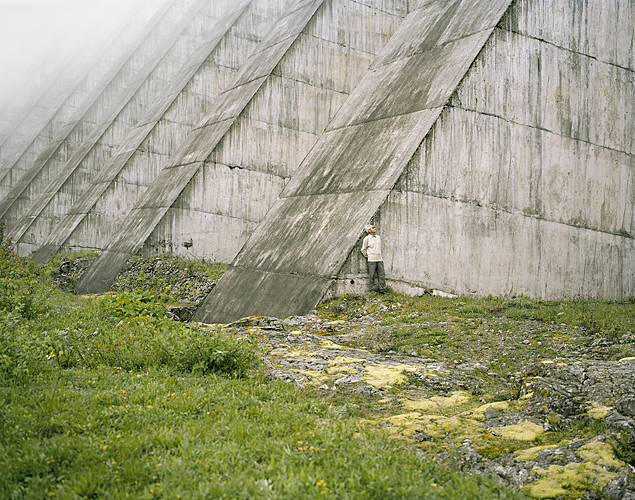
I came across Celina Clanet’s work in Jesse Alexander’s book Perspectives on Place. This project looks at dams in the French Alps, and men connected with them. This intimate connection between place and self drew my attention, as has Clanet’s beautiful images, with their clear, warm palette and careful composition that rarely strays far from the picturesque and the sublime. That’s certainly the case here – the deft use of mist and the receding diagonals of the dam are answered in the line of moss in the lower right hand side, while the figure’s gaze up draws out gaze up too – to take in the vastness of concrete out of frame but presumably above.

It’s this inclusion of people within the landscape, and the way they’re included, that disrupts her work from being simply attractive. The men are generally, as here, diminutive, and neither large enough to be portraits, nor active enough to be documentary. To an extent, they become symbols of the smallness of the men in comparison to the things they make or manage, and thus the extraordinary power of human ingenuity. This mixture of vulnerability and omnipotence is unsettling, as if mankind has alienated himself in the world he makes. It’s both celebration and criticism of the foundations of the anthropocene.