The Heaths and Me is in its very early stages, but as it in part arises from coursework on Surfaces and Strategies, it’s worth briefly discussing.
I’m interested in what places mean to people and the many ways there are for expressing meaning. I’d originally intended to meet and interview as many people as I could during this module, but the pandemic made that impossible. Instead, I thought it’d be interesting to collect people’s photos and ask them about them. It’s a fairly common strategy in sensory ethnography, a methodology that interests me greatly, and it’s also something that can easily be done remotely. I mentioned this to Kim, the site manager of the East Devon Pebblebed Heaths, and she was immediately enthusiastic. Kim has moved to her position from the National Trust, was very much involved with their Spirit of Place public engagement activities, and wants to use this approach to understand people’s relationships to the heaths to better answer their needs communicate with them.
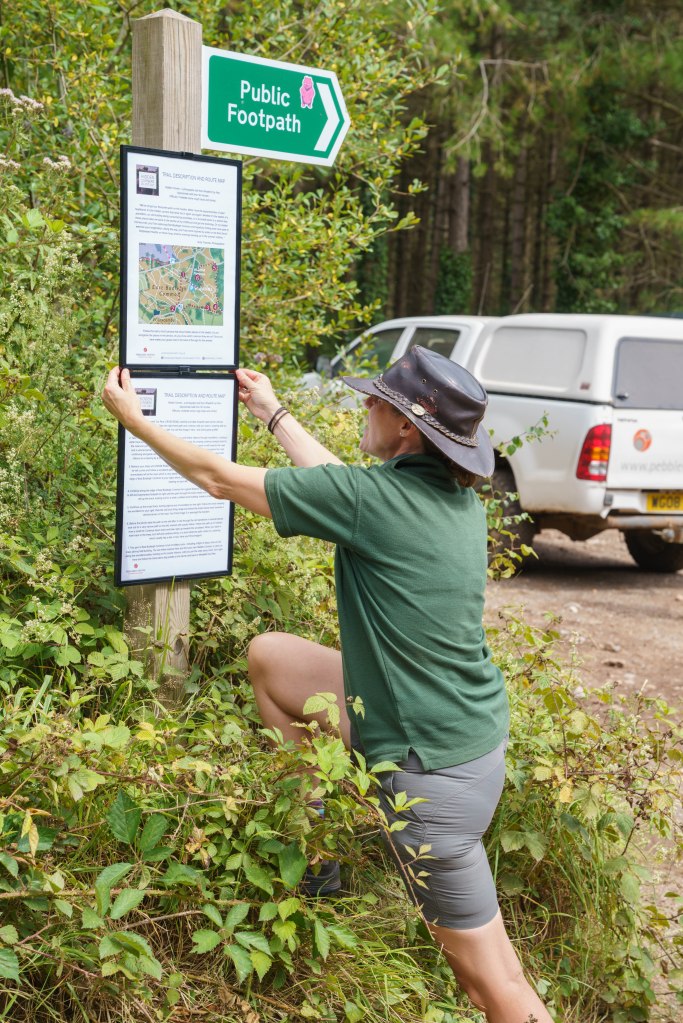
We came up with #TheHeathsAndMe, a 2-month project starting in July 2020, asking for people to share images through social media and email, not just pretty images but images that communicate how they feel about the heaths, or what they mean to them. A series of weekly challenges are being posted online and on signage around the heaths themselves. The response has been modest so far, but I imagine we’ll find some good material once the two months is up.
It’s my plan to pick the images I feel communicate the most – that have what Barthes describes as a punctum – regardless of their level of technical proficiency. That’s not to disregard pictures that are simply pretty – obviously that’s a completely valid expression of meaning. Just that I feel there needs to be something additional in the image. I’ll then interview the photographers and take a photo of my own in response – most likely I’ll visit the spot and photograph the spot where they stood, either down at the ground, or framing the shot ‘as if’ they were in it. The two images and a salient quote will form a single piece and a series of these will be exhibited when the heaths are launched – hopefully – as a National Nature Reserve next year.
So, wrapped up in a single project, we have rephotography, presentation, appropriation and participation. Watch this space.
There can surely be nothing further removed from exhibiting in a ‘white cube’ than picking up a dog poo bag from one’s exhibition space before 8am, hoping not to hit the Friday changeover traffic at the M5 junction on the way back home.
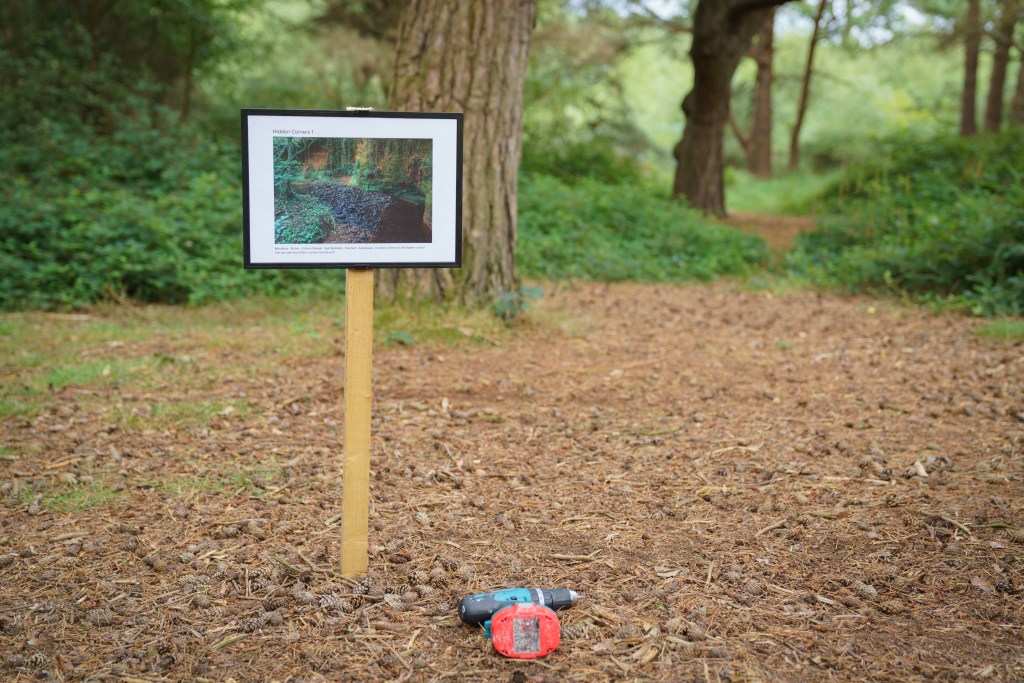
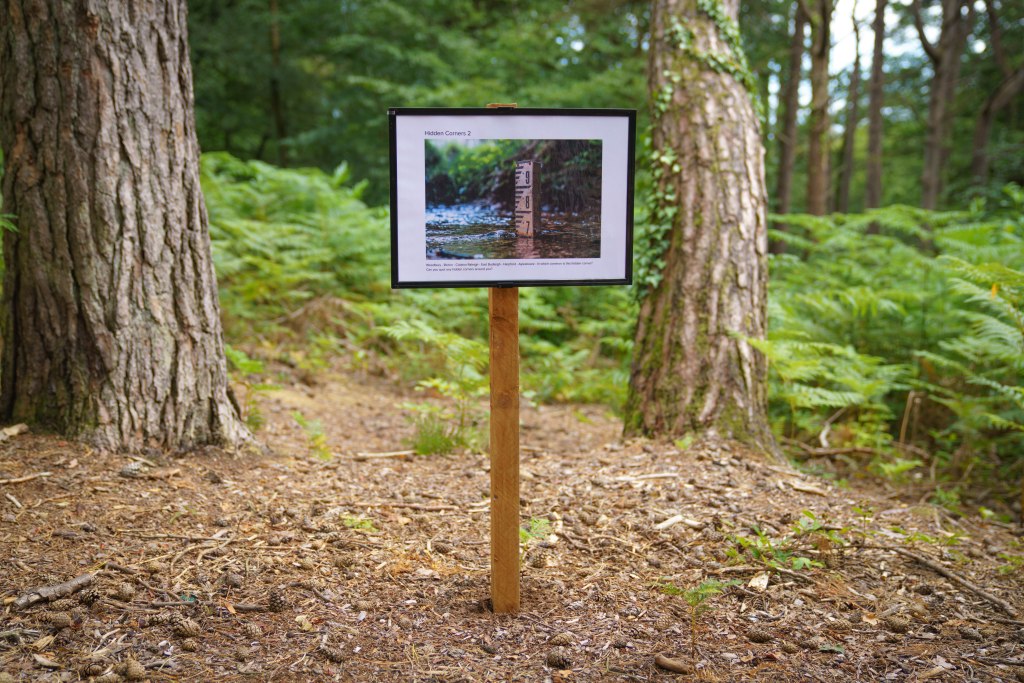
I’ve been delighted with how my first exhibition, Hidden Corners, has gone. It was amazing luck that Pebblebed Heaths Conservation Trust’s annual heath week – which coincides with the heather being at its peak – also coincided with Falmouth Flexible’s Landings 2020. Unfortunately, I’ve been too busy with the exhibition, family and work at Devon Wildlife Trust to involve myself much with Landings, which is a shame. But I do feel lucky that I’ve been able to put on a physical exhibition in this very strange year. I also feel really lucky that Kim and Kate at PHCT have been so enthusiastic and helpful.
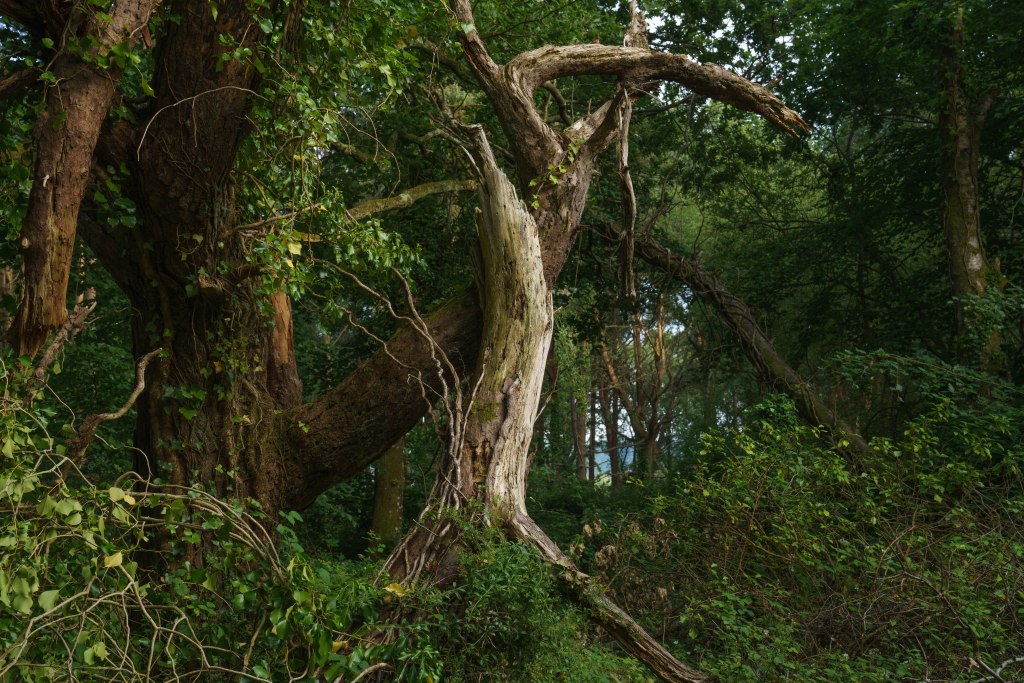
To recap: a discovery over recent months is that it’s the hidden corners of places that really draw me – places that are a bit overlooked, neglected, a bit sinister, but also full of vitality. They’re places to dream about, prompts for the imagination, and I’ve worked with them in various media time and again. The fascination stems from the books of my childhood and has continued on through my love of horror films. This fascination is not informed by photography, and interestingly, it was brought to my attention as much by my daughter’s imaginative preferences for our choices of family walks.
With my exhibition, I didn’t want to tell people what kind of relationship to have with the images; rather, I wanted them to enter into the process which brought them about. This was in part a result of a conversation with Jesse Alexander early on in the exhibition’s development; he’d mentioned he thought it a bit pointless having pictures of the place where you were already standing, and I agree – doing so would be an arrogant statement that the artist’s vision of a place is implicitly superior to that of the ‘mere’ visitor. I’d been to a photography trail in Fingle Woods on Dartmoor some years ago where huge photos were hung in the trees, and this was exactly how that trail struck me.
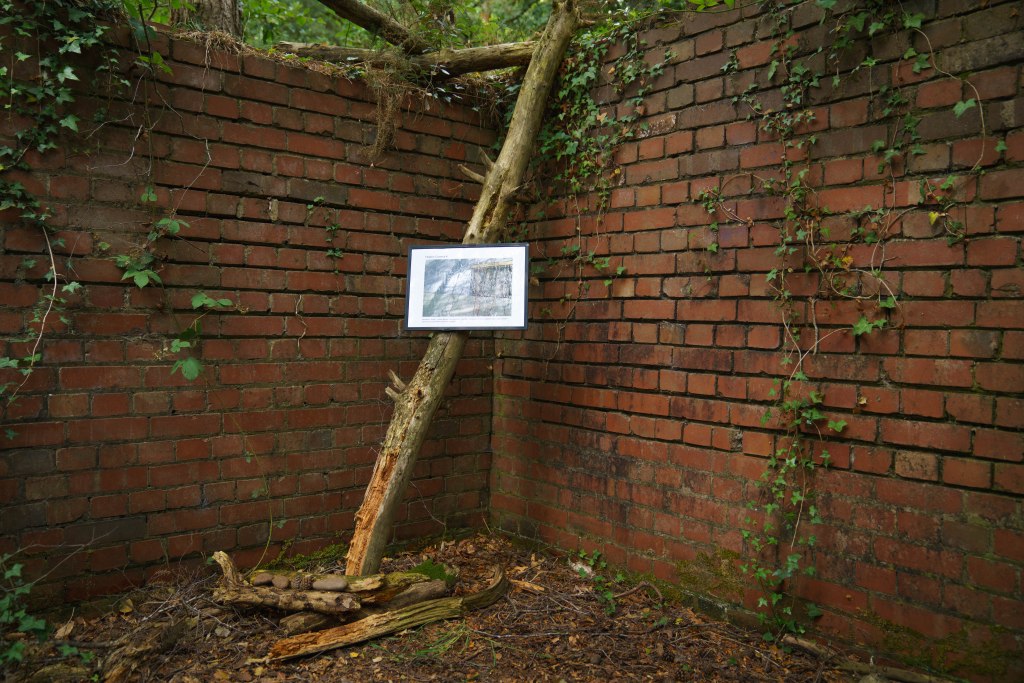
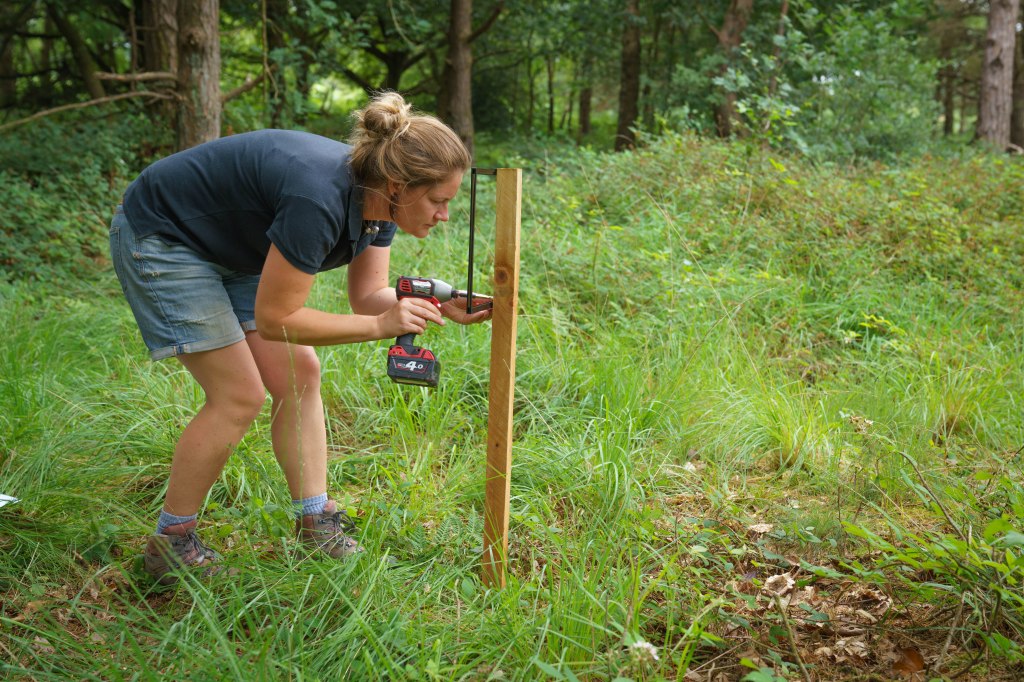
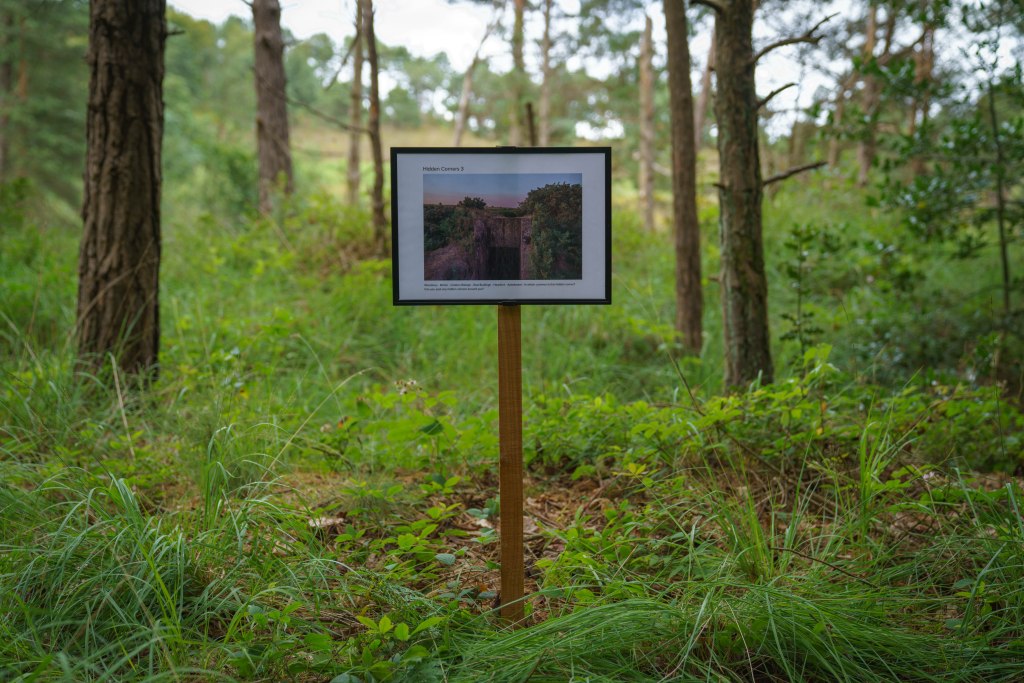
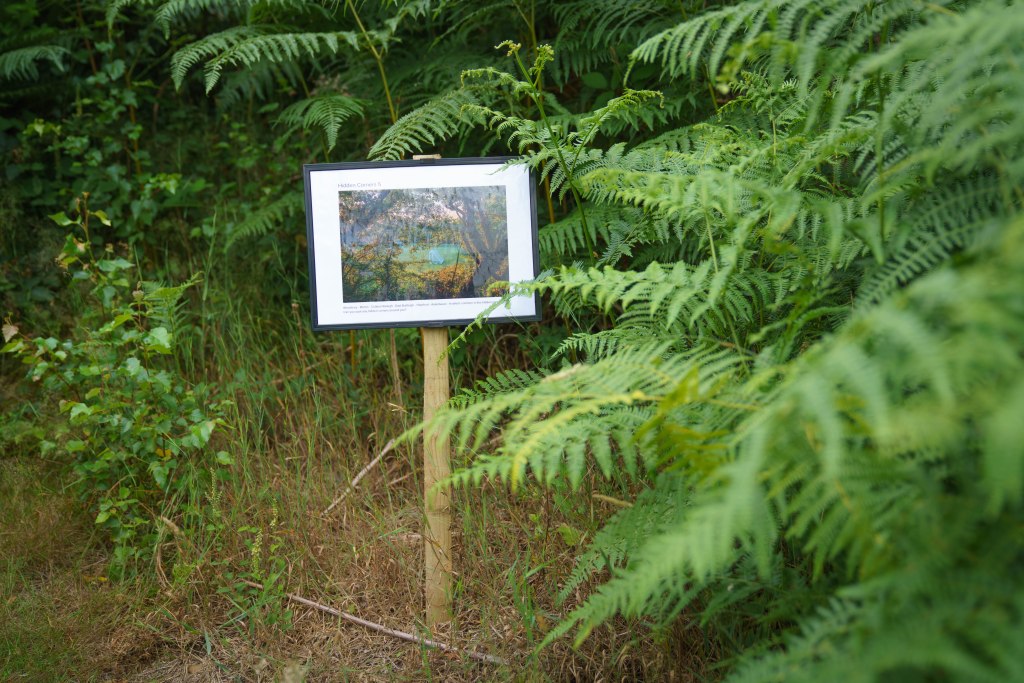
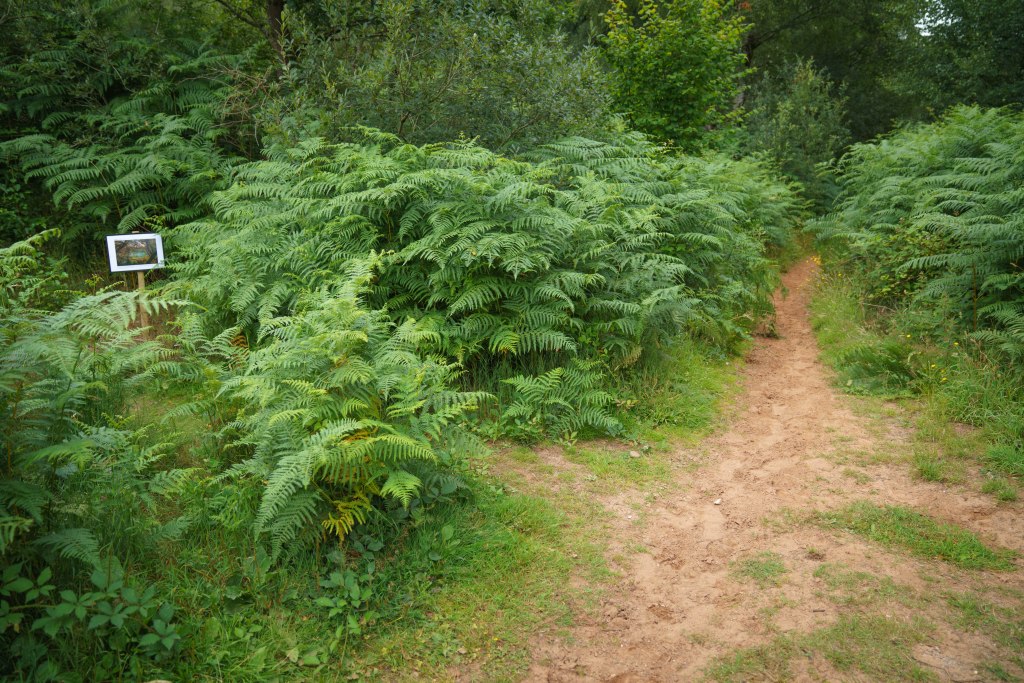
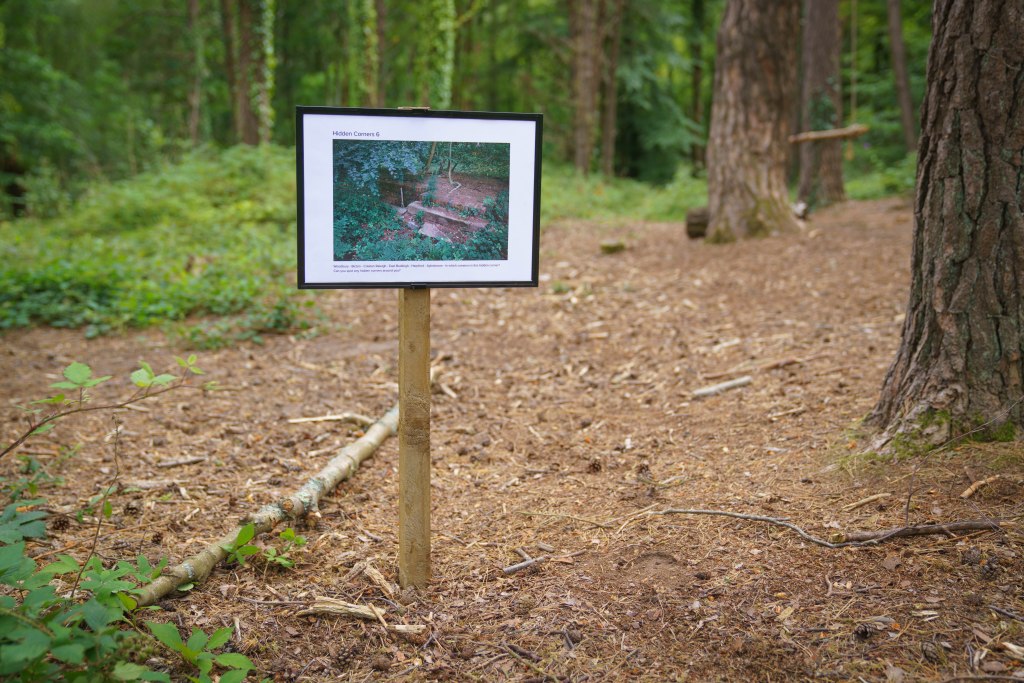
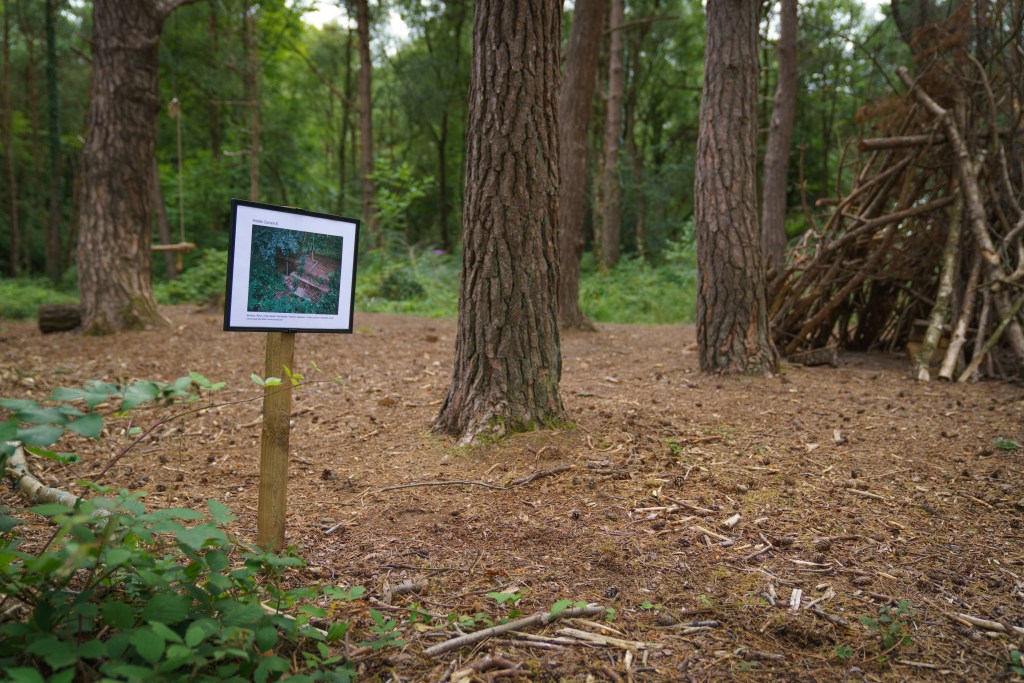
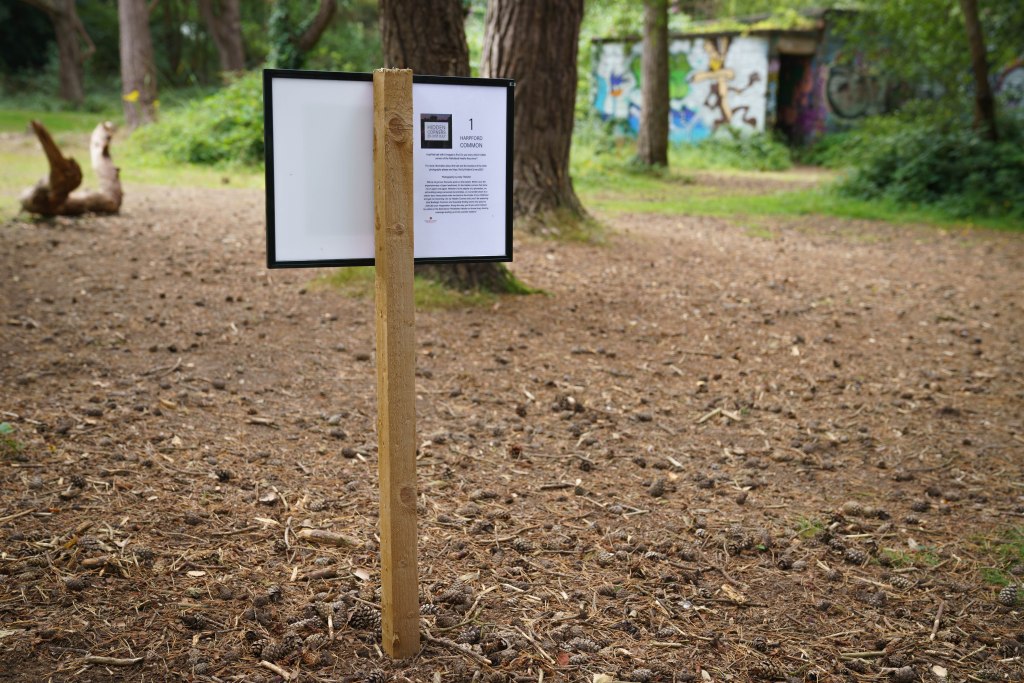
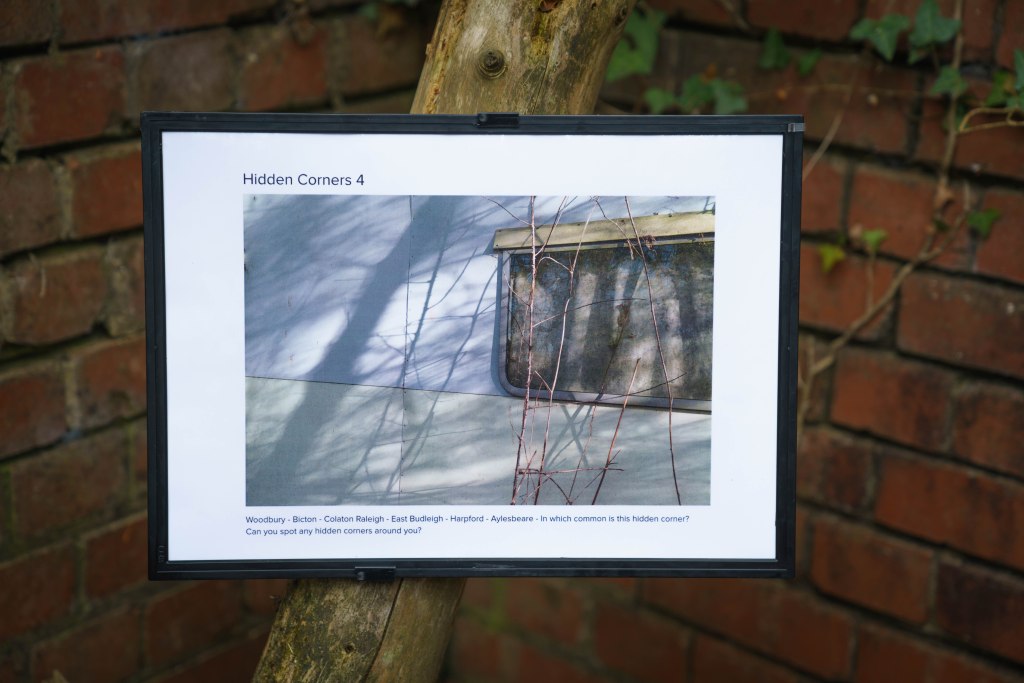
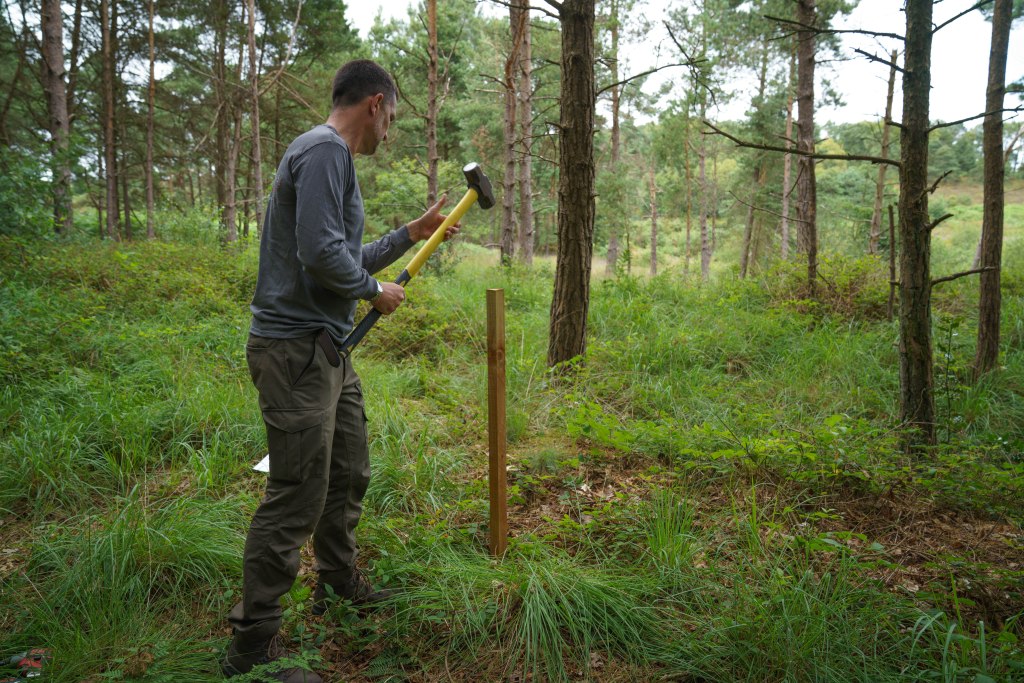
Hence, I came up with a photography trail of around 90 minutes around a lesser-known part of East Budleigh Common, taking in a few hidden corners where six laminated and framed images were planted on wooden stakes. The trail itself and the selection of sites for images are thus an expression of the same thing as the images; they have been selected and arranged in a manner not dissimilar to going on a shoot and editing images afterwards. To this extent, I guess the trail is more an installation than an exhibition. Each image invites viewers to look around for hidden corners close by, and also to guess on which of the six named commons it was taken.
There’s been some good feedback. Everyone, including Kim and Kate, ended up visiting spots they’d never been to before and, as I’d hoped, this proved to be as important to viewers as the images themselves. One respondent is now keen to visit all the spots where the images were taken – which is easier said than done in one or two cases, as it’s quite hard to describe accurately how to do so.
Having walked the trails numerous times, it became obvious that once the exhibition had entered the landscape, it took on a life of its own. First, it was clear that the images were also being encountered individually where they intersect with the habitual circuits of dog-walkers, horse-riders and young families. Doubtless, some would think it just some arty nonsense not worth bothering with, but I hope that most would be pleased to find something a bit unexpected and hopefully like the image, possibly giving them pause to think throughout the rest of their walk or ride.
Second, someone somehow got wind of the trail and put up their own numbered photo trail which in places intersects with mine. The photos are military, mainly tanks, and generally depicting desert warfare. Kim suspects she knows who this might be – a member of the public who has previously taken it upon themselves to inform others about the military use of the commons.
Third, the trail took its place amongst the events of the common. The Royal Marines have been training in exactly this corner or the commons throughout the exhibition, and this has meant that one image, close by a spot favoured for boozy campfires by local teens, has remained pristine and spotless, a series of makeshift shelters being made and remade nearby. Meanwhile another image, housed in a former military hut, was the favoured dumping ground for a particular dog walker’s filled dog-poo bags, and the same place was used to dump Costa Coffee cups (presumably the same person). This has continued throughout the exhibition.
Last, it has entangled me even deeper with the landscape than my photography ever could. Walking between my images early in the morning, blank gunfire all around me as I stride out with my litter picker, has been a slightly humbling experience. However much I might intellectualise my work – and goodness knows, I love to do this – the fact remains that it is grounded fundamentally in the materiality of existence, and is intended to communicate precisely this, even when inflected with affect. It also acknowledges the profound democracies at play on a registered common, that no single experience is more or less valid than the other, and it is for this reason I was quite delighted to come across a rival trail.
Two bits of feedback within a couple of days regarding my WIP zine saying the same thing: the questions don’t work. When that happens, I always pay attention. My intention behind the questions was, rather than tell viewers what these places meant to me, to get them to engage imaginatively with the images. I didn’t appreciate that doing so was essentially another form of dictating a response, perhaps in a way that seemed rather artificial, maybe even patronising. In fact, simply having a blank page following each grouping gives the viewer pause to reflect anyway, and the groupings are, I believe, interconnected enough to communicate a collectively shared theme. Cemre Yesil, my tutor for this module, has suggested throughout I put in a piece of writing to add context (I think ‘narrative’ may be used interchangeably with this after a fashion when it comes to photography). I’d mentioned I didn’t want to get too autobiographical, but I can now see how a viewer’s curiosity could extend to the person behind the lens come what may (mine certainly does) and so a deft bit of writing, with an accent on creative language use, could both answer that curiosity without detracting from the experience too much. I hope I’ve achieved that. Certainly, it’s made me confident enough to give the zine a title, the same as my exhibition trail: Hidden Corners.
Colaton Raleigh Common, May 2020, Andy Thatcher
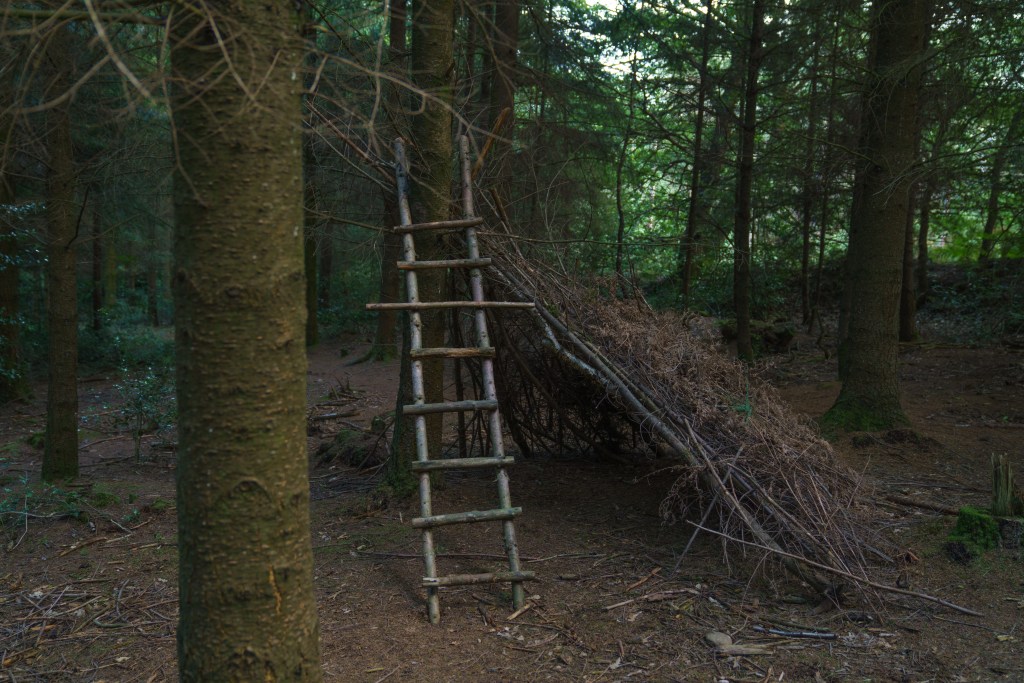
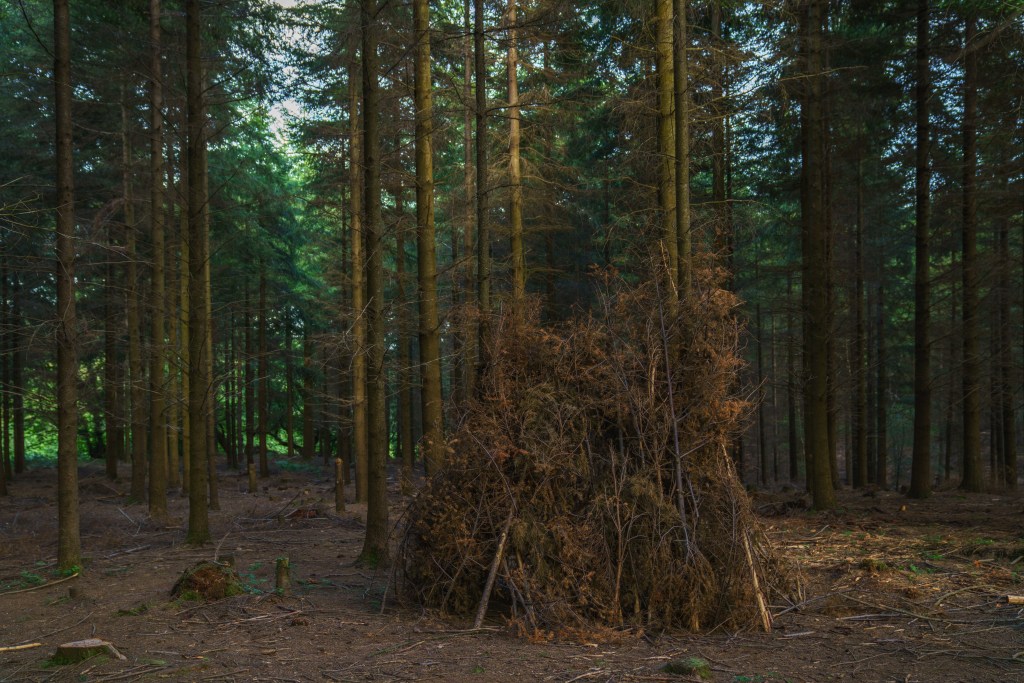
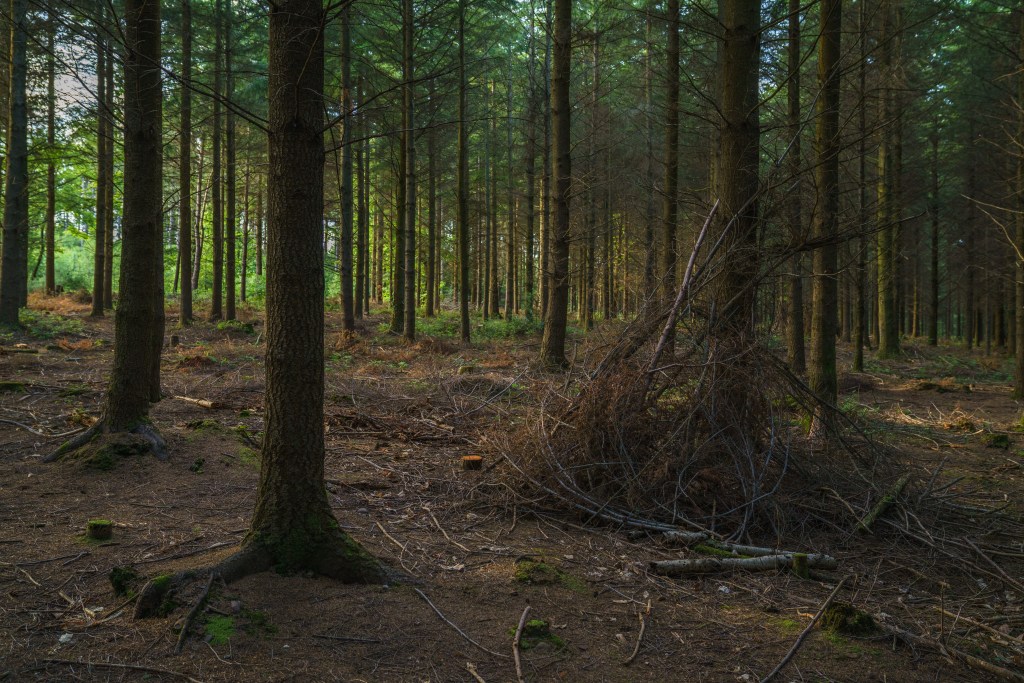
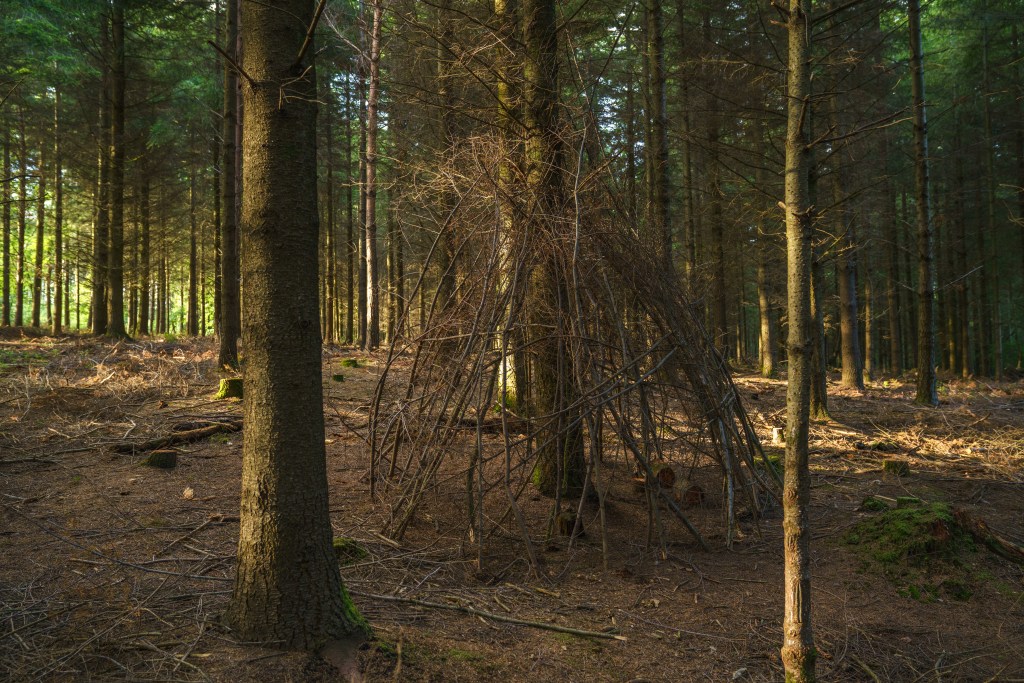
Cemre had also queried a group of images I’d used – the ‘traces’ – and I can see that without explanatory text it might seem that I’d contrived these. Besides, the group of close-ups were more to add interest and texture and were intended as imaginatively stimulating; without the questions, they didn’t fit in, and this has allowed me to put in three of the dens images I’d enjoyed and others had responded to enthusiastically.
Uphams Plantation, June 2020, Andy Thatcher
Cemre had also queried two other images put in to support the intended imaginative stimulation and let the collection appear deliberately open-ended. These have now been replaced with, I believe, superior images that provide more of a sense of completion.
I’m interested in people’s connection with places and the meanings places come to have. Through preventing me from restlessly visiting commons around Southern England, as for many of us, the 2020 pandemic has enforced a more subjective, introspective attitude towards the same subject. There came a point of realisation in May, when I was stumbling through mud and brambles in a neglected corner of Colaton Raleigh Common. I realised at this moment that I wasn’t blindly exploring, open to everything and to happenstance, but actively looking for a specific type of experience. I realised, suddenly, that at 47 I was doing exactly the same thing I’d been doing throughout my life – since childhood, in fact.
My more recent background is in writing fiction and filmmaking, and the kind of writing and filmmaking that’s always been most important to me is the weird and the eerie, as I’ve mentioned previously. There’s a psychological explanation for this, as I’ve also recently mentioned, linked to a very lonely and unhappy childhood and a no less easy adult life full of a repeating cycle of hope and disappointment which has led to a lifelong battle with dysthymia. My attraction to weird and eerie places is that such places more accurately reflect my inner states and, through my then being able to externalise them, I can find solace and approach them creatively, rather than trying to suppress or battle them.
It would, however, be foolish to reduce this interest entirely to my unhappiness. Such books and films are enormously popular and not everyone who loves them suffers depressive moods; in fact, many of their creators are full of joy and vitality, living lives full of event and people. And so in creating a zine from images of these places, I needed to decide whether to make the work introspective or more outward looking. As I don’t think my life, personal history or my character are of much interest, or at least as I’m insufficiently interested in them to make them the focus of my work, I decided it would be better to use the images as a started point to look beyond the circumstances that brought them about.
My daughter is, like me, someone driven by their imagination. She’s also drawn to the weird and the eerie – has, in fact, elected to read Mark Fisher’s The Weird and The Eerie over the summer. Though she’s had her ups and downs, they’ve not been more than one would expect for a sensitive child at a difficult time. Ruby is, like me, drawn to unsettling places, which she then fashions into artwork, teasing out stories, characters and moods.
I have likewise, over the years, had similar responses to places and these have appeared from time to time in my work. Initially, I’d thought to create a fictional narrative from the twilight images shot in May and June of this year, drawing on horror, dystopian sci-fi, disaster movies, and folk fantasy. I quickly felt uncomfortable in doing so; this was too contrived a response to the actual places, too abstracted from the lived experience of being there, smelling the damp, noticing the commons enclosures. It felt too removed from my more general interests in place and in commons in particular. It felt like a betrayal of my attention to and concern for context.
Instead, I wanted to communicate not what I was thinking, nor even really what I was feeling, being in the diminishing light in these strange places, but to somehow provide an experience for the viewer, such that a viewer might have their own experience of the place. This is something I’ve encountered in photobooks: I’m yet again going to mention John Gossage’s The Pond, but also W.P. Eckersley’s Dark City. It’s more common, however, for a photographer to curate the experience of place in some way, and there’s nothing whatsoever wrong with doing so: Joel Sternfeld’s Rome After Rome, for example. But with this particular engagement I’ve had with place, what I’ve found most interesting, and what I’ve particularly wanted to communicate is the uncertainty, the liminality, and the imaginative potential of the commons’ hidden corners. By either interrogating the autobiographical and psychological impulses which have drawn me to them, or imaginatively developing the images in the form of a narrative or world-building logic, I would be closing down that potential for the viewer and thus be unable to communicate it.
Instead, while there has been imaginative engagement in the WIP – the idea of unwittingly entering a parallel world draws on works like The Lion, the Witch and the Wardrobe or more recently numerous episodes of Black Mirror – the engagement is left unfinished, inviting completion by the viewer through asking questions rather than making statements. This inclusive engagement was something I began exploring in my Ruscha task at the start of this module, and was why the zine didn’t have a title or an explanation. Likewise, my Hidden Corners exhibition asks questions of its viewers, inviting them to seek out their own engagements with the places in which the images are found.
This is all a very, very different approach to the one I’d been taking up until this module. To some extent, it draws on previous film work, but is far more deliberately obscured in terms of meaning. Whether or not it’s an approach which will have a life beyond this module is difficult to say. However, in terms of exploring and communicating my own attachment to place, it’s been a novel, crucial and necessary step: how else could I possibly begin to examine and represent the attachments of others to place if I hadn’t put in considerable work to doing so?
The idea of narrative or story across the arts is one I’ve found increasingly overblown. This is perhaps surprising given that my earlier creative work was in writing short and long fiction for adults and children. When it comes to these explicitly narrative forms, and that includes film and graphic fiction, I’m very much a signed-up believer in the persistence of classic myth arcs, whether it’s The Tiger Who Came to Tea or Mrs. Dalloway, the work of Junji Ito or Jacques Tati. There are situations where I’m looking for and expecting to be told a story, and when I don’t get one, or the one I get is deficient in some way, it can be infuriating. However, there are numerous artistic encounters where I’m not expecting this. It’s not always at the forefront of my mind in an exhibition, nor when watching a documentary, and it certainly isn’t at the forefront of my mind when I pick up a photobook or a zine.
That’s not to say that narrative shouldn’t be incorporated. Mark Leckey’s 2019 retrospective exhibition O Magic Power of Bleakness blended immersive installation with theatre, folk myth and film. Documentary has long since powerfully drawn on fictional strategies to articulate complex ideas or drive home messages, from conventional works such as Morgan Spurlock’s Supersize Me to experimental ones such as Patrick Keiler’s Robinson in Ruins. John Gossage’s The Pond is perhaps my favourite photobook, and it teases the viewer as it takes them around a nondescript landscape. Jack Latham’s Sugar Paper Theories deftly takes the viewer through the labyrinthine story of a failed criminal prosecution.
But it seems to me there’s an overemphasis on narrative across the arts – and beyond, to PR and advertising – that’s been there for some considerable time. I think this is limiting, and I can equally point to favourite works to which narrative is irrelevant: Richard Misrach’s Desert Cantos, Simone Nieweg’s Landscapes and Gardens. The images of Gregory Crewdson’s Twilight might hint at narratives, but the book, from my own responses, is arranged for affect rather than logic.
It should be noted that in the case of Gossage and Latham, the works follow readymade narratives – a journey, a criminal case. There is a logical reason for adopting these. Of course, it could be that to the more tutored eye, narratives do emerge, to which I would argue that in such a case, they are of significantly lesser importance than those who created them or identify them might realise.
As I’m intending on creating a zine for my work in progress portfolio, I’ve been acquiring and evaluating a number which explore space in some way. The relationship between space and narrative is complex: narratives assume beginnings, crises and endings, whereas space is without such events. Exporting human narratives onto explorations of space would be to anthropomorphise it. Additionally, to impose narrative on space is to tidy it and simplify it. Space is complex and, especially when dealing with a maximum of 16 images, to impose narrative would be reductive. And, last, it is to curate it: what I intend, as with my film work, is to give viewers the possibility of their own experience of the space being represented.
It’s interesting just how few of the zines I’ve looked at have explicit narratives. The most overtly narrative is Nils Karlson’s Iceland, which takes the viewer from remote mountain to farmstead, town and to the ocean, also making use of the changing of seasons. In River to River, Stephen McCoy takes the viewer between the rivers Mersey and Douglas, with scant attention to continuity of light or season. But that’s it. Marc Vallee’s Down and Up in Paris is a visceral immersion in tagging that riffs on repetition and ubiquity, in keeping with its subject. Kyle McDougall constructs mini-journeys within snowbird around sites, but groups these together thematically, interspersing with diptychs chosen for their thematic or aesthetic relationships. Likewise, Alexis Maryon occasionally groups images thematically across several pages in Port of Newhaven, but there does not appear to be any narrative logic behind their arrangement, but rather a deft manipulation of affect, a progression that is more akin to music. Francesca deLuca’s extraordinary Cyan Sands begins with a logic of aesthetic repetition and variation, but eventually takes the viewer on a journey from the high desert mountains to sandscapes. I could discern no particular logic behind Nicholas J R White’s The Militarisation of Dartmoor – which at 23 images is the shortest of the zines here – but there is a sufficient degree of interest and aesthetic care for that not to matter. Grant Archer could well have used the journey up and down the rock of Gibraltar for his two-zine set Mons Calpe, but rather takes the viewer up and down at random; this confusion could be said to be reflective of the complexity and strangeness of his subject.
So where does this leave me? Narrative is something I can draw on, is something I enjoy, but if it does not appear to match the intentions of a work, I should consider other logics of organisation for my work. These could be the logic of artefact and repetition, of theme, of aesthetics, or of affect, or a combination of these. As I turn to make sense of the odd series of images I made at the end of June and which will form my portfolio, it is these I will be considering. Not narrative.
This week’s task has been a bit perplexing. Being asked to think outside the box about exhibitions when you don’t know anything about exhibitions requires less of a leap of the imagination for me than putting one on in a ‘white box’ would have needed. Actually, one of the reasons I’m studying at Falmouth is to learn more about such things, and I very much hope that at some point someone will pass on their knowledge about this.
What’s been useful in considering all this is helping consolidate how I see myself as a photographer – and an arts practitioner generally. I don’t come from a fine art background. I don’t have fine art friends. I didn’t study fine art or photography. I don’t work in either. So it’s probably unsurprising that I struggle to see my work ever being put on those hallowed white walls. I can’t see the circumstances which would lead up to it. I can’t see my work fitting in. And I have to say in many ways the hallowed hush of the white box feels to me somewhat exclusive, alien, and just a teensy bit pretentious if a work fails to live up to all that such reverence implies.
Many of my favourite contemporary artists create work outside the gallery. Andy Goldsworthy is one, Keith Haring is another, Grayson Petty yet another. I bounced on Jeremy Deller’s inflatable Stonehenge in my local park, and I was a part of Anthony Gormley’s One and Other, reading childrens’ fiction from the Fourth Plinth of Trafalgar Square. I like these artists because they work with rather than against the general public, and understand that for art to be broadly accessible means neither dumbing down nor preaching nor belittling. And that art can also be enormous fun. The filmmaker Agnes Varda is a perfect example of someone who knows how to do this.
The project I’m working on with the Pebblebed Heaths Conservation Trust is all about connecting with the artwork that untrained photographers make, looking for images that communicate affect rather than technical and aesthetic accomplishment – though without excluding those that do. I’d been reticent to then extract such work and transplant it somewhere I don’t think it belongs, but also been at a loss as to where exactly to place it. Similarly, I don’t want to position my practice above anyone, and I have to say, I’ve seen work in amateur camera clubs that has more about it than some of the most revered contemporary photographers. I’ll post later about my plans for Landings, but this week has given me the opportunity to reevaluate where my work sits, because it’s given me the chance to look hard at where it doesn’t. My work belongs in the thick of things. A gap does not need to be opened up, a break does not need to be made, a translation does not need to occur. Placing my work in a white box – perhaps, also, in a costly photobook – risks doing all of these things.
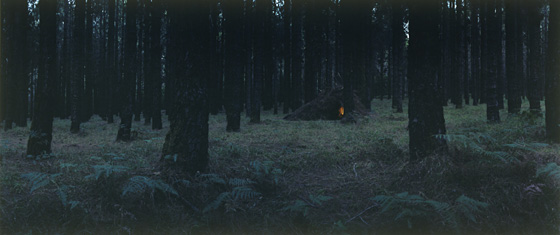
This small book is a little wonder. Despite its small size, Between Dog and Wolf (2006) provides an utterly immersive experience into the various twilights of Finland, England, Belgium and Japan. This isn’t just because Lebas’ chosen format is the panorama, nor that the images often take up their entire pages, but particularly due to Lebas’ unashamed, even brazen, embrace of black.
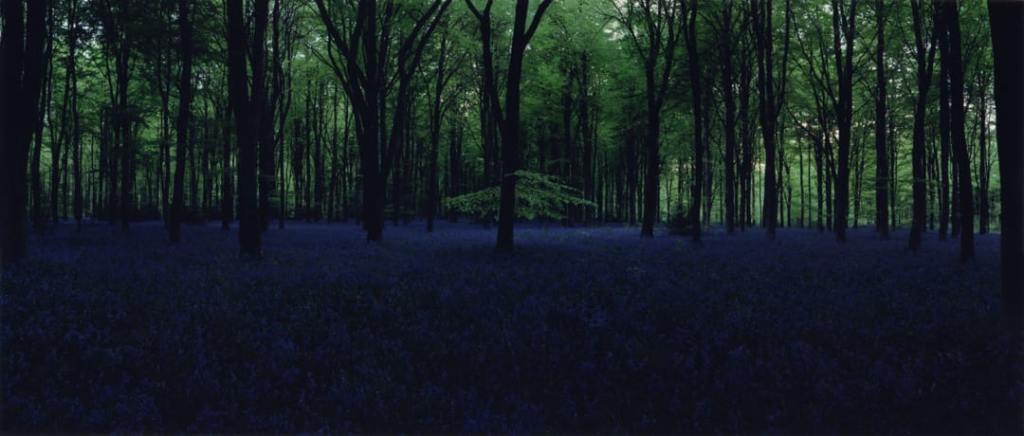
untitled #4, 2005, Chrystel Lebas
The series Blue Hour, included here, lingers in the same bluebell glade until only a few unidentifiable dots of colour break up the final shot. The viewer is made to strain, made to work, just as when faced with dying light. The known becomes abstract and slightly unsettling, the complexities of woodland reduced to vague structures.
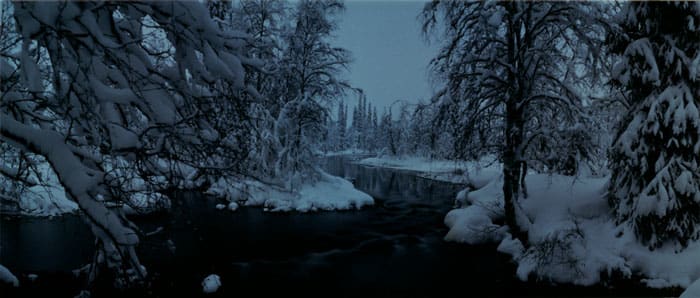
untitled #9, 2005, Chrystel Lebas
Even where the trees’ shapes are more defined – as with the snow series Between Dog and Wolf (a French term for twilight) – the presence of large dark patches, or dark borders, implies an encroaching darkness. Lebas leaves much of the perception of this work to the viewer’s imagination, a perfect analogy of twilight’s cultural heritage.
untitled #1, 2003, Chrystel Lebas
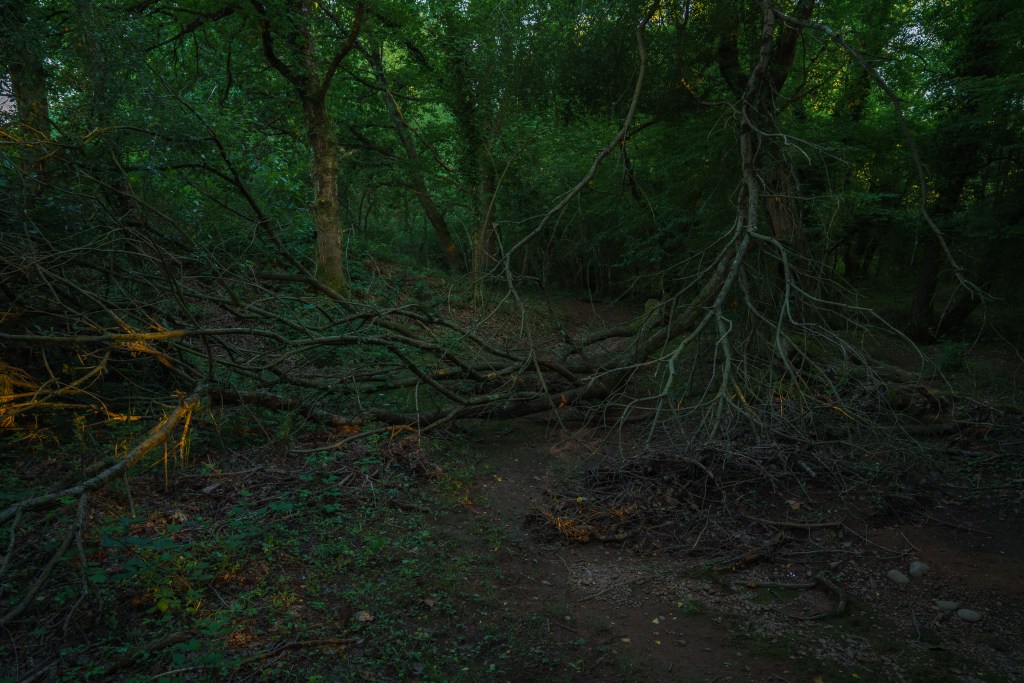
I have much to learn here. Digital photography permits an almost forensic analysis of light, details in the shadows unavailable to the naked eye unveiled through Lightroom. I often find this an irresistible temptation: to lift the leaves, bark and pebbles from obscurity is an act of discovery with a certain amount of childish delight attached to it. However, doing so does not necessarily make for images that communicate affect as effectively as Lebas fuzzy edges and jet black patches, and it’s affect that interests me the most – at least at present – working as I am with the end of the day. Just because my camera has recorded detail in the shadows should not dictate that I reveal it. I am already beginning to darken some images, plunging details back into obscurity and leaving sections of the images featureless for the viewer to make their own mind up about.
Harpford Common, 2020, Andy Thatcher
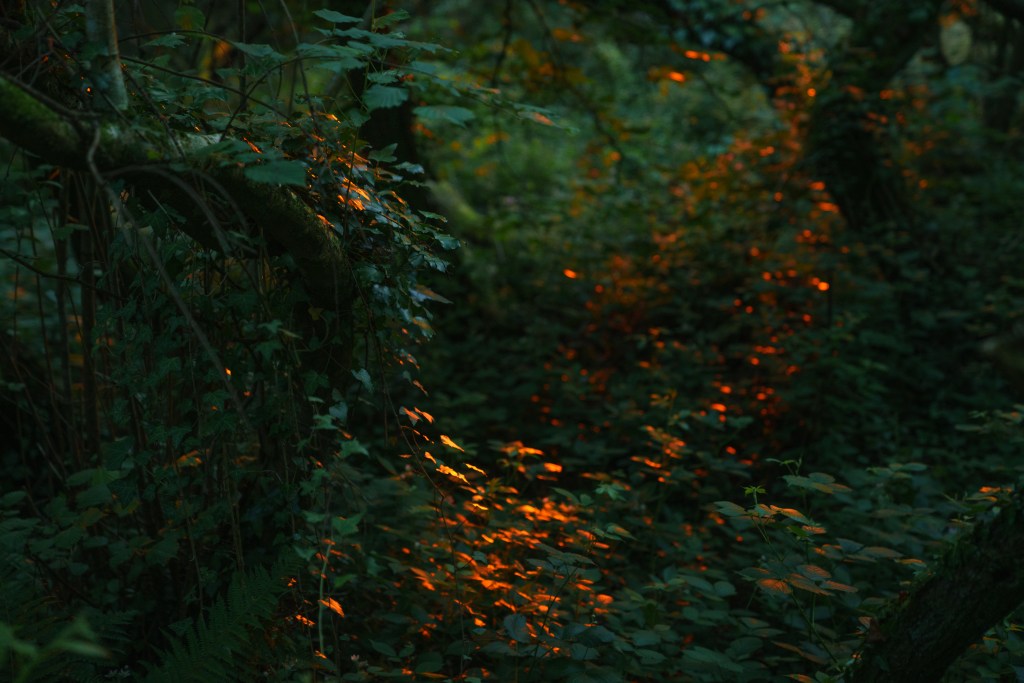
It’s also worth mentioning that I find high summer a difficult time for me to photograph. I’m drawn to geometric structures and the profusion of dark texture makes branches, paths, and streams complex and dense. Through plunging them back into darkness, the forms, paradoxically, begin to emerge once more, while new shapes emerge in the diminished points of light which have struggled through the foliage.
Woodbury Common, 2020, Andy Thatcher
Lebas, C. 2006. Between Dog and Wolf. London: Azure Publishing.
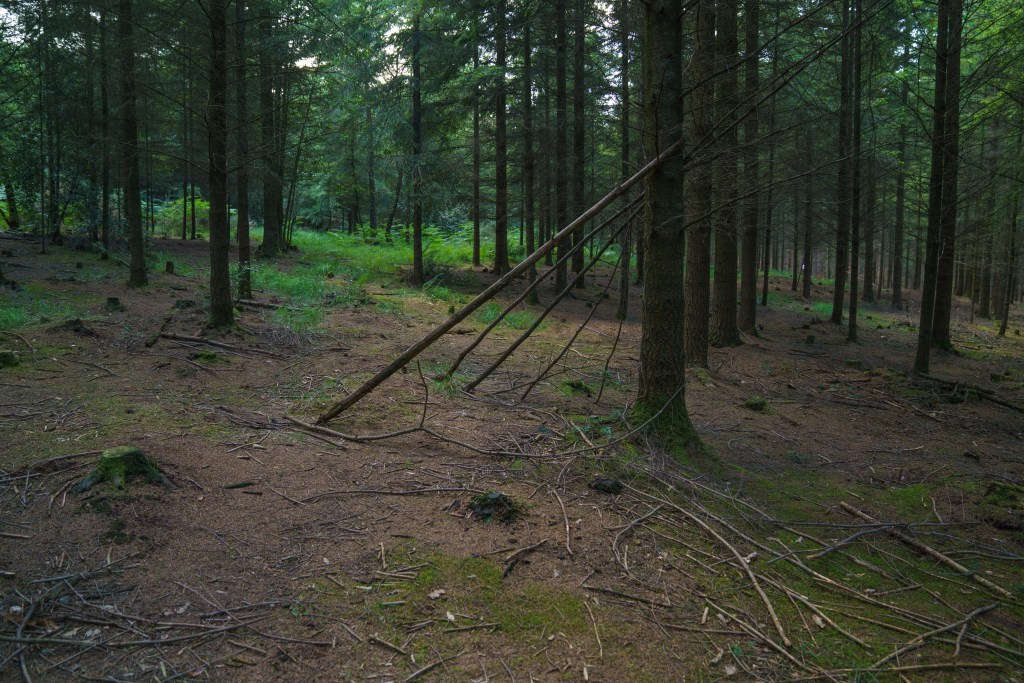
Geographer Yi-Fu Tuan’s writing has resonated across disciplines and his term topophilia, or love of place, has entered into relatively common parlance. Like other geographers I’m interested in, Tuan’s focus is on place and on space (1977). I’ve been incorporating Doreen Massey’s (2005) work in this field in considering my own practice for some time, but I’m new to Tuan. Their analysis is markedly different, though not, I believe, contradictory. Both are useful and valid perspectives from which to consider these elusive terms.
Uphams Plantation, 2020, Andy Thatcher
One key differences is, to my mind, that while Massey sees place-making as being a collective, social activity in which an individual involves themselves, for Tuan, place-making is a more individualistic, willed process of cognitive configuration in response to need and intention. For Massy, place acts upon us and we become entangled in it, our actions shaping the place not just for ourselves but for others; it is an interactive, social process. For Tuan, place is primarily constituted by the individual – the resident, the architect, artist, the scientist – through specific forms of gaze, enclosure and categorisation. Massey does acknowledge this as a part of place-making, but argues that it sets up conflict and a tendency towards enforcing stasis on place, as seen with conservationists, heritage organisations at one end of the scale and extreme nationalists at the other. Using this more individualistic model, Tuan is thus able to interrogate why place-making is a fundamental form of human conceptionalisation, arguing that doing so provides physical and emotional stability and calm, as well as a means of practical comparison between places.
Uphams Plantation, 2020, Andy Thatcher
Space, on the other hand, is abstract, threatening, unformed, that to which we respond fearfully when we find ourselves lost; place, in essence, is tamed space. Space is movement; place is stasis. Massey, however, argues that the movement of space is unstoppable, and place is simply a combining and exclusion of different trajectories which constitute space.
Uphams Plantation, 2020, Andy Thatcher
The timing of reading Tuan’s work is fortuitous, as I’m focussing on a more determinedly subjective response to the Pebblebed Heaths during this module, in preparation for exploring the subjective responses of others. Previously, I had let myself be open to and informed by the Heaths, when photographing, in social encounters, and through research. Now, however, I’m more interested in my own responses and, particularly, how I am constituting places and choosing places according to my own needs. I have mentioned previously my turn to the melancholy, but I believe the environments I seek out also provide psychological benefits; there is something reassuring in being enclosed by trees in some of the dense woodland, just as the emptiness of the plantations at the end of the day provides not just solitude but a privacy not possible on the heaths. I am aware of such places as being pre-made as such – enclosure banks, naming on maps, the prevalence of dens and trail adaptations – but I am also drawing on this material to constitute the place for myself, after my own fashion.
Uphams Plantation, 2020, Andy Thatcher
What constitutes Uphams Plantation, for instance, as ‘place’ is quite different for me as for the mountain biker, the forester, the young family, the conservationist. Indeed, I’m increasingly finding myself subdividing the placeof the heaths in smaller and smaller places, with affect being the foundation of these. I suspect those groups previously mentioned will also be doing so, but for the mountain-biker, the trail is a place, for the conservationist, so is the Dartford Warbler habitat; Tilley and Cameron-Daum’s anthropological study of the heaths (2017) included map-making from different users, from model aircraft flyers to Marines, demonstrates the diversity of such placemaking, even amongst the same user groups.
Uphams Plantation, 2020, Andy Thatcher
As the heaths’ role in my personal life has been its support for my mental wellbeing – it was the place I knew I must visit first when recovering from nervous exhaustion – it makes sense that my own map, constituted by placemaking according to my own needs, should be the focus of a more subjective engagement with this considerable and varied tract of land. Conversely, it also helps account for the difficulty I have in capturing affect in areas to which I find it less easy to develop intimacy.
Massey, D. 2005. For Space. London: SAGE Publications.
Tilley, C., & Cameron-Daum, K. 2017. An Anthropology of Landscape. London: UCL Press.
Tuan, Y. 1977. Space and Place: The Perspective of Experience. Minneapolis: University of Minnesota Press.
I’ve been a fan of Rebecca Solnit since reading Wanderlust (2014) a few years back and find her an uncompromising but compassionate and balanced voice on social media. It’s been great discovering that same voice applied to visual arts – the roots of her critical engagement – and photography; I’ve discussed elsewhere her excellent collaboration with Klett and Wolfe, Drowned River (2018). As Eve Said to the Serpent (2003) is a collection of essays and three have proven especially useful in developing – and challenging – my thinking.
At its core, Elements of a New Landscape is a critique of Plato’s cave which proposes alternatives. This foundational metaphor has never sat right with me, and Solnit problematises it as a highly gendered metaphor: a move from womblike irrationalism, upward to male empiricism and separation from the earth. She argues that much recent landscape art, and landscape photography, reverses this movement, and that a return into the cave is turning back from toxic progress, demonstrated in the mounting ecological crisis. It is also an unsentimental return to connecting with the earth, a restatement of unavoidable human entanglement with natural systems – and thus also the damage meted out on them. This entanglement rejects abstraction, favouring a subjective, sensory, tangible collaboration with landscape and a close observation from within. With specific reference to photography, Solnit notes its historic emphasis on the frame’s caesura and demonstrates how through installation work and self-insertion, the viewer can become involved while keeping intact photography’s evidentiary force which, she argues, plays a crucial role in reporting on the crisis. While I’ve long viewed my practice as an embodied entanglement inside landscape, and while I’m increasingly adopting a more subjective stance in my practice, it remains conventional. I’m not – yet- ready to make the leap to self-insertion, or installation, but will let those ideas float at the back of my mind.
Unsettling the West: Contemporary Landscape Photography challenges an inherent binary in more conventional work, which distinguishes between landscape and social documentary photography, forcing a choice between aesthetics and tradition on the one hand, and political awareness and commentary on the other. Solnit does not see this is a recent turn, referring to Frank and Eggleston as documentarians of landscape, but is nevertheless one which has becoming more prominent. Speaking of Klett’s work, she points to his accommodation of both majestic “wilderness” and man’s banal but savage impact on it, without recourse to simplistic “elegies for a raped landscape” (94). This clean break between ‘virgin’ and ‘raped’ landscapes is one she returns to, arguing that the foundational work of Ansel Adams on the one hand, which deliberately strips Yosemite of human traces, is one side of the same coin as the New Topgraphic photographers’ trash-filled prairies in which human activity is dominant. This certainly resonates with my own work, as I never wish to settle on either the pristine or the ruined, but somehow incorporate both; certainly, to address conservation and the human enjoyment of non-urban areas is to weigh up precisely this.
Scapeland is an essay written to accompany Misrach’s Crimes and Splendors: The Desert Cantos of Richard Misrach (1996), which I will explore in some depth at a later date. She develops the themes of Unsettling The West with specific reference to the work of Misrach, arguing that in landscapes such as the desert is to be found precisely the complex, violently confrontation landscape that eludes the pastoral or sublime modes. Solnit specifically evaluates the role of beauty in these images, attacking a leftist rejection of beauty as unequal and elitist, no less than a right-wing belief in it as wholesome, conservative. She argues that beauty can be and is found everywhere, citing Constable’s belief that nothing is truly ugly, and that beauty is profoundly complex, suggesting fragility, transience, as well as seduction and violence. The desert, she points out, is the ideal landscape for exploring such contradictions. I am similarly troubled by but unwilling to reject, ideas of beauty, especially where beauty might permit a decontextualisation – and thus depoliticisation – of landscape. The commons are not so violent as the desert, and yet with their military traces and the evidence of often brutal landscape management, such as soil scrapes, to portray the experience of them in pastoral terms is to turn them into something they are not; finding the beautiful in a soil scrape is, however, something I have yet to achieve, though not through lack of trying. I look for an uneasy tension between beauty and political complexity in much of my work. Solnit illustrates here how it might be done by a master of his art.
Klett, M., Solnit, R., & Wolfe, B. (2018). Drowned River: the death and rebirth of Glen Canyon on the Colorado. Santa Fe: Radius Books.
Misrach, R. (1996). Crimes and Splendors: the desert cantos of Richard Misrach. Boston: Bullfinch Press.
Solnit, R. (2003). As Eve Said to the Serpent: on landscape, gender, and art. Athens, Georgia: University of Georgia Press.
Solnit, R. (2014). Wanderlust: a history of walking. London: Granta.




 out of the picture
You must be logged in to post a comment.