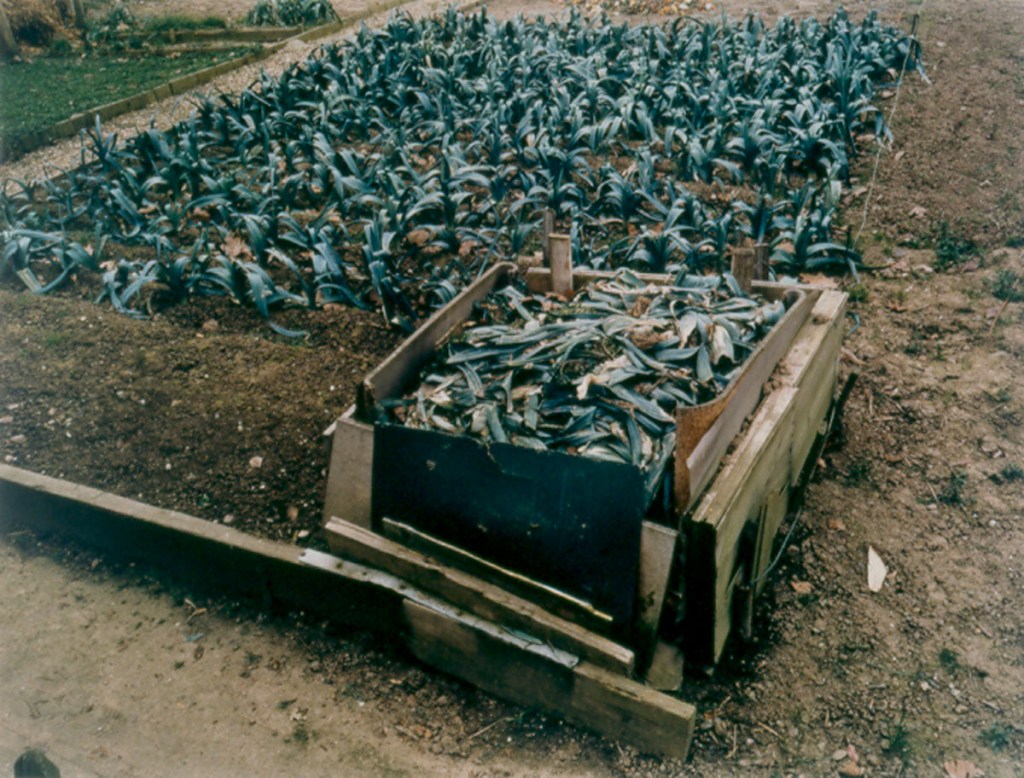
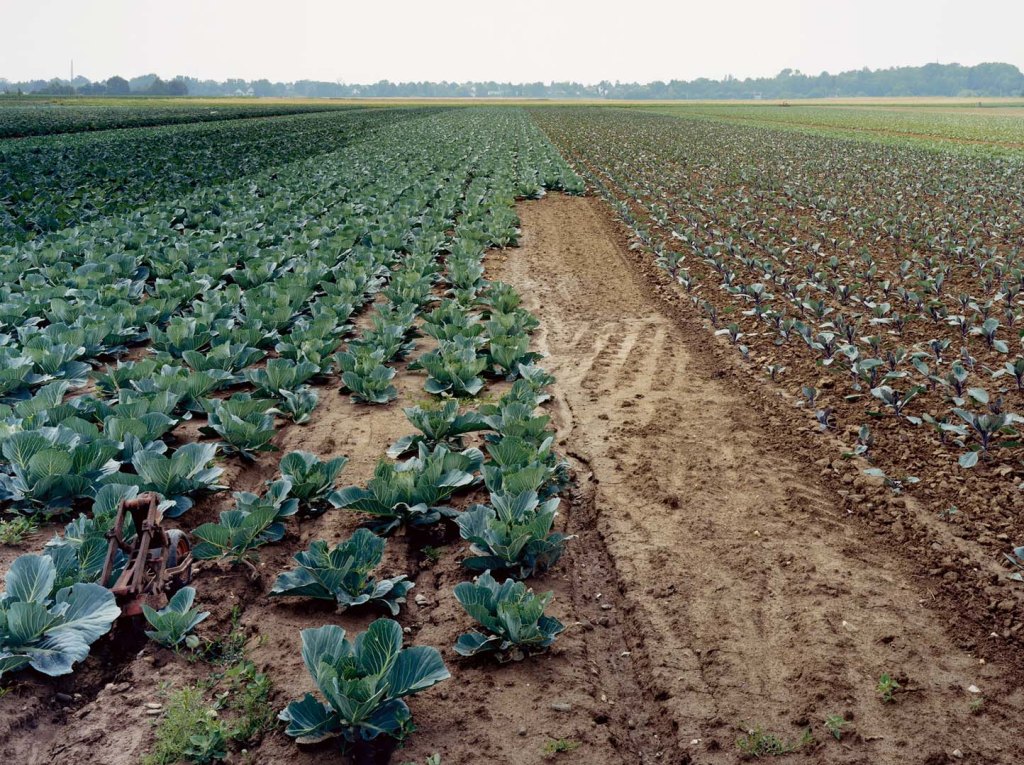
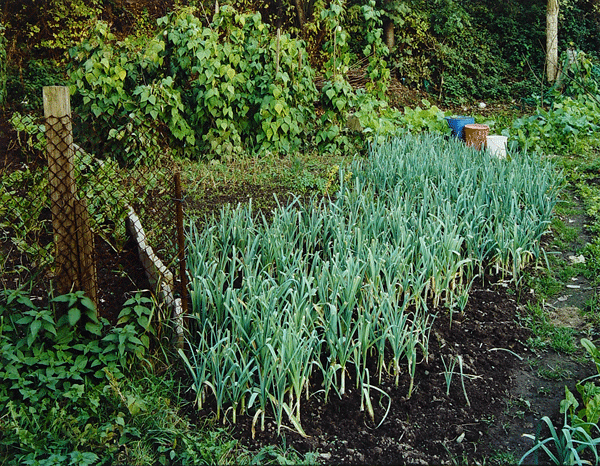
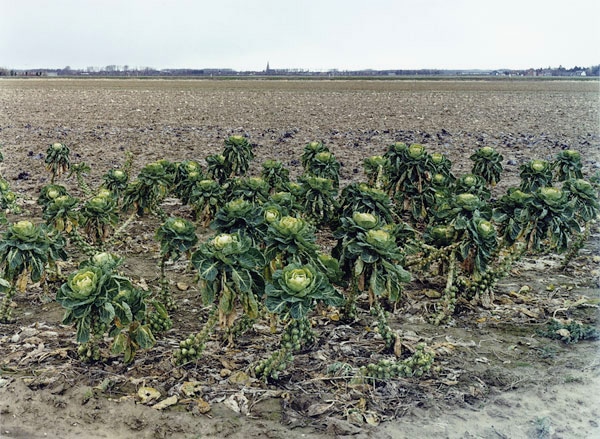
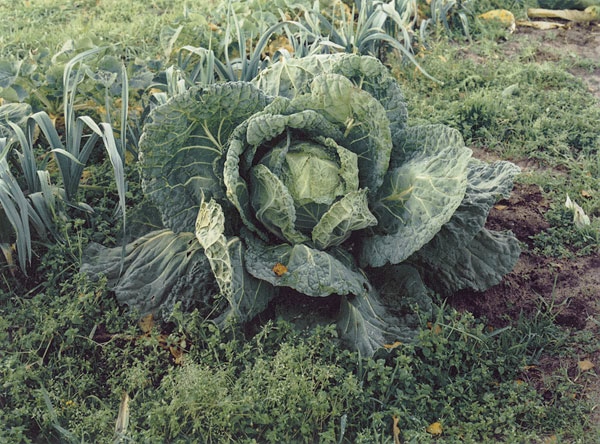
Simone Nieweg is a photographer I can really learn from. This collection, shot between 1987 and 2001, explores very specific German agricultural landscapes. That she’s a Becher student is evident in her patient recording of typologies under typically Becher-ish overcast lighting conditions. The collection, like those of the Bechers, becomes hypnotic through repetition. Endlessly unremarkable vegetable plots. Squashed horizons. Cabbages and sprouts and leeks. As with the Bechers, after a while, the repetition begins to abstract its subject, and the plots becomes geometric patterns of texture and colours – and under the light and the palette Nieweg uses, the distinctions between textures and colours is very subtle, drawing you in to look harder.
It’s an exquisitely beautiful experience, strangely reminiscent of Rothko. Nieweg has a fascination with line that I share with her, and she knows how to draw it out and assemble it from both organic and non-organic elements. Lines move this way and that, there are sharp corners and though there is often so little to look at, the eye is drawn through and around the scene no less compellingly than if this were a Hokusai.
And yet, for all this abstraction, this is neither a-political, nor does it efface photography’s documentary facility. Human intrusion into the vegetable world is shown as abrupt and all-present, as if the yellow grass and battered brassica have been beaten into submission. The industrial scale of agriculture is laid bare, squashing human habitation into distant horizons, the emptiness of most scenes suggesting people have invaded, wreaked their violence on the soil, and then retreated from the battlefield of churned up mud. This is the countryside, but it’s a man-made countryside, anything growing, doing so permissively, submissively.
That the book is so beautiful, punctuated occasionally and ecstatically with sunlight on fences or a truly glorious swede, prevents the message from being overbearing or didactic, but it’s unavoidable. It’s almost too rich to consume in one sitting.
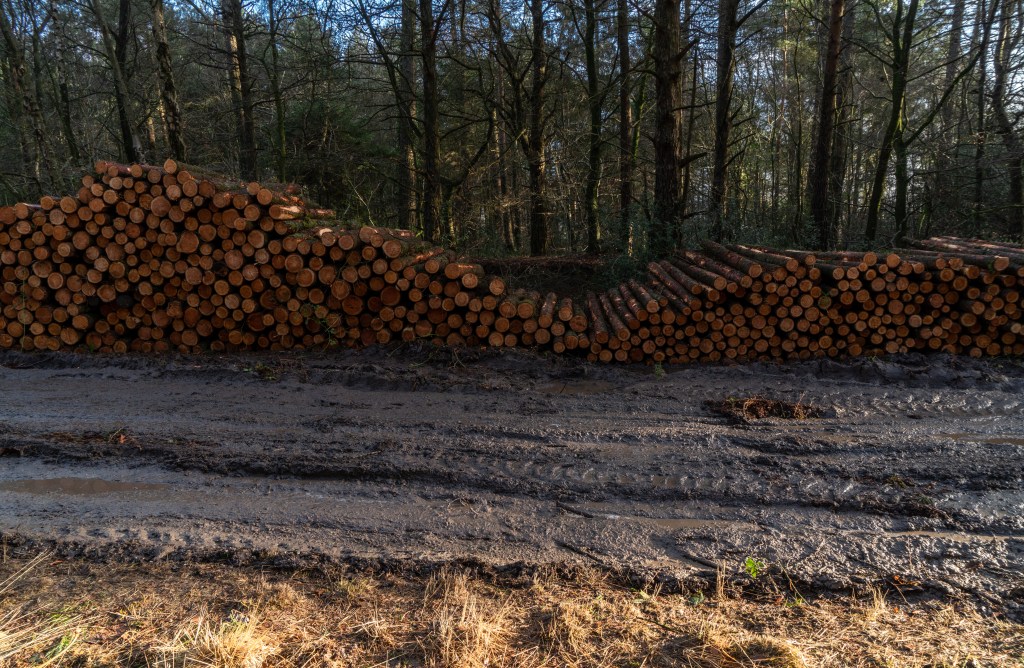
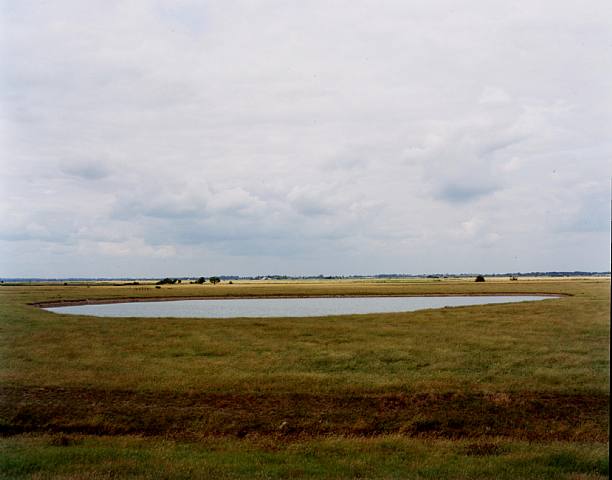
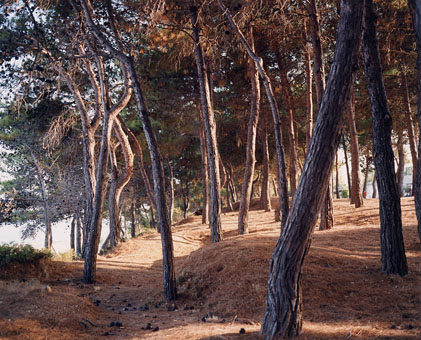
I have found a key influence here. I need to understand the geometries available to me through heathland paths, birch scrub, log piles, pool reflections and pine copses, and how these can be harnessed with human artefacts to develop the commons beyond being simply attractive. This will let me politicise my aesthetics.
Mutters Moor, 2020. Andy Thatcher.
Nieweg, Simone. 2002. Landschaften und Gartenstücke. Berlin: Schirmer/ Mosel.
I need to get these thoughts down while they’re still in my mind – hence this post won’t be illustrated with images just yet.
I guess in response to this week’s topic, I’m thinking quite hard about just what my practice is, where it’s going, and where it needs refining. I’m starting to realise that going out shooting stills is actually a very different experience to shooting video, even if it’s on the same camera, even if the subject matter is identical. The really big difference isn’t out in the field – it’s what happens to those bits and pieces afterwards. Whatever strength stills photography has, in comparison with film, it lacks the immersive textual experience of the voiceover, it lacks the thematic and emotive games that can be played through sound, it lacks movement, both on screen and of the frame, and it lacks the sophistication of meaning made possible by editing. This isn’t to imply that photography is inferior – it’s absolutely not – but that I’m going to have to think carefully about how to translate the thematic and textual elements into a new medium.
As I go out shooting, I’m thinking. The shooting is part of that thinking, and this is why I settled on the essay film as the best match for my inclinations as a film form. My thinking can be expressed through choice of shot, choice of frame and focal length, sound, dissonant editing, duration, voiceover, music, on screen text.
In particular, as I shoot, I note down my thoughts and these form the basis of an accompanying text. This text is very important – as a writer, it’s of equal importance to the image. In my dissertation film, and my film about the M5 bridge at Exeter, this was worked up rigorously and was an integral part of the editing process. I realised today that there are things that I won’t be able to say through photographs, but that I want to say, as part of my commons project. These are personal reflections, moods and abstract ideas. I need to think about how to keep this as part of the project.
For example, walking amongst some of the really small patches of common land left – such as Manor Farm, which isn’t even signposted but is actually rather wonderful, and looking across the Otter valley towards Mutters Moor and Harpford Common, it’s like island-hopping between these extraodinary places. Islands in a land inundated with private owndership.
For example, it strikes me that the timelessness of the land is in its useage, in its history. There’s nothing timeless about heathland – it’s heavily managed – but people have been free to wonder on these little patches of land since there were people. In all that time, they have not been stopped, and if they have, they have fought back and won. There’s a dream inherent in the commons, and it’s a dream found in national parks, wildlife reserves, public parks. But common land is the origin of all this – and of course, many of these types of amenity ARE commons. To a certain extent, streets are also a kind of commons.
That was pretty much my train of thought. It’s something I want to develop – but I can only think of doing so in writing. So it’s time to stop messing around, and be including writing in what I’m doing.
As another note, it’s time to stop being so prissy about leaving things untouched. The pebbles on the commons look so much nicer when they’re wet. I need to start getting them wet to photograph them. To hell with authenticity.
And as one final note – one thing that I’m starting to do is understand my terrain, my own take on it. Starting to understand how best to photograph paths, birches, seeing the possibilities in kinds of land. In this, what I’m doing is no different to street photography.
My practice hasn’t really moved on since last week, and I haven’t found this week’s learning, although interesting, especially relevant. I’m not much interested in questions of truth or the peculiar nature of the photographic medium. Rather, I’m interested in photography as a way by which I can engage with and interpret the world can reveal a set of truths – provisional ones of course, as truth is always thus. I’m interested in photography as methodology.
Through being forced to consider communicating meaning, I find I’ve come back to where I was in later Spring last year, beginning to understand the essay form in documentary film – a thinking through of ideas, a gleaning and sifting of materials, a self-conscious testing out of notions and practices. This is why this week’s materials haven’t been terribly productive for me – everything is much too, albeit necessarily, up in the air. Ask me these questions again some time, and I’ll most likely have some answers. I’m using my camera as a form of thinking, so let me think some more and I’ll get back to you.
As for contexts – I’m thinking book, or possibly article, or possibly both. I want my work to exist in dialogue with text, certainly, and I’m keen to escape the increasingly oppressive omnipresence of the screen somehow. I’m also keen to use sensory ethnography as a methodology, and some of the opportunities opening out at the Pebblebed Heaths will lend themselves to this. I continue to explore geography in connection with this, and am also learning about landscape art more broadly. But it’s all very early days, I don’t have anything specific to say beyond that.
I’ve looked at the idea of truth from a number of angles over the years. I’ve looked at realism in the novel, taking in, ostensibly, foundational realists such as Dickens and subversive historiographic metafictionalists such as Rushdie. My conclusion was that the novel, whether realist or not, aims to represent an ironic impression of truth in which the author is always implicit, whether intentionally so or not. I’ve looked at different models of documentary truth, a battlefield of authenticity still arguing with itself over whether the fly-on-the-wall objectivity of ‘direct’ cinema is ever possible – or even relevant in a postmodern age. My own conclusion is that any documentary ‘truth claims’ are found not in the material itself, but in a contract, whether explicit or implicit, made with the viewer as to the relationship to truth being presented. Through market research and psychology I’ve studied the age-old antagonism between qualitative and quantitative data and thus the merits and problems with empiricism – and psychology’s current and growing ‘cultural turn’ through social constructivism. Crucially, from the perspective of truth and photography, it’s worth noting that even a basic understanding of cognitive psychology utterly destabilises any notion of ever being able to directly perceive an objective reality through the sense (contemporary physics increasingly proposes that there is no such thing anyway). Indeed, the ‘naturalness’ which we assume is inherent in looking at a flat image is anything but, as demonstrated by the length of time it takes blind people to ‘learn’ to interpret them should their sight be restored.
In other words, ‘truth’ is a slippery, ideologically loaded term. There is, of course, a cultural expectation that persists even in the era of deep-fakes, that photographs tell the truth, even if it’s only the faintest echo of a truth. It’s my belief that this isn’t something inherent in the medium itself, but rather something that has grown up alongside it in the ways it has been deployed to support scientific, legal, journalistic assertions about ‘truth’ in the specific era it did. I would thus caution that denoting photography as being, or being believed to be, more truthful than any other form of image-making – including textual descriptions of images – is thus culturally-specific. In an era saturated with photographs, it’s difficult but worthwhile considering that painted portraits, for example, were as much freighted with ‘truth’ prior to photography’s invention as photographic portraits were afterwards. So, my answer to the question ‘what kind of truth can photography offer us’ would be: any kind of truth one feels like making a claim for – so long as one sets the terms of that claim or understands the terms implied in the contexts in which one permits one’s work to be viewed – and then fulfils them.
I believe the photograph is different to other forms of visual representation, though I believe the degree of difference varies with the process and form of the image. Take, for example, evidentiary photographs such as passport photos and compare them with one of the few remaining circumstances where drawing is evidentiary – the courtroom. Both are perceived to be highly objective, and whether forced facial expressions, flash lighting, or use of shading or pencil colour, these are accepted as elements of each medium which transcribes a ‘reality’ onto a flat surface for scrutiny. In both cases, light has entered through a lens – the photo booth’s, the courtroom artist’s eye – and a process has been initiated for this to happen. In neither case is the implicit subjectivity of authorship considered relevant. And yet in the courtroom drawing, the artist is omnipresent. We know that this artist was sitting in this chair, saw this scene with their own eyes, and used their hands to make those lines. In a photograph, regardless of how objective or subjective it is viewed as or intended to be, there is an implicit surplus, however slight, which escapes the control of the artist: to some extent, the image that we see was recorded by a machine and no conscious decision was made by anyone about it: it was a direct relationship between a primed mechanical process and the light available to it. However much the process or the available light might have been manipulated by human agency, there will always be a surplus which escapes.
Take, for example, Warhol’s screen-prints: Warhol is understood as ‘author’ of these images (even though he frequently didn’t make the prints himself). They are exhibited as ‘Warhols’ and the identity of the original photographer negated: the process is overtly one of paint and paper and the human hand is everywhere present. The Marilyn photos themselves are understood as fictionalised to a certain extent even before Warhol’s intervention – as icon of beauty and gender, she has a cultural meaning that Warhol accentuates – and understood as staged glamour shots. And yet there persists, deliberately, a mechanical surplus which escapes any intention to interpreted, and the screen prints are careful to retain the faintest echo of this: they remain photographs. Had this been a painting of a photograph, however faithful, the mechanical chain would have been broken – although, and this is crucial, the painting would have to be ‘understood’ as a painting, and not a photograph. It is this ‘understanding’ of the photograph’s unique quality of mechanical ‘surplus’ on which rests the cultural meanings of photographic ‘truth’ and makes possible the myriad strategies and games of communicating the photographic image.
Even in the era of deep-fakes, I don’t believe any photograph can escape questions of veracity – even if it positions itself to argue against this, whether tableau, digitally enhanced, in the gallery or used for publicity. Public scepticism might be more attuned to it, but there remains a contract of truth between photographer and viewer, even if that truth is as basic as the photograph being a photograph and not another medium.
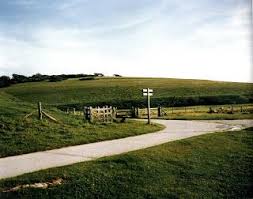
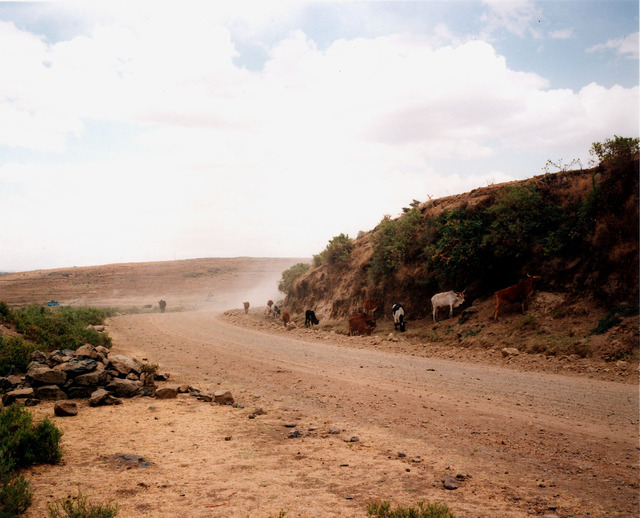
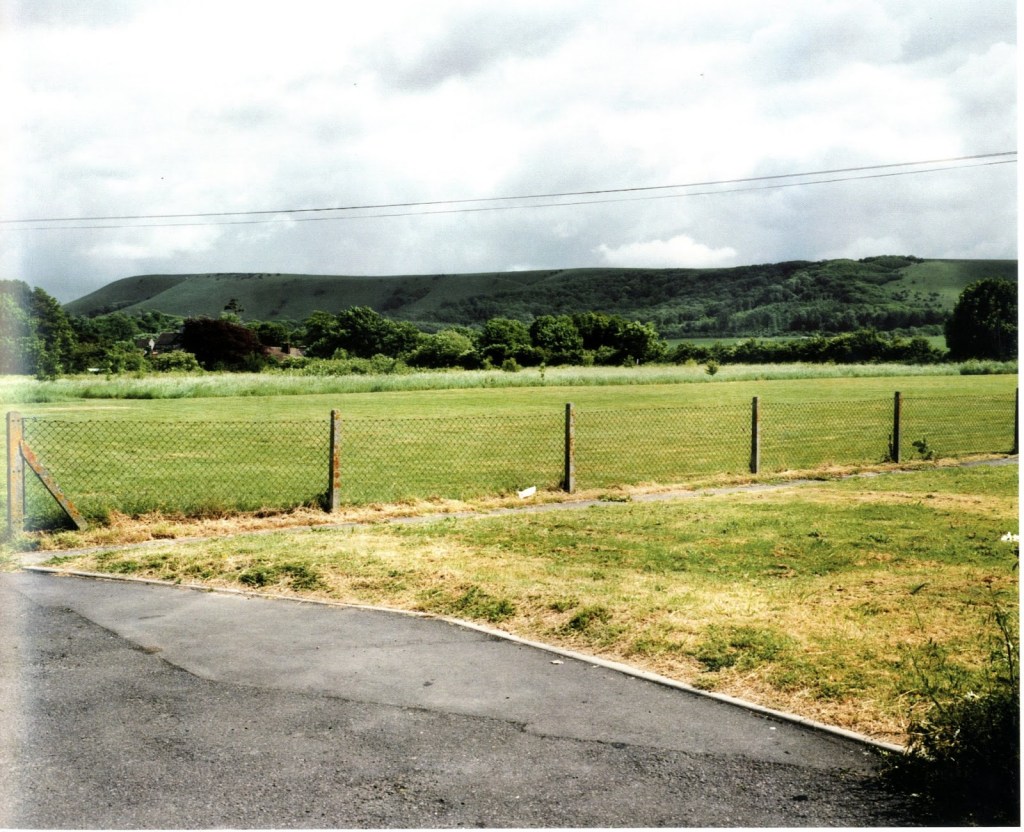
I love it when I come across a photographer who feels like a fellow traveller. Shore. Godwin. Gossage. And now Billingham to add to the list. Why? Billingham, like me, has a fascination with bold lines and bands of texture and colour. Like me, people are within the landscape, if they’re there at all. He also has an eye for extremes – acute angles, brutally partitioned flat horizons. What is especially interesting is that his images largely place natural lines either horizontally (horizons, water) or vertically (trees, cliffs). It’s the manmade lines that are typically diagonal – tracks, wires, fences.
Pond, 2002.Tree Boles. 2002.
What really impresses me, aside from the immersive sequencing of this collection, is how his eye and style applies itself to such a variety of landscapes in such a way that they’re rendered both uniform and distinctive, as with the two pictures below.
South Downs. 2003. Ethiopian Landscape. 2002.
The collection demonstrates a sameness to landscapes which allows the viewer to consider their distinctiveness by, effectively, placing them side by side. Here, both compositions are similar. But the colours, the sky, the cattle, dust – and lack of it, metalled surface – and lack of it – sharply delineate the economic power which makes a leisure trip to the South Downs, from the lack of it which is evidenced by the subsistence farming of Ethiopia.
I’m still determining my style, as I don’t want to limit the communicative aspect of my practice by narrowing too much. Billingham’s work demonstrates that style and message can form a coherent whole.
Grass Verge, 2001.
Billingham, R. 2008. Landscapes 2001-2003. Stockport: Dewi Lewis Publishing.
I was out shooting yesterday at Mutters Moor, a sliver of common along an East Devon ridge, when I came across a shiny white Land Rover and a picnic table groaning with thermoses, bottled water and snacks. The table commanded a stunning view, new to me, up the coast towards Exmouth and on to Torbay. It’s a view so stunning, so I was told by the Land Rover’s keeper, it’s even got a name: The Queen’s View. The keeper explained he was awaiting a group of off-roaders in 4X4s off for a corporate day out – his business. After chatting a while, I took in the view and went my way.
This would have been a great photo op. It’s incongruous, political (considering the ongoing battles against off-roaders in the Lake District) and would have been aesthetically interesting. However, as I went my way, it occurred to me I never even thought to include what I’d stumbled across in my walk, in the way I’d included logging an hour or so earlier. This is partly because I’m still very shy of asking to take people’s photos, however much reassurance I might have had from people over the years. But I think there’s something else going on. I think, for what I’m trying to achieve, people are a distraction.
The influential theorist of film sound, Michel Chion, argues that whenever a human voice appears in a soundtrack, it without fail attracts attention to the extent where it instantaneously becomes predominant. I’ve argued previously, also referring to film, that the appearance of people into landscape has an analogous effect, and used this phenomenon in my film, Strands, by allowing the audience time to experience an unpeopled landscape before people enter the frame and after they leave it. This was intended to allow the audience both to ‘dwell’ in the landscape in sensory terms and to experience it as mediated by people connected with it in narrative terms.
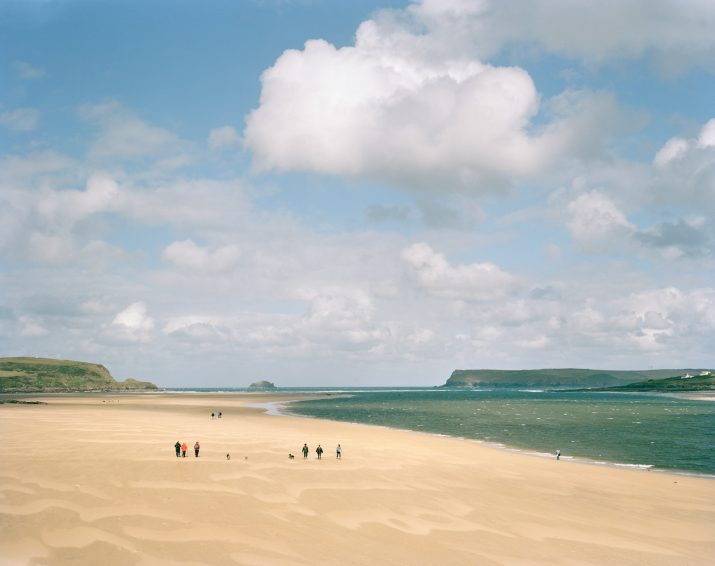
The temporally-fixed frame of stills photography does not allow for such flexibility, but neither does it make such flexibility impossible. The work of, for example, Simon Roberts, envisions landscape in a very human, narrative way by including activity, even when taking up a minute portion of the frame; it is about landscape, but it is even more about specific people’s relationship with their landscape, as demonstrated in series titles such as We English. When faced with his work, which I love, my initial response is to wonder who these people are and what they’re doing, before beginning to see their relationship with the rest of the image.
Camel Estuary, Padstow, Cornwall, 27 September 2007. Simon Roberts, 2009.
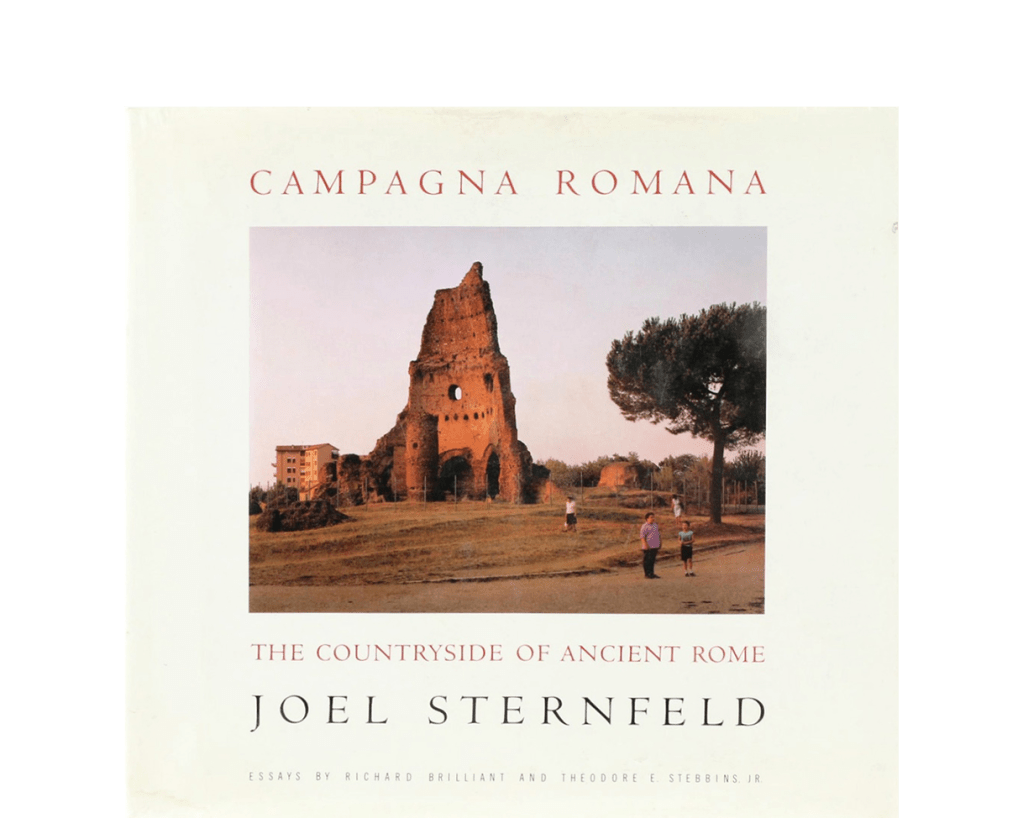
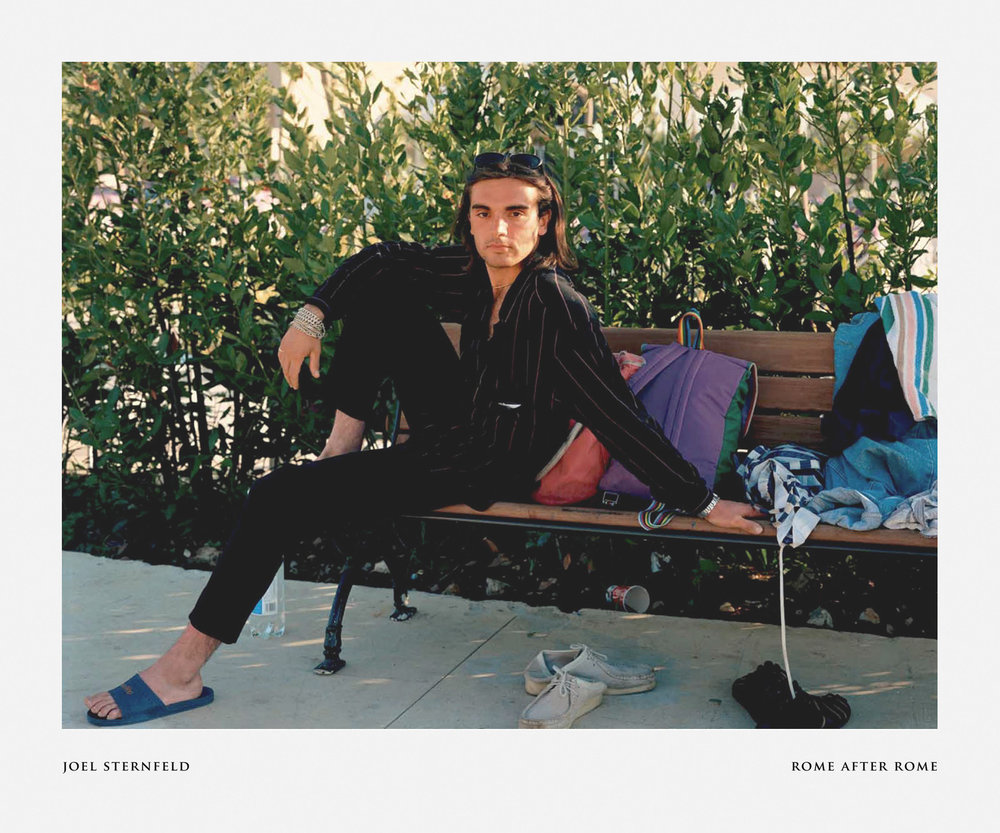
Another strategy is to interlace unpopulated landscape shots with portraits or documentary images. This was Joel Sternfeld’s approach in Campagna Romana, which has scant, slightly surreal but poignant portraits in amongst the shots of the remnants of ancient Rome taken over several years. It’s an exquisite series that allows for a sense of discovery of this extraordinary landscape that extends to a map at the back. Last year’s Rome after Romerevisits and reenvisions this series, richly updating its reproduction but also including far more portraits to the extent where portraits follow one another. The book is, deliberately, much more about the people: the landscape becomes theirs, rather than as previously, they appearing as a part of their landscape. While no less successful as a book, the sense of immersion is gone, and one gets the sense of peering around the portraits to see their landscapes. This difference is demonstrated effectively by their two different front covers.
People are very much a part of my commons project. Commons are given their characteristics by human agency, whether conservation, history, leisure or economic usage, or – especially – legal status. I want to explore these dimensions in my project, and I also want to explore the different sensory ways in which they can be experienced – what it feels like for people to be on a common. I want my project, as with Strands, to be an immersive experience. I want viewers to have a degree of agency, to be able to develop their own connections and explore the landscapes presented for themselves, partly to give them space to reflect on their own experience of commons, and I believe my intentions could be at odds if I included people visually in this project. So, had I included a portrait of the man with his Land Rover, or his assistant at the picnic table, even if relatively small in the frame against the magnificent backdrop of The Queen’s View, the image would become primarily about off-roading, and the meanings to be drawn from it, and about The Queen’s View as a cultural rather than sensory experience. Nothing wrong with that, of course, just not my intention.
It has long been my intention to include writing in my work, and through leaving the visual ‘channel’ unpopulated but populating the textual ‘channel’, I think a balance could be struck: ultimately, it’s the viewers choice how to interrelate text and image and all kinds of interrelationships can be explored through formatting, something I’m investigating presently. But that’s something to discuss on another occasion.
Chion, M. 1999. The Voice in Cinema. NYC: Columbia University Press.
Roberts, S. 2009. We English. London: Chris Boot.
Sternfeld, J. 1992. Campagna Romana.NYC: Alfred A. Knopf.
Sternfeld, J. 2019. Rome After Rome. Göttingen: Steidl.
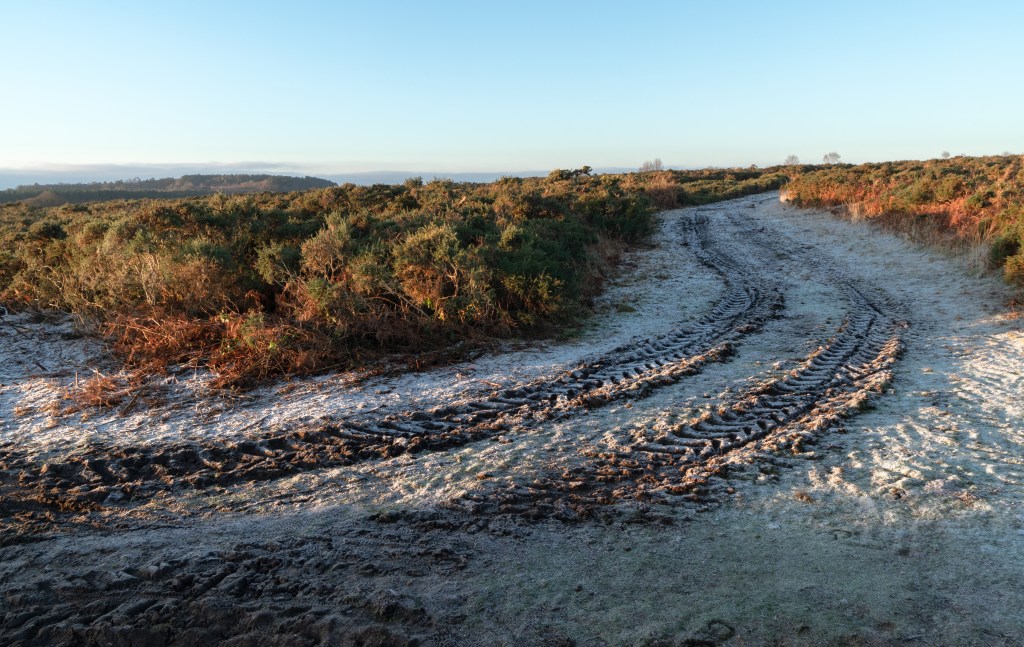
Taxonomies are tricky, paradoxical creatures. They both open up and shut down conversation, make sense and nonsense. I hate them and love them in equal measure, but find them indispensable in developing thinking. I can see that Szarkowski’s might be useful, so here’s my attempt at applying it to one of my most recent shots of Woodbury Common.
The thing here is the track. It’s easily recognisable. We can see it’s a track through countryside, that both people and vehicles use it, that it comes from somewhere and goes somewhere and without considering the ambient conditions, it’s a very ordinary track indeed and that very ordinariness imparts a sense of familiarity. It’s the kind of track anyone might come to know.
The detail here, its ‘truth’ is those tracks. Not only do they animate the image and give it the dramatic lines, but they’re somewhat brutal. They remind the viewer that, even in such a beautiful setting, noise and management and people are at work: there is nothing ‘natural’ here. A narrative is – perhaps – suggested through the absent activity, and I would question Szarkowski’s assertion that photos don’t tell stories – that they are so frequently used to prompt them in creative writing workshops and therapy sessions suggests that any narrative absence is paradoxically an overabundance of possibilities.
The time here is a frosty morning. I’d chosen to be here to capture exactly this – the reddish light, the elegant blue frost tints. But it’s also, on a longer scale, the intensive heathland management practice of scraping topsoil which requires the heavy machinery. It’s also – implicitly – the time it took to make those tracks. Coming from a film background, which records time in a very different kind of way, I’m increasingly finding photography a much more supple and subtle way of registering time, and one that more actively engages the audience through inference.
Likewise, through segmenting the actual, the frame infers what cannot be perceived visually, and in this photography and film are very similar. It’s through frame that the previous elements – thing, detail and time – become arranged into an animate whole. It’s also through frame that this becomes very much my shot – I wasn’t the only one out on the common that morning taking photos of tracks and frost – but the way I’ve arranged the track, the gorse, the sky, to create a slightly dramatic, slightly abstract image is wholly mine. This is precisely, as Szarkowski says, ‘to quote out of context’.
Vantage point, the final characteristic, is an unusual one here for me. As I wanted to include the distant trees, I lifted my camera as high over my head as I could reach to take the shot. I’m not sure that comes across, however, and it was a purely aesthetic rather than thematic choice. That being the case, the vantage point appears to be – even if it actually isn’t – at about head high walking amongst landscape. It’s not in flight through a zoom, picking out a detail crouching down and scrutinising. The vantage point is that of a walker, any walker, out enjoying the morning, and this gives emphasis to the ordinariness of the scene and the track. The extraordinary – the frost, the morning sun – thus becomes accessible, commonplace, within the democratic realms of ordinary experience.
Szarkowski, J. 2007. The Photographer’s Eye. New York: The Museum of Modern Art.
Considering my own practice as a photographer, the concept of context is troubling, has been for some time, and is my primary motive for this Masters course. Since reconnecting with photography in 2008, my work has been framed almost exclusively by social media. First, from 2008 until around 2011, on Flickr, thereafter Facebook and additionally, from 2017, Instagram.
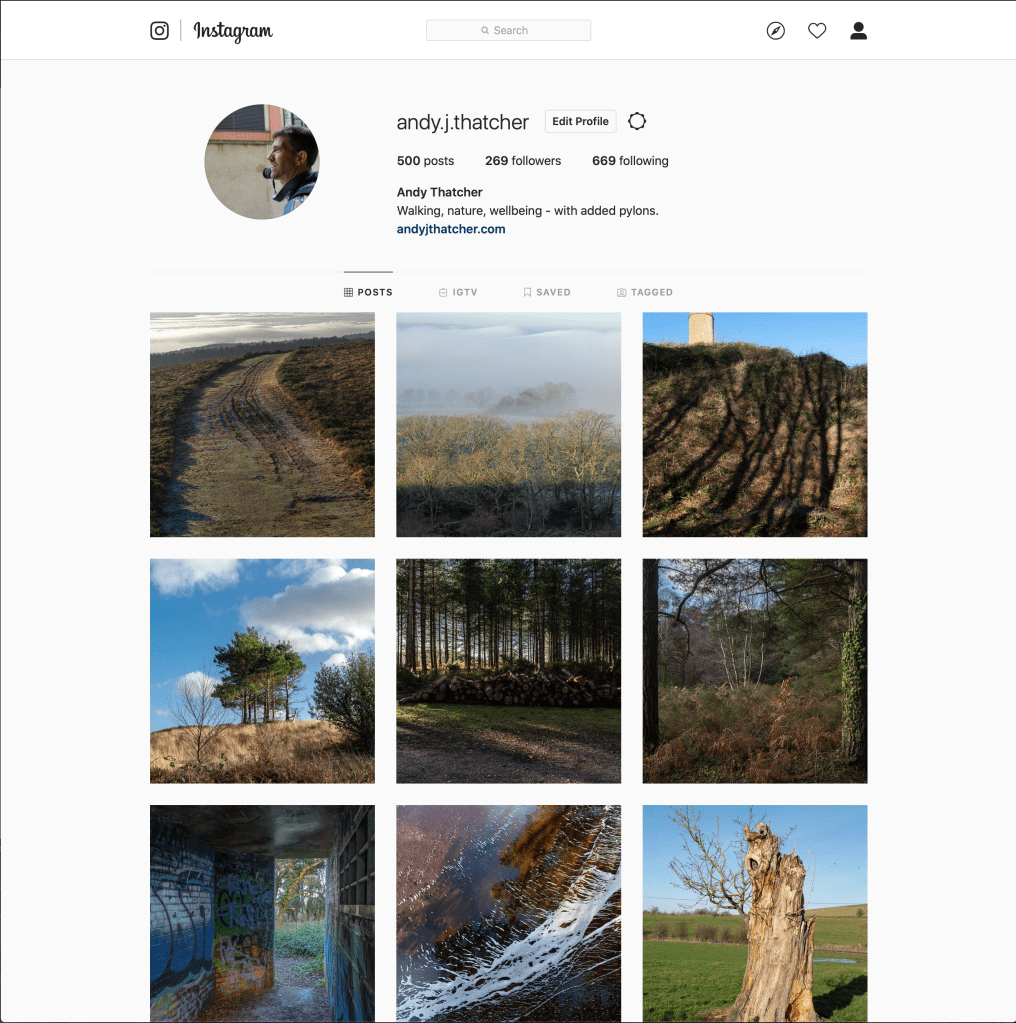
Troubling, as I have become increasingly aware of how this context has shaped and is shaping my practice and my emotional engagement with it. To no small extent, when I’m out with my camera, I’m rehearsing a role that will ultimately be performed digitally on social media. I’m thinking which shot will get the most likes. I’m thinking whether those likes will come from my individual style – my obsession with surreal shadows – or from conforming to contemporary picturesques such as sunset or edgeland exoticism. I want to move beyond this, to discover new contexts. I believe I have more to ‘say’ with my work, that the single-shot, scrolling brevity of social media is inadequate as a means of interrogating ideas about place and landscape, and that there are conversations about art, the record and land that I wish to join. Photography, like film, like literature, is performed somewhere and for somebody, and the place and audience set the terms of this performance. I want to shake up my ‘channel of consumption’ completely.
Where I am now is discussed in posts below. I’m experimenting. Learning. Growing. And just beginning to think about where – other than IG &I FB – my work might find an audience. It’s exciting but still – necessarily – vague.
The nature and intent of my practice is discussed in posts below. I’m a landscape photographer – I guess – but I like working in abstractions and details. I want to evoke the sensory experience, idiosyncracies, politics and history of the places I visit. I want to draw critically on established approaches – e.g. the picturesque, banal details a la Shore – and harness them to my thematic intentions.
At the moment, my work is consumed here, on IG, FB and that’s it! I’m hoping conservation charities will find a use for my work for promotion or evidence, either online or in print, and I’m interested in using my work in academic settings – whatever those are, and this is something I need to explore. I think my end goal is a book in which writing plays a crucial part. I’m currently investigating ways of turning my M5 motorway bridge project into a book. Early days, and I’ve no idea about format, audience, cost, or collaborations. These are all things I’m exploring but don’t really have anything worth discussing here.
My practice is interwoven with film work, and it’s possible I’ll be doing some filming on the commons I’m focussing on currently – possibly for money. I’m interested in the possibilities that photography opens out that film doesn’t, especially the very different experience of time through the two media. As an online project, of course, these two could co-exist. I’m interested, too, in interrelationships with text – also having a background in writing. I’m exploring works that chime with my own interests, such Joel Sternfeld’s sparse but eloquent text in On This Site and Campagna Romana, John Kippin’s Cold War Pastoral, which is interwoven with essays, and Dominick Tyler’s Uncommon Ground, a hybrid work that perhaps is closest to what I want to achieve. Critically, I’m embedding myself deeper in the traditions of landscape art through Andrews’ Landscape and Western Art, nature writing through Robert MacFarlane’s Landmarks, anthropology through Matthew Engelke’s Think Like an Anthropologist, critical geography through Doreen Massey’s For Space, and photography through Geoffrey Batchen’s Each Wild Idea. When I finish Batchen’s book, which I’m loving, I’ll write up a separate post reflecting back on it – as will I be reflecting in greater depth on my reading and photography research elsewhere in this journal.
Andrews, M. 1999. Landscape and Western Art. Oxford: Oxford University Press.
Batchen, G. 2002. Each Wild Idea. Cambridge, Mass: MIT Press.
Engelke, M. 2017. Think Like An Anthropologist. London: Pelican.
Kippin, J. 2001. Cold War Pastoral. London: Black Dog Publishing.
MacFarlane, R. 2016. Landmarks. London: Penguin.
Massey, D. 2005. For Space. London: Sage Publications Ltd.
Sternfeld, J. 1992. Campagna Romana. New York: Alfred A Knopf Inc.
Sternfeld, J. 1996. On This Site. Göttingen: Steidl.
Tyler, D. 2015. Uncommon Ground: A word-lover’s guide to the British landscape. London: Guardian Books.
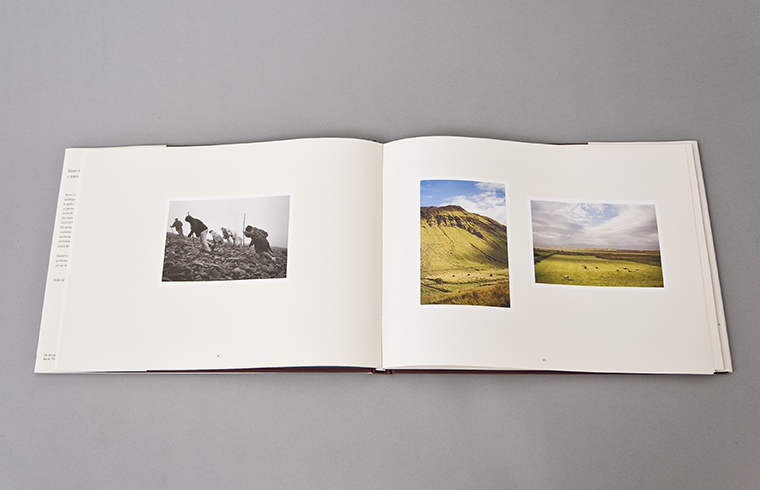
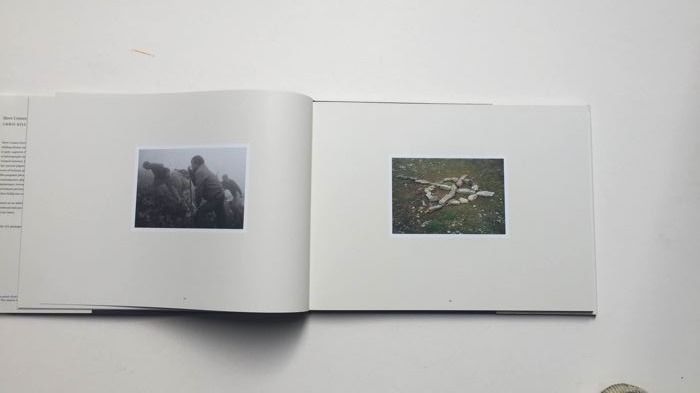
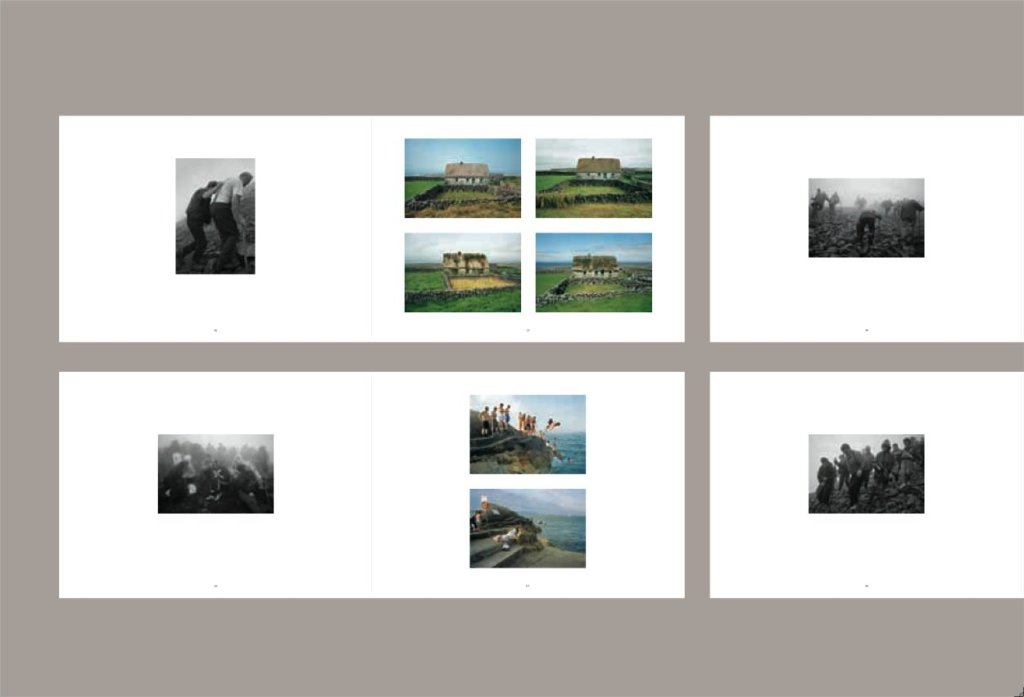
This book is a masterpiece of mood and narrative. Chris Killip is new to me, however celebrated he might be within the world of photography. This selection of photos were taken over a ten year period across Ireland. A third are in black and white, Killip’s style dips into documentary shots of events such as pilgrimage and sea bathing, abstracts, landscapes, domestic details, some are shot from car windows. And yet, and without any accompanying text, they form an emotional and narrative unity. There is much, much for me to learn here, about suggestion, narrative, mood, continuity and discontinuity. One format is continually adhered to: the left hand page is always a single black and white shot of a pilgrimage into the mountains, with the pilgrims almost uniformly dominating the frame, which the right hand page is aways colour, though between one and four images. The effect is of following a single pilgrimage – without accompanying detail, it might just as well be a single pilgrimage though it is in fact two – up and down the mountain. This provides a narrative arc, perhaps the most primordial of all narrative arcs.
The colour shots are brought into dialogue with each shot – sometimes through explicit visual referencing such as a winding road, or thematic, such as a particularly arduous moment of the pilgrimage with a stone hand-constructed cross, suggesting penitence. Sometimes both sides show pilgrimage, providing a paradoxical sense of changing times and continuity.
At other times, the connection isn’t explicit, but so carefully sequenced around other images that one feels as if it must be connected and so forges the connection oneself – an old man paired with a thatched roof decaying implies the inevitability of time passing and thus death, linking the teenagers in black and white and as misbehaving sea-bathers suggests a universality of experience that embraces contradiction and subversion.
Particularly important for me is that, when Killip pairs with semi-abstracts with a botanical or geographical subject, a powerful sensory impression is delivered: the textures of scree suggest the sound and difficulty of walking over it illustrated in black and white, a young adult in prayer paired with a colourful, sunlit tree suggests peacefulnes, pilgrims on steep inclines paired on two double spreads with blocked field entrances suggests difficulty and determination. What I can begin to learn from here – and what I can now begin to transfer as knowledge from editing film – is how photographs can together create meanings that individually they cannot. I am accustomed to thinking of photographs as singular worlds. Killip has shown me that fresh and powerful meanings are possible when thinking of them in combination.
Killip, C. 2009. Here Comes Everybody: Chris Killip’s Irish Photographs. London: Thames & Hudson.

 out of the picture
You must be logged in to post a comment.