A matter of resources

Any successful creative endeavour, whether in the fields of the arts, business, science, whatever, is dependent on a practitioner having an understanding of how to get the most from available resources. Resources are diverse, and include materials such as machinery, inks, paper, screens, physical spaces and buildings, human resources such participants, collaborators, enablers, advisors and audiences, and knowledge in the form of contextual understanding, practical and thinking skills.

My resources as a photographer are very limited. My technical skills are basic and limited to the use of a digital camera in a digital environment. I do not have access to studios, printers, other cameras or camera kit, and I do not have a local network of people I can work with. I have no experience of galleries or understanding of exhibitions, no connection with people who work in them, and no idea about approaching them. I had hoped that I would begin to learn these things on this MA, but that does not appear to be on offer. An input session on ‘working with galleries’ would have been useful, but it seems to be taken for granted that I know these things already. As with so much else.

Video art, installation art, these are complex technical forms that rely on galleries and belong to the world of fine art. It would be pointless, I believe, to pursue this line of research further. Were I on an MA which, for example, provided a module in installation art, or in video art, and gave me the training and contextual and philosophical understanding of these things, then there would be a basis for learning and experimentation. But I cannot meaningfully learn about these things from books; I need discussion and input and guidance, and I am unable to find these things from peers or tutors on this MA. The resources which I would need to create video or installation art are thus out of reach, and pursuing them would be a fruitless distraction. To create a meaningful work, I must examine the resources that are available to me, work with those, and somehow bring to bear the learning that I’ve achieved over the past year. Quite where that leaves me, I have no idea, but that’s not such a bad place to be.

I know I can make an excellent film for this module’s Work In Progress Portfolio. I have everything I need to do this – I have much greater faith in myself as a filmmaker than as a photographer. I have no doubt that I can make a film which would get a good grade. But what I don’t want to do is ‘just’ make a film. I want to make a film that’s somehow relevant to my time on this course, that’s in conversation with the ongoing struggle I have with placing myself in the context of contemporary photography. I don’t need to do this, and in many ways I don’t want the hassle, but neither do I want to feel like I’ve passed up the opportunity to rethink my filmmaking in a possibly radical and productive way.

Susan Trangmar: Unfound

In 2016, Trangmar was commissioned to create a film in commemoration of the Battle of The Somme. To do so, she visited the area, both the landscape, the war graves and the everyday places in Somme.

Unfound (2016) is not a film that has me convinced, and lacks coherence – markedly different to A Play in Time (2008). Trangmar has described the difficulty of creating a work about which so much has already been said, and that the film did not capture her entire response, something which she has set right in a later article (2098).

I can’t help but wonder why there isn’t a voiceover. Unfound seems to demand verbalising, as if Trangmar has decided to keep her thoughts muted. This would have been fine if her thinking were more explicit, through the development of a more strident range of symbols, or carefully placed events, but Unfound seems like a slide show. There is thinking happening, quite clearly – juxtapositions of industry and commemoration, agricultural routine and leisure – but it’s hard to penetrate. A Varda, or a Keiller would have quipped, mused, questioned. And I wonder if this reluctance to narrate is one of the features of video art as a moving image genre. If so, and there most definitely are works which don’t require narration – A Play in Time for starters , then it’s a decision which should arise from the work and its demands. To refuse one of the most powerful facilities of the moving image – to be able to have words and images in a single experience – seems deliberately obstinate. Perverse, in fact.

Trangmar, S. 2019. Passages of Inscription. Photographies 12. pp. 63-80.

Field notes

I’m maybe interested in creating a moving image version of The Pond called – you guess it – The Field. The interesting thing here would be, rather than finding nature in the urban, finding the urban in nature. As the field is – aside from being quite a weird place – away from settlements, that means the intrusion is going to be harder to find – no litter or knives in trees. BUT, there today, the intrusion was sound – you can hear the M5 from there, which I’d never noticed. Also planes, helicopters, and the sound of heath users – the RM, mountain bikers etc. So rather than look for natural sound, look for dissonant sound. 

The Field is weird, but actually what I’m looking for this time isn’t narrative – it’s visual form. To an extent, when I visit places like this – as with the M5 bridge – I’m going for the same reasons I visit a gallery (aside from getting the inspiration of a meeting of minds). I’m looking for formal fascination, beauty, sensory experience. It’s another kind of fantasy, another kind of play. Not separate either from the fantasy of childhood fiction and horror, another kind of escape, but again an imaginative interaction with environment, adapting raw material, inventing. So choosing one particular place, the approach, the enclosure of a gallery space, it kind of makes sense. So not a documentary exploration of space, a sensory one, an abstract one. An adventure. Placemaking.

David Campany: Motion and Stillness.

I love the way David Campany writes. It’s for the same reason I love the way Geoffrey Batchen writes: it’s lucid, personally felt, rigorously thought-through and informed, and with a general readership in mind. You don’t need to knee-deep in postmodern theory, or catapulted from your private fine art niche to hear what he has to say. 

I’ve read Photography and Cinema (2008) before, when I was studying for a Masters in Film & TV at the University of Bristol.  Back then, I was thinking about looking at documentaries about photographers for my dissertation project (I didn’t, in the end). But having read Campany, I could see he not only had a profound grasp of film, but also knew how to talk to those working in film. In fact, until beginning a Masters in Photography, I hadn’t appreciated that photography was his point of departure. 

What particularly impressed me about Photography and Cinema was Campany’s grasp and elucidation of the qualities, limitations and overlaps between the still and moving image. As a practitioner in both, and as one whose practice as a filmmaker, using fixed frames and long takes, was deeply inflected with the working methods of stills photography, I’m acutely aware of and curious about what makes a still image quite so still, and what makes a moving image truly moving, aside from technological differences. After all, the movement in Warhols’ Empire, is barely perceptible, while the blurred figure of Cartier-Bresson’s celebrated Behind the Gare Saint-Lazare is a trace of movement; to this extent, Warhol’s is more the still image, Cartier-Bresson’s more the moving one. 

I’ve heard it said that such permeable boundaries between the two types of photography render the boundary arbitrary, yet another rigid binary for the all-conquering postmodern army to demolish. Permeable and arbitrary, sure, but to deny difference is to deny their qualities and usefulness. As Campany argues, this tension, this constant struggle over territory, is as old as the medium itself and practitioners in both fields, often using this site of conflict in their practice, are to be found ever since the inception of the moving photographic image, the younger of the two technologies. 

Campany argues that what defines each, moving beyond photochemical or digital processes, is not what they are but what they are for. There is nothing inherent in such processes that determines their utility – moving image as popular entertainment, still image as scientific record, for example: rather, that lies in the domain of the cultural. The phenomenology of each is also defining: the still implies a past moment recorded, whereas the moving image provides an illusory presentness, and relate to the previous two examples which I have plucked at random: moving image as voyeurism, still as symbol, as fetish. To phrase it in terms of environmental psychology: the still and moving recorded photographic image offer different affordances

Campany notes that the still and moving image are phrased differently depending on context. To be confronted with a still image – even if it’s actually a sequence of 25 frames per second – in which nothing appears to move accentuates its stillness, anticipates motion to an almost unbearable degree, and invites scrutiny: which is this? Still or moving? To come across a moving image where one would expect a still – such as a flat LED screen on a gallery wall – frustrates the idea of stillness, accentuates the perception that a movie screen is a window rather than a terminal surface. And yet, paradoxically, the still image implies duration in a way that the moving image does not: through accentuating its extraction from a continuous present, the moments bracketing it, stretching out infinitely, are implicated. This does not happen in the moving image: the illusory presentness of film implies an immediacy unavailable in the still, and one is trapped inside the moment of the film in a way that does not happen in the still. These paradoxes, especially when still and moving images are set against one another, liberate extraordinary, profound and distinctive effects. 

This divergence deeply inflects the way narrative operates in each medium. At its most basic level, the moving image is a medium of narrative, even if that narrative is no more complex than ‘the blade of grass waved back and forth’. The still image, on the other hand, as with the painting, requires the imaginative engagement of the viewer to construct the narrative. Even when the images, moving or otherwise, are connected through editing or montage, the demand on imaginative engagement remains higher: it is, to the uninitiated, more effortful to ‘read’ a photobook than a short film, and this should not be seen as a difference in effectiveness but a difference in qualities. As Campany argues, ‘photojournalism requires journalism, because facts, however ‘powerful’, cannot speak for themselves’ (p.28); this cannot be said for video-journalism (should such a word exist), which has a wider range of communicative strategies and a more visually literature ‘readership’ (at least for the past several decades). 

I’ve mentioned that my fondness – partly born from necessity – of fixed-frame long takes makes my filmmaking more ‘photographic’. Operationally, this makes my work more akin to the large-format landscape photographer than my rapidly-moving landscape still photographic practice, chasing light and change. It also taps into a rich tradition of avant-garde filmmaking which eschews the rapid-fire editing of commercial film, allowing the viewer to ‘dwell’ in an image in a way similar to how they might view an image on a gallery wall. This problematises filmmaking, calling attention to the event of recording and implying the present of the filmmaker to a greater extent than if the viewer were carried along on an endless stream of montage. Crucially undermining the perceived function of filmmaking, it drains image of narrative: the longer a shot persists, by and large, the more the uneventfulness of daily life is implied, narrative being an artificial imposition on its random, meaningless flow. It also opens up space for the viewer to exert agency, to gaze around an image of their own volution. The fixed-frame long-take is a cinema of surplus, and many of my favourite directors – Michaelangelo Antonioni, Kelly Reichardt, Gideon Koppel – grasp this. There is much I have yet to understand and articulate on what is known in some circles – already rejected by many filmmakers – as ‘slow cinema’. This post is not the place to engage with this matter fully, but will be the focus of my research in the coming weeks. 

Campany, D. 2008. Photography and Cinema. London: Reaktion Books. 

Returning to video

It’s time to reflect on what’s happening with my practice since I – essentially – stopped shooting stills and moved on to video. It needs to be said, this hasn’t happened exactly like this – I’ve always shot stills alongside video, but video has always been project-based, not the casual shooting of stills. That’s changed – if I’m currently going out shooting, then it’s going to be video. 

I’ve learned lots. One of the first things is practical: if I’m looking at an image, whether still or moving, then I want to be able to look at it for a while. Hence, I need to make sure each take is around 30 seconds and – crucially – that I don’t mess around with ND filters, exposure comp, depth of field or any of that. I just need to set the shot up and let it run. The only thing I’m happy with changing is focus, to move that to where my attention goes, or where things are happening. 

This is instructive. It reminds me that there’s a pleasure in looking, whether the image is still or moving. There’s an ontological sameness, gazing, focussing on different parts of the image, weighing up, making sense, appraising. That’s probably because I’m looking at the image on a screen, the framing of an app reminding me of a certain parity. But that curiosity, and that meeting of inquiry with stimulus, is identical. 

But there’s a distinct difference in duration: to a certain extent, movement divorced from narrative, movement that’s reactive and reflexive, can appear abstract, ghostly. There is no hand making this movement: it’s not the movement of a car or a pan or a couple kissing. It’s movement not put on for the camera, but captured by it. It has agency beyond the frame. The world is revealed – or at least foregrounded – as alive and with its own agenda. 

It’s these kinds of movements that I seek out, have always sought out. Reeds waving in the wind. The play of patches of sun on concrete. A butterfly shooting across the frame. Clouds moving across the sky. Even the slightest wave of a dead twig suggests a continuity, foreshadows greater movement. 

Such movement, for me, jars against a too restrained, too formally literal composition. Composition that’s too neat, too obvious – this is the ground, this is the sky – imposed an order on the world that the movement demonstrates to be completely artificial. The shots I’m happiest with are ones you have to work at – using shallow depth of field to keep the moving trees blurred, having only the treetops against the sky, not having the banks of the river, looking up at the tree without roots or tips, avoiding horizontals. In the field I shot on Friday, there’s no structure to fix things, anchor things, like the motorway bridge. There’s no information. There’s just sense. I think, for this project, I’m moving towards the impressionistic. 

I’ve taken one or two shots that repeat the tree close-ups of ivy and weird shapes. These have fascinated me, for superficially, they are repetitions, but the slight movement provides a sense of the spatial completely different to the stills. In those, the tree is everything, and the background is scenery, whereas with moving image, the background has its own life, its own agency. It invites the viewer to look longer and more carefully. 

These are just tentative thoughts. I need to go back over David Campany’s Photography and Cinema (2008) to flesh this all out a bit. 

Campany, D. 2008. Photography and Cinema. London: Reaktion Books. 

A video artist can be a filmmaker and a filmmaker can be a video artist but video art is not film and film is not video

Not coming from a background in fine art, I’ve struggled with the fine art focus of much contemporary photography, much of which leaves me completely cold. I’ve also struggled to address this with tutors and peers, who have of occasion been quite definite that fine art isn’t such an integral part of contemporary photography as I think. And yet, on deciding for the current module to return to shooting video, it’s been indicative that I’ve been pointed in the direction of video art by everyone I’ve spoken with. 

If I’ve had any contact with video art, it’s generally been by accident or because there’s a crossover of some kind with a filmmaker. Every once in a while, I’ve come across video art in gallery spaces and the only one that has left any impression was a ridiculous black and wide film of a naked man bouncing on a trampoline from the 1960s, memorable only for its absurdity. I went to Mark Leckey’s retrospective at Tate Britain essentially because it was built around a motorway bridge, and I enjoyed it as an installation – less sure what I’d have made of Fiorucci Made Me Hardcoreif I’d come across it in isolation. Much of Agnes Varda’s installation work is an extension and reconfiguration of her films. Hassan Hajjaj’s recent exhibition at the Arnolfini included a brilliant film which was basically an extension of his portraits of musicians and performers, but playing with the juxtaposition so that the separate portraits appeared to be aware of one another. I’d had Tacita Dean recommended to me and went to her exhibition last year at the RA – and I’m afraid walked out after 10 minutes as I just didn’t get what on earth was supposed to be going on (without such knowledge, the whole thing was an ugly mess). 

It’s worth recalling the reasons for my return to video. First, with my new Sony, I’m now able to shoot video that looks the way I want it to look. Second, my background is in film and narrative form, primarily the novel. Third, I’m curious to learn just how video occurs in the context of the discipline of stills photography – I’ve heard repeatedly that working in video is something photographers do, but nothing about how that works and why it’s done. Last, I’m keen to bring what I’ve learned over the past year into the way I shoot the moving image and see what happens. 

The first book I tried engaging with, Still Moving(2008), is a collection of essays. It is, I swiftly discovered, an exercise in interrogating the medium, a solipsistic analysis of the technological, economic and ideological contexts of the making of still and moving images. The focus is here on the act, as often in academic works on photography, and rarely moves beyond that. As I’ve mentioned before, I’m not interested in these conversations, at least not right now; what interests me is what I can learn and draw from my environment, physical and cultural, through the act of photographing. I have other means of doing this at my disposal – writing, walking, discussing, researching, looking, listening. When I listen to the world, what interests me is what I can hear and through experimentation, getting the most out of hearing; I’m much less interested in HOW I can hear, and it’s the same for me with photography. After a skim through of introductory paragraphs, Still Moving is consigned back to the shelf. 

The second, Moving Image(2015), is a collection of interviews, articles, reviews and the like, investigating the subject of video art. There is here, too, an overwhelming emphasis on interrogating the medium, a fascination with scratches on celluloid, repurposing tv adverts, the technologies of utopias and a telling discussion which attacks narrative cinema for being toxically ideological (I think there are better ways to destabilise ideologies than making difficult art which is only readable by your peer group). It is telling that Bill Viola, who I’d never heard of until beginning this investigation (such is the invisibility of video art beyond itself), and who makes work that is accessible and exquisitely crafted but philosophically astute (my personal definition of what makes for great art), has explicitly stated his gradual rejection of these obsessively abstract, obfuscating means of practice. 

In amongst this is the concept of ‘expanded cinema’, which envisions video art as a development of, not a reaction against, narrative film. Expanded cinema reconsiders the context in which the moving image can be experienced, whether in an art gallery, projected onto derelict buildings, through water, or whatever. I think this is useful as a defining concept that draws a line, however tentative, between the cinema-based film, in all its forms, I have come to develop considerable knowledge of, and video art. It – literally – expands cinema, suggesting novel opportunities and creative forms. In an era when the moving image is now nearly always experienced on a personal digital screen, this strikes me as crucially important. Other discussions comment on the relationship between film and context as a central part of the art – such that a work of video art can only be exhibited, indeed will only make sense, if the artist’s instructions for exhibition are followed. 

One of the great frustrations of video art – and one I suspect that keeps it from being better known – is its inaccessibility, which is a perhaps inevitable outcome of all the above. With non-time-based media, like photography, painting, sculpture, it’s easy to encounter this work second hand, through print and digital media. Even with time-based media such as cinema or theatre, it’s possible to encounter through DVD, scripts, streaming services, Youtube and so on. But video art appears difficult to experience remotely. There doesn’t seem to be a platform which lets you view video art: the majority of films being talked about aren’t available and so – and this is surely a bitter irony – the only way of accessing them is through the words of someone who isn’t the artists. There ARE platforms, but aimed at exhibitors and at a discouragingly high price tag. And whereas you can experience excerpts from a photobook online, there is not the complete caesura in experience as that between a still from a work of video art – which is an art of movement – and the video art itself. 

Anyway, the upshot of all this investigation is this: being a video artist and a filmmaker are not the same thing, though a filmmaker can also be a video artist (such as Agnes Varda, who is exemplary at both), and a video artist can also be a filmmaker (such as Steve McQueen, who likewise is exemplary at both). And the defining element, to me, is not to be found in interrogating the medium (which film has been doing anyway right from the outset – the Lumiere brothers played with still and moving images after all), but in the contexts in which video art is encountered. It is the markedly different possibilities and limitations of ‘expanded cinema’ which I will now need to investigate to see how my photography can be reconfigured as video art, rather than narrative film. Or whether I will continue to work as a filmmaker, but draw on the experience and knowledge acquired through the practice of photography. 

Beckman, K., & Ma, J. (eds.) 2008. Still Moving: Between Cinema and Photography. Durham, NC: Duke University Press. 

Kholeif, O. (ed.) 2015.Moving Image. London: Whitechapel Gallery. 
Susan Trangmar – A Play in Time

Susan Trangmar originally trained as a sculptor and has in time moved through still and into moving image work. A Play in Time is the result of a year’s residence, partnering with Photoworks and Brighton and Hove District Council, in St. Ann’s Well Gardens, a small formal municipal park. Trangmar worked with a digital camera fixed on a tripod, recording small details of plants, the activities of the users, the park’s built environment, as well as considerable sound archives. The result is a 25-minute film with one or two clips playing at any one time, and a book containing stills, essays and an interview with Trangmar. 

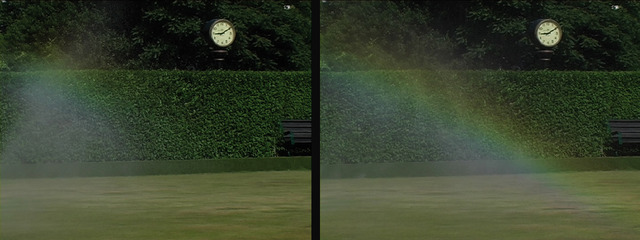
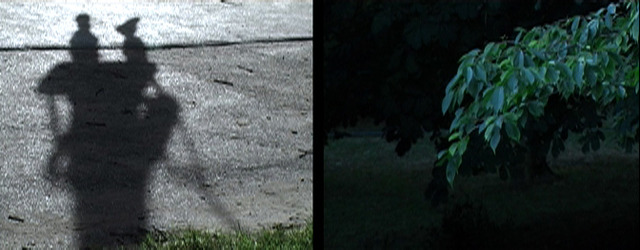
This is a work I can really relate to. It demonstrates a very deep immersion by the artist in a place, such that she becomes a part of it. The long take, fixed-frame format, taken from a tripod is exactly my preferred way of working, and Trangmar is likewise interested in the formal possibilities of the frame beyond the representational. Many shots are semi-abstract, and all are lovingly composed. Where Trangmar differs from my work is that she has not sought to ‘explain’ the park: there is no walking of the boundaries, no attempt to orientate the viewer, but rather it is as if we have been transported to the park and are looking around to discover it for ourselves. This is something I can learn from. Nor does she differentiate between semi-abstracts of the human and the non-human – park users are often headless, or just a pair of limbs, and their activities abstracted, such as the shadows of children on swings – again, more to provide a sense of place than a logical, linear document. 

Trangmar has constructed space in a fascinating way. This is partly due to the split screen format, which gives both a sense of simultanaeity of events, rather than singling them out as a single screen would do, and it is also in her lavish use of sound, almost all of it off-screen, giving snippets of conversation, seagulls, traffic, and many sounds which can’t be easily identified. The bird song, like the traffic, is foregrounded to the point of exaggeration and this provides a considerable sense of the pastoral. The split screen also adds a disorienting sense of slippage where different moments of the same shot are side by side; this is partly intended to emphasise the slipperiness of memory, but for me it suggests the park as embedded in individual routines. 

It’s also interesting that Trangmar has chosen not to delve into a key moment in the park’s history: in the late c.19th, it was the site of the second ever film studio, and a huge number of early films, many of them technically revolutionary, were made in St. Ann’s Well Gardens. Many filmmakers and artists would have taken this as an opportunity to ‘interrogate the medium’, but for Trangmar it appears to be sufficient that she is continuing a tradition, leaving the accompanying essays to flesh out this detail. 

The accompanying book is also notable: it picks out stills from the film and resets them against the white of paper, hence the images resonate differently. It is a different and by no means inferior way of encountering the park which emphasises the images’ formal aspects. It also emphasises the importance of movement to the film. 

There is much for me to learn here: returning to filmmaking after developing a stronger sense of how and why I make images the way I do, it’s interesting to see a work where formalism is both central but never overbearing. It’s also worth considering what can be achieved beyond a cinematic context, by the use of split screen and different media. I will be investigating Trangmar’s work more thoroughly in future. 

Trangmar, S. 2008. A Play in Time. Brighton: Photoworks.

The eagle never lost so much time as when he submitted to learn of the crow.

The discovery that there is a photographic counterpart to writer’s block has been uncomfortable. I should have seen it coming, however. Since my interest in photography reawakened, probably around 2015, there has been a continual moving forward of things to discover, new things to photograph made possible by new technologies and personal investigations of the world. It has been a thrilling ride and made life much more fulfilling. But Hidden Corners has felt like the apex of this: it was the culmination of my discoveries of the Heaths (having exhausted my fascination of the M5 bridge) and the combination of an excellent camera with an excellent lens. It has been hard for me to see where I might go from here: I’ve certainly come to the terminus of buying kit (for financial reasons, apart from anything else) and the pandemic and the perennial practical and financial constraints of domestic life, tied with the insecurity of the pandemic have made it regrettably unlikely that I can pursue the grand projects I would like at present – I will most likely have to wait for my daughter to leave home and for a vaccine to emerge before I can hop around the country photographing literary woods and famous commons.

The pandemic has put my perennial constraints on those who previously didn’t have them. It’s been interesting watching how peers and professionals have responded: there has been a turn to local communities, personal and domestic lives, autobiographies and evaluations of identities, a return to older ways of working more connected with fine art. I have not followed this trajectory inwards and into the immediate backgrounds to daily life; daily life is something I have wanted to escape my whole life, harking right back to the intense loneliness and emotionally and intellectually crushing family environment in which I spent my childhood, and which has its exact counterpart in a marriage from which, for the sake of my daughter, I cannot extricate myself for some time yet. That I have never attempted, let alone succeeded at, ending my life has been seen as remarkable by a number of mental health practitioners: I have never had the circumstances conducive to happiness or personal growth.

Since abandoning writing fiction, my drive to create work, whether moving or still photography, has been all about looking outward to strike new experiences and encounters, or where it is more introspective, to find a space to encounter myself anew, free from the deadening dullness of my isolated quotidian routines. I interrogated my daily life and my personal histories in my fiction, and it made for very sad, unloveable work, unattractive to others and painful to write. The reason I love photography, and filmmaking, is it makes me look outwards and that gives me the  courage and inspiration to want to live. My writing is something intimately tied with despair and the fundamental despair that leads to suicidal thoughts (more of an occupational hazard amongst fiction writers than in any other art form, it should be notes). My writing is, in the parlance of the mental health professions, essentially a form of rumination.

I’ve been told, often, during this course that making beautiful photos isn’t enough, and this is something I can see to be true, painful though that is. After all, the world is awash with beautiful photos, and doesn’t really need any more. Beautiful photos need to be in the service of something else, something more compelling, and now I have come to understand this, I feel considerable pressure to find that something more. Photography, whether still or moving, is a medium of recording: you cannot take photos of things you understand in words, or images you see in your head (unless maybe you work in abstracts and have the technical proficiency and resources to do so). And so one is limited by the opportunities and experiences available. In my case, the limitations are extreme, and so I must go wherever there is a glimmer of curiosity; escape through whatever crack in the quotidian opens up.

This is why the return to video. The possibilities of the a7siii are startling and overwhelming, and I find this is what I want to invest my energies exploring. I am excited, curious to see what I can create, and how I can engage with and look out at the world anew. And, frankly, trying to anchor this experience in the context of photography, with its philosophical foundation in fine art, is hugely frustrating. Having investigated and spoke with people, it seems that video, in the context of photography, becomes this thing called ‘video art’ which is something I just cannot relate to. I don’t like the conversations around it – they are too abstract, solipsistically obsessed with the medium itself – and for the most part, I don’t like the work I’m encountering. Much of it I think is awful. I have no curiosity about this and that’s why, however much I try, I can’t focus on texts about it. It also seems rather pointless investigating installations. I’ve only ever seen one or two, and isn’t it rather defeating the object of the exercise only ever encountering them now through words?

I think I could end up wasting time here. Again. And I should follow my intuitive curiosity. And go back, yet again, to that Blake quote which really I should get tattooed on my arm:

‘The eagle never lost so much time as when he submitted to learn of the crow’.

I should just follow my intuition. Make the film I know I want to: make another essay film, as I know I want to, explore the enclosures in the winter as I know I want to (autumn is perhaps too beautiful, too distractingly so). Completely scrap the tuition from Falmouth, which I suspect cannot help me, as I regrettably find I want to. And completely ignore the fact that what I make gets assessed. If there’s no difference between video and stills photography, if, as Colin says, those genres are uninteresting and pointless, then nothing should be stopping me anyway.

Installation, video art, whatever

Given that the two filmmakers who’ve made the biggest impact on my own filmmaking – Agnes Varda and Gideon Koppel – have both worked on installation projects (prolifically, in Varda’s case), it’s a medium that should be relevant to me. In fact, I’ve often wondered whether this wouldn’t be a better place to put some of the very slow films I’ve made like Strands, which is surely too ponderous for a film festival screening. I find it also neatly straddles the divide between photography and film, both contextually and phenomenologically. To a certain extent, I want to create works in which to dwell, to rest oneself rather than be propelled along, and an installation strikes me as an excellent medium for providing such an opportunity. 

My reason for taking this Masters had nothing to do with this interest. I had wanted to explore my visual sense, its cultural influences and – latterly – its autobiographical imperatives. I had also wanted to begin exploring how others connected with landscape visually and phenomenologically and to find ways of expressing this in my own work. I had also wanted to deepen my connection with the Pebblebed Heaths, and all of this has been in preparation for a film PhD. To a considerable extent, I’ve achieved much of what I set out to do, and in some ways even surpassed that. And so it’s little wonder that I have found myself floundering during this module. I just don’t know where to go next. 

There have been further destabilising factors. As I’ve mentioned previously, the arrival of the Sony a7siii has completely thrown me, and this has been compounded by an ever-increasing abundance of film work. A recent trip to Bristol brought me to the buildings where I studied for my MA in film – a difficult experience, but the difficulties were practical, and I found myself absolutely flying in that context in a way I never have on this MA. And with all this general vagueness, the deliberate vagueness of this photography MA has just compounded things: right now, being asked to make a specific kind of film with a set length and specific objectives would be wonderful. 

And so I have to set my own specific objectives: create some kind of video-based thing. I’ve the germ of a concept: base the work around the tiny enclosures on Colaton Raleigh Common, as these are weird places, places to dream and imagine, and so can extend the Hidden Corners ideas (perhaps referencing works like The Secret GardenThe Enchanted Castle and other examples of childhood magical trespassing) but also connecting this to the deep politics of enclosure (childhood as anarchy). Deliver both a sense of place, but an angle on that which draws on both the politics and the reverie. 

But who to model what I’m doing on? I’ve had a few ‘video artists’ recommended to me, but for the most part I can’t stand this stuff. It feels – well, if I’m being honest, it feels horribly precious and pretentious. It feels like the kind of thing you could only ever connect with if you were from the same world as the person who made them – that fine art background, with all the attendant ‘criticality’. I’m sure if you know how to read her work that Helen Sear is really good, but I don’t and – frankly – I’m not interested to learn how to. I can see this is going to be a struggle, but I’m sure there will be fellow travellers. Likewise, though much ‘video art’ is performance based, even though work such as that of Bill Viola is stunningly good (that I’d never heard of him demonstrates how niche video art is, all but invisible to most), it’s not going to be useful to me to investigate that. I’m certainly not about to put myself in my work as I just don’t think I’m that interesting as a subject, and there, quite frankly, isn’t anyone else to work with. 

Given his deep connection to the Parisian film scene of which Agnes Varda was a part, it’s perhaps little surprise that William Klein, a photographer/ filmmaker recommended to me, is one whose work resonates. His Broadway by Light, from 1958, is dazzlingly beautiful, both documentary and abstract, grabbing the gorgeousness and complexity of the world of actuality and building a montage piece that overwhelms in a way that is both aesthetically rich and highly political. I will be looking at his work further. 

And then there’s Susan Trangmar, whose A Play in Time I encountered exactly a year ago at the Martin Parr Foundation, back when the world made rather more sense. Trangmar, I can see through her work and the way she talks about her work, is someone from who I can learn a great deal. I suspect the next post from me will be exactly about her. 

WHERE’S THE GODDAM CRITICALITY IN THAT BARK????

So many questions. So many questions. And no one to answer them. 

On Saturday, I walked past the building at Bristol Uni where I studied film. It was a really imperfect situation, but the problems were all practical – class sizes, a disengaged lecturer, a strike, not living in Bristol like the other students. As for the subject, I knew, instinctively, what I was doing. I flew. I could talk and just absorb everything around me. I got really great grades and was with people with who I shared a common language. The course was structured around chunks of knowledge, and there was choice to develop specific areas. 

I wonder if it’s because I’m doing a course which is founded on a fine art pedagogy that I’m struggling. I’d heard you don’t really get tutored in skills, you don’t really talk about style, you just get prompted to think critically about what you do. I just cannot connect with this course and as time goes on, I feel more and more adrift from the other students who’ve been able more or less to follow what’s been provided. 

I’ve been here before, when I studied for my creative writing MPhil. Then, too, there was a gap between what I was doing and what I was expected to be doing. Of course, this gap isn’t supposed to exist, and few will acknowledge its existence. In creative writing, the gap is about class and privilege – the only English white men who are allowed to write novels about having an ordinary life are from the professional classes, or from Oxbridge, or both. Otherwise, you have to find something exotic to write about, or are banished to genre or historic fiction. So I have been here before, and if I’d known that writing psychologically-insightful fiction about everyday, unglamorous middle class people was forbidden (which it’s not in Scotland, or the US, or Australia etc. etc.) then I’d never have even started down that road. So yet again, I’m feeling the gap, and I need to think about what’s missing. 

I’m noticing more and more of my peers are working on autobiographical and self-referential work. I’m wondering if this is a currently common theme in photography, if it’s been like this for a while, or if it’s always been a big part of it. I wouldn’t know, because my knowledge of photography is quite specific. It’s a fine and noble thing to do, and goodness knows, enough great art, whether visual or not, is highly personal – but if you don’t find yourself or your life subject matter you want to work with – if your compulsion to create art is to escape rather than encounter yourself, then it always fills me with a certain amount of awkwardness and a great deal of jealousy as people mine their pasts, their families, their relationships, their inheritance. I’ve nothing to say about mine, frankly. It’s all terribly, terribly dull. Of course, you can never escape yourself, not entirely, and your point of departure will always determine the direction of your escape, but even so, even so. 

I’m also entirely uninterested in interrogating the medium. Again, I guess it’s all about escape. When I photograph, I pour myself through the viewfinder, through the lens, and go about reinventing the world, rediscovering the world. A camera lets me perform an act of alchemy, lets me see the world afresh, lets me connect in a new way. That this little box does such a thing is nothing short of a miracle. I don’t want to think too much about how that happens. It would destroy the magic. Who needs to know the mechanisms by which vanilla acts on us? You just want that fragrant, sweet, mustiness. It might be interesting that vanilla is a kind of narcotic, but who really cares? That’s how I feel about taking a photo. Why is there such an obsession with the medium? I remember walking through the Tate Modern Shape of Light exhibition and coming to the final room which was drab and ugly and clever and I just walked through it, after being dazzled with all this play and transcendence in the previous rooms. Interrogating the medium. There’s only a point to that if you’re making work for someone who wants to interrogate the medium along with you. I’m so goddam bored of clever. 

Cemre told me that what was lacking in my work was putting criticality in my practice. My ability to make pictures is fine. There’s nothing to be fixed there. The thing is, I don’t understand what that means. I don’t understand why there needs to be any criticality visible. When I look at photos, I’m not looking for criticality, and I don’t know how to read for it anyway. When I look at a photobook, I’m usually fairly oblivious to that sort of thing, and for the most part, I don’t see the narratives, or the visual language that’s being spoken. I just see images, and they act on me, and they draw responses from me. 

This isn’t so with film. I know exactly what I’m doing there, exactly what can be achieved with an edit, with sound, with carefully written voiceover. I know what I want to say and I know how to say it. It’s informed by a huge amount of research and thought and it’s all there in the film. This doesn’t happen with my photography, as in it’s not there in the photographs: you need a bit of written context to support that. And without conversation, and thorough and regular feedback, I’m not going to be able to put the criticality in my work. These are not things that have been available to me on this course, and it’s not something that comes intuitively to me as it does with film. 

And so, unsurprisingly, I’m back with video, remembering how I know exactly what I’m doing. And I wonder just how this is now going to work. I suspect that when I hear people talk about photographers also working in video, it’s actually, mostly, just a bit of an add-on, a side-show, just like photography is for filmmakers. Even if they get really good at it. Maybe this is why I’m struggling to get any advice. It’s all – yes, such and such also works in video. And that’s it. 

It’s all driving me nuts, it really is. I’m hardly taking any photos. I just look out at the world and think, it’s all been taken before, it’s just another fucking tree, who cares, so what. WHERE’S THE GODDAM CRITICALITY IN THAT BARK????