Susan Trangmar originally trained as a sculptor and has in time moved through still and into moving image work. A Play in Time is the result of a year’s residence, partnering with Photoworks and Brighton and Hove District Council, in St. Ann’s Well Gardens, a small formal municipal park. Trangmar worked with a digital camera fixed on a tripod, recording small details of plants, the activities of the users, the park’s built environment, as well as considerable sound archives. The result is a 25-minute film with one or two clips playing at any one time, and a book containing stills, essays and an interview with Trangmar.

This is a work I can really relate to. It demonstrates a very deep immersion by the artist in a place, such that she becomes a part of it. The long take, fixed-frame format, taken from a tripod is exactly my preferred way of working, and Trangmar is likewise interested in the formal possibilities of the frame beyond the representational. Many shots are semi-abstract, and all are lovingly composed. Where Trangmar differs from my work is that she has not sought to ‘explain’ the park: there is no walking of the boundaries, no attempt to orientate the viewer, but rather it is as if we have been transported to the park and are looking around to discover it for ourselves. This is something I can learn from. Nor does she differentiate between semi-abstracts of the human and the non-human – park users are often headless, or just a pair of limbs, and their activities abstracted, such as the shadows of children on swings – again, more to provide a sense of place than a logical, linear document.
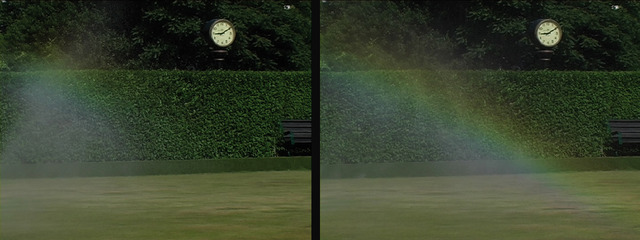
Trangmar has constructed space in a fascinating way. This is partly due to the split screen format, which gives both a sense of simultanaeity of events, rather than singling them out as a single screen would do, and it is also in her lavish use of sound, almost all of it off-screen, giving snippets of conversation, seagulls, traffic, and many sounds which can’t be easily identified. The bird song, like the traffic, is foregrounded to the point of exaggeration and this provides a considerable sense of the pastoral. The split screen also adds a disorienting sense of slippage where different moments of the same shot are side by side; this is partly intended to emphasise the slipperiness of memory, but for me it suggests the park as embedded in individual routines.
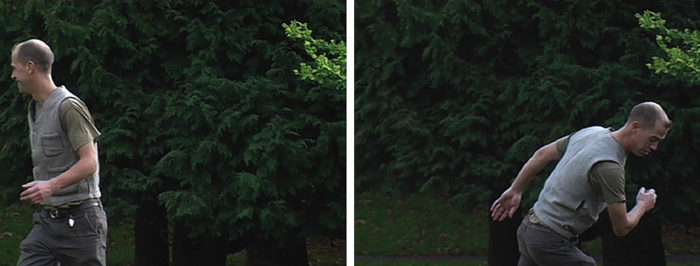
It’s also interesting that Trangmar has chosen not to delve into a key moment in the park’s history: in the late c.19th, it was the site of the second ever film studio, and a huge number of early films, many of them technically revolutionary, were made in St. Ann’s Well Gardens. Many filmmakers and artists would have taken this as an opportunity to ‘interrogate the medium’, but for Trangmar it appears to be sufficient that she is continuing a tradition, leaving the accompanying essays to flesh out this detail.
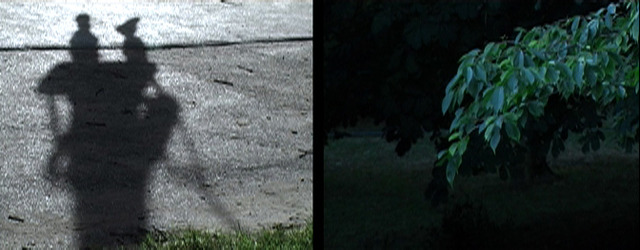
The accompanying book is also notable: it picks out stills from the film and resets them against the white of paper, hence the images resonate differently. It is a different and by no means inferior way of encountering the park which emphasises the images’ formal aspects. It also emphasises the importance of movement to the film.
There is much for me to learn here: returning to filmmaking after developing a stronger sense of how and why I make images the way I do, it’s interesting to see a work where formalism is both central but never overbearing. It’s also worth considering what can be achieved beyond a cinematic context, by the use of split screen and different media. I will be investigating Trangmar’s work more thoroughly in future.
Trangmar, S. 2008. A Play in Time. Brighton: Photoworks.
 out of the picture