Working towards my critical review, I’m answering the following questions posed on my current module.
How do you critically articulate the intent of your photographic practice (verbally or in writing)?
This is something that’s radically changed over the past year. I’ve spent much of my academic life clearly demarking my critical writing from my creative output. I think this has been a mistake and a lost opportunity to create something much more coherent – and potent. Studying the essay film, and the essay form more generally, has been the catalyst for this. Essayism permits a hybrid intermixing of styles: according to Aldous Huxley, a formidable essayist, describes this ‘personal investigation’ as existing between three poles: ‘…the personal and the autobiographical; …the objective, the factual, the concrete-particular; and…the abstract-universal…The most richly satisfying essays are those which make the best…of all three’ (p. 84). Curiously, this very closely mirrors Robert Adams’ discussion of landscape photography: ‘Landscape pictures can offer us…three verities – geography, autobiography, and metaphor. Geography is, if taken alone, sometimes boring, autobiography is frequently trivial, and metaphor can be dubious’ (p. 14). Also central to essayism is a tentativeness, an incompleteness, a depiction of the act of thinking through which invites rather than closes down debate (Rascaroli, 2017). After many years ignoring my emotive, personal responses to the world in favour of the cool logic of the critical, it has been a joy to return to subjective response and use that as the starting point for criticism, rather than treat it is an embarrassing burden. It has returned critical activity to the realm of play.

How is your photographic practice critically, visually and contextually informed?
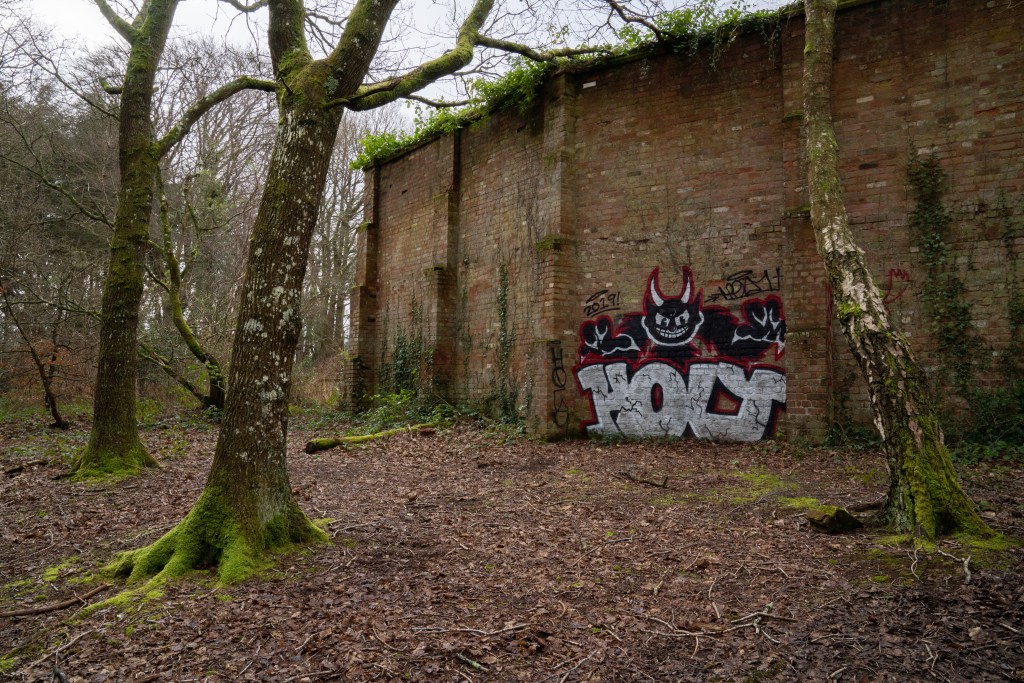
My response here is connected to the previous one. When I head out with my camera, I usually have in mind things I want to explore and think through; my photography, from the planning stage to the sequencing, is itself an act of criticism. For example, on my last shoot, I wanted to explore the military ruins on East Budleigh Common, and consider how they have been reappropriated by conflicting users – graffitti artists and The Bat Conservation Trust – while remaining under the ownership of the Army. Doing so, I thought through ideas of impermanence, conflict, subversion, and also felt the weight of distance between my own artistic activity and that of the graffitti artists. Was I being voyeuristic capturing their decaying art, or was I responded to it and extending it artistically? Probably both.

When I go out, I immerse myself in a place: this is something referred to by other landscape photographers such as Ansel Adams, but I suspect is also commonly found among street photographers. To an extent, I lose myself in experience, allow my surroundings to act on me and coax responses from me: the external world has an agency which I believe the apparently one-way model of ‘the gaze’ does not consider. Rather, there is a dialogue between myself and the external world: through my photographs, I shape it, while it in turn shapes me. I test out my ideologies by identifying subjects that allow me to consider them and see what comes back. I rarely take pictures that I could have foreseen. Finding expression for this blurring of boundaries between self and environment is a central concern of cultural geographers who study place and landscapes by drawing on phenomenology, such as John Wylie. It has been foundational to my filmmaking for the past year and, without my quite realising it, has shaped my photographic practice similarly.
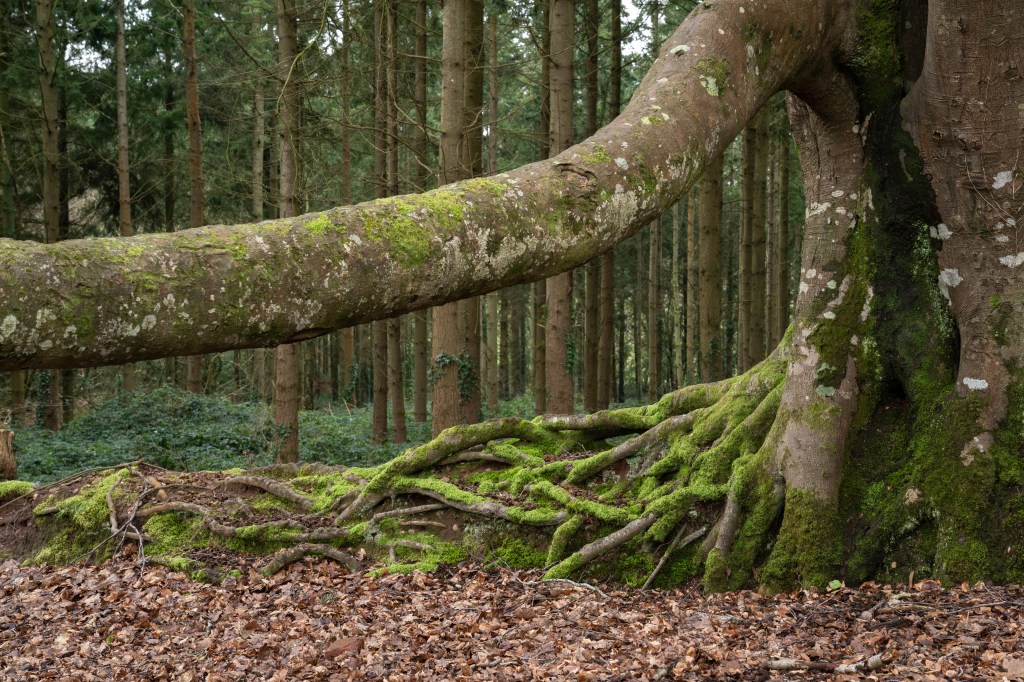
It’s hard to consider how my practice is visually informed. It’s rarely a conscious choice. Certain photographers create work that chimes with my own intentions and I immerse myself in the experience they communicate. Increasingly, I am finding the means to evaluate such work critically, as evidenced throughout this journal, to understand my responses to it, and to consider what I believe is being communicated. It’s rare that I take a shot that quotes another photographer consciously: I have a ‘Fay Godwin’ view of a tree that I’m very fond of shooting under different atmospheric conditions, and I’ll sometimes square off a shot looking down at surfaces in a vaguely Stephen Shore-ish way. And I have always taking shots which I believe have picturesque or sublime qualities; the only difference is that now I understand the heritage of these.
How do you reflect on your photographic practice (e.g. editing / research etc) in order to progress it (consider successful and less successful work)?
I reflect in three ways. Firstly, I expose myself to photographers whose work I believe I can learn from, especially work which I can see is reaching for similar ideas or effects but which does it with vastly more sophistication and polish. Secondly, I go out and take shots. Again and again and again. I try new things, I develop and refine old things. Lastly, I review my work and consider it first on its formal and technical merits, and then I will consider if it is communicating or suggesting something worth caring about – an idea, a mood, a narrative.
In what professional / viewing context should your work be seen in. why?
I’d like to see my work in galleries, photobooks, because that’s where the photographs I like and aspire to are found. I’ve an idea to work up my commons project into a text-led book, but this is still in the development stage. I don’t think I’m yet at a point – or if I’ll ever get to a point – where any of this is possible. Besides, I wouldn’t even know where to begin. I’ve no idea who’d care enough about my work to help make that happen. This is probably a question best left unanswered until after the next module. Frankly, it intimidates the hell out of my. Why should anybody care about my work when there are so many great photographers out there still struggling to get noticed?
Adams, R. 1996. Beauty in Photography (Second Edition). NYC: Aperture.
Huxley, A. 2017. Preface to The Collected Essays of Aldous Huxley. In N. Alter & T. Corrigan (eds.) Essays on The Essay Film. New York: Columbia University Press. pp. 83-85.
Rascaroli, L. 2017. How The Essay Film Thinks. Oxford: Oxford University Press.
Wylie, J. Landscape. 2007. London: Routledge.
 out of the picture