Taxonomies are tricky, paradoxical creatures. They both open up and shut down conversation, make sense and nonsense. I hate them and love them in equal measure, but find them indispensable in developing thinking. I can see that Szarkowski’s might be useful, so here’s my attempt at applying it to one of my most recent shots of Woodbury Common.
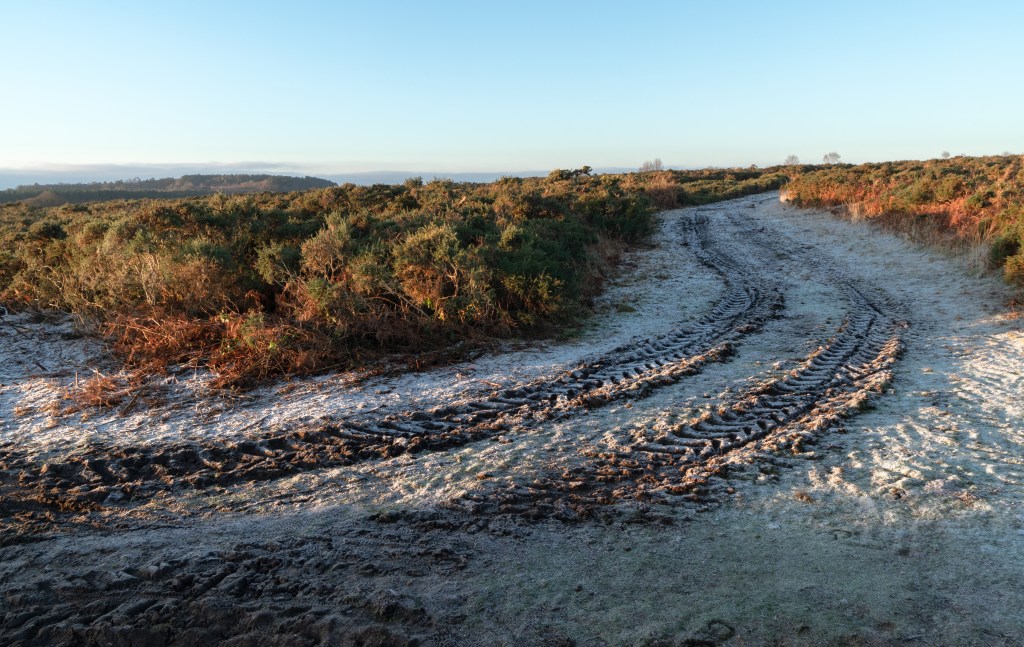
The thing here is the track. It’s easily recognisable. We can see it’s a track through countryside, that both people and vehicles use it, that it comes from somewhere and goes somewhere and without considering the ambient conditions, it’s a very ordinary track indeed and that very ordinariness imparts a sense of familiarity. It’s the kind of track anyone might come to know.
The detail here, its ‘truth’ is those tracks. Not only do they animate the image and give it the dramatic lines, but they’re somewhat brutal. They remind the viewer that, even in such a beautiful setting, noise and management and people are at work: there is nothing ‘natural’ here. A narrative is – perhaps – suggested through the absent activity, and I would question Szarkowski’s assertion that photos don’t tell stories – that they are so frequently used to prompt them in creative writing workshops and therapy sessions suggests that any narrative absence is paradoxically an overabundance of possibilities.
The time here is a frosty morning. I’d chosen to be here to capture exactly this – the reddish light, the elegant blue frost tints. But it’s also, on a longer scale, the intensive heathland management practice of scraping topsoil which requires the heavy machinery. It’s also – implicitly – the time it took to make those tracks. Coming from a film background, which records time in a very different kind of way, I’m increasingly finding photography a much more supple and subtle way of registering time, and one that more actively engages the audience through inference.
Likewise, through segmenting the actual, the frame infers what cannot be perceived visually, and in this photography and film are very similar. It’s through frame that the previous elements – thing, detail and time – become arranged into an animate whole. It’s also through frame that this becomes very much my shot – I wasn’t the only one out on the common that morning taking photos of tracks and frost – but the way I’ve arranged the track, the gorse, the sky, to create a slightly dramatic, slightly abstract image is wholly mine. This is precisely, as Szarkowski says, ‘to quote out of context’.
Vantage point, the final characteristic, is an unusual one here for me. As I wanted to include the distant trees, I lifted my camera as high over my head as I could reach to take the shot. I’m not sure that comes across, however, and it was a purely aesthetic rather than thematic choice. That being the case, the vantage point appears to be – even if it actually isn’t – at about head high walking amongst landscape. It’s not in flight through a zoom, picking out a detail crouching down and scrutinising. The vantage point is that of a walker, any walker, out enjoying the morning, and this gives emphasis to the ordinariness of the scene and the track. The extraordinary – the frost, the morning sun – thus becomes accessible, commonplace, within the democratic realms of ordinary experience.
Szarkowski, J. 2007. The Photographer’s Eye. New York: The Museum of Modern Art.
 out of the picture