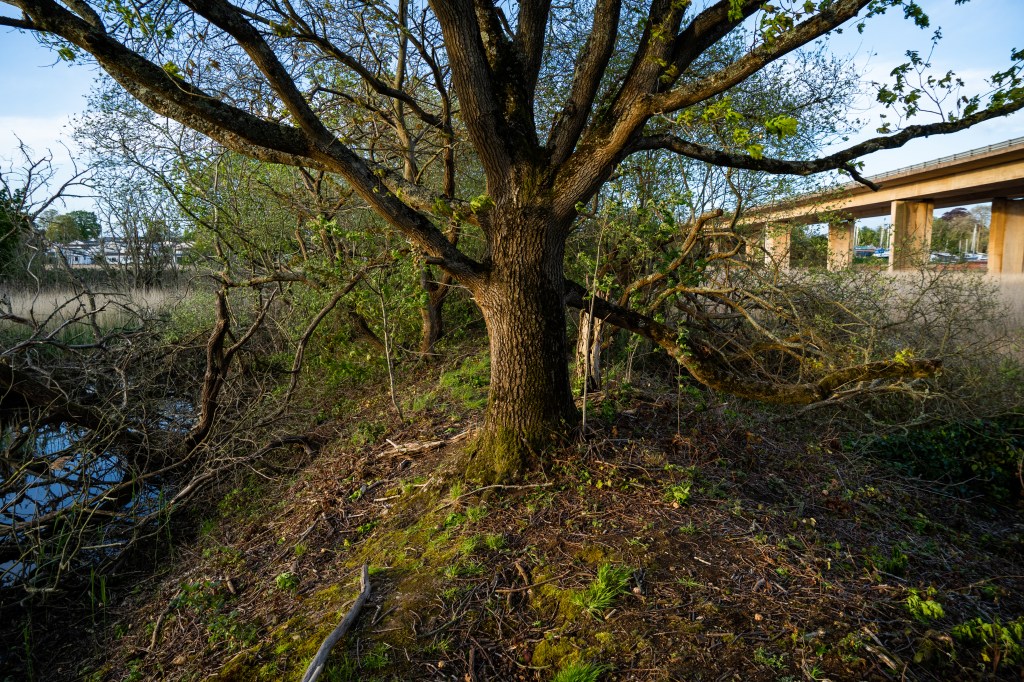
It is a wonderful experience when you find a photographer of enormous skill who seeks out the same things as you. It’s a validation, a challenge, and an education in how much better you could do what you do. This is absolutely the case with Pfahl’s 1982 series Power Places, which I’ve come across in the retrospective A Distanced Land. While Pfhal uses the power plants as the starting point in all his images, each is about what he finds more generally: Pfahl explores a landscape, develops his own relationship to it and his own fascinations and embeds the ‘power places’ within that. Paradoxically, this throws perhaps even more stress on his subject, and through making it smaller it is often somehow more dominant, drawing the attention again and again. This is one major aspect of my M5 Exeter bridge project – although I have also used many images up very close indeed. To demonstrate this, and without in any way suggesting our photography is equal, I’ve included a photo of my own below Pfahl’s – taken long before I’d registered for this Masters course, let alone even hearing of Pfahl.
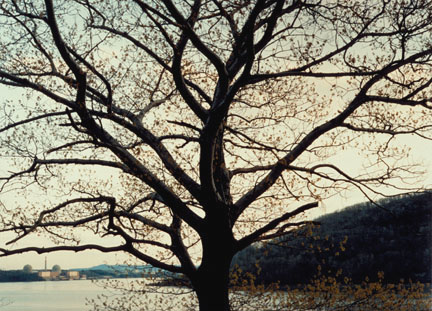
Pfahl’s image is dominated by the tree. Other photos of other power stations are dominated by mountains, clouds, water, scrub. On a formal level, the framing in exquisite, the tree filling the frame but, so it appears, making room for the power station while blending in with the wooded river bank. The messy late autumn textures and veinlike branches and dull colours are thrown into disorder by the power plant’s geometric shapes, and pale yellow and red. The eye is drawn back to it again and again like an itch that needs scratching.
Pfahl took pains to present the power plants neutrally. He invites the viewer to respond for themselves, and was amused that both anti- and pro-nuclear groups believed him to be on their side. The plants are embedded in the landscape, he seems to be saying. They are part of it. Whether this is a good thing or not is in the personal response. ‘A tension is created’, he said, ‘that cries out for resolution.’
Kremer’s book draws on 6 years of exploring the sites of conflict, past and present, in his native Israel. He is largely drawn to traces, such as ruins and blast sites, but does occasionally document events, such as a speeding army vehicle. Kremer has a keen eye for line and the absurd, and grounds high-tech modern warfare in history such beehives at a blast site, the stumps of olive groves.
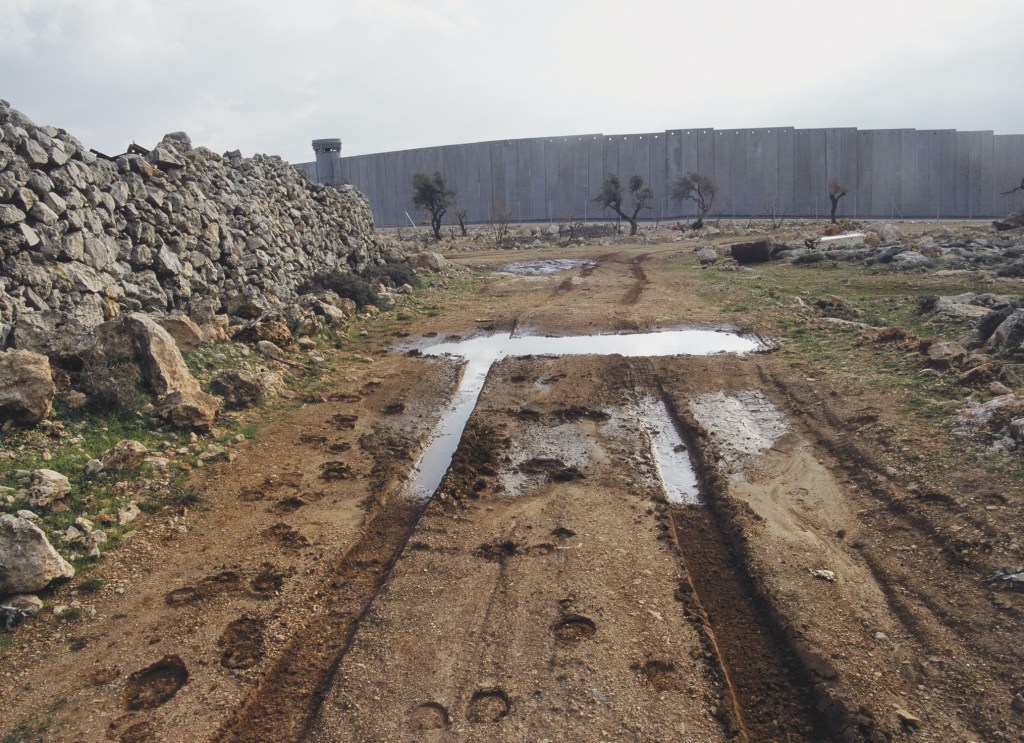
This image of the separation wall at Jerusalem is my favourite, as it balances simplicity with complexity, and like Pfahl’s power stations, builds tension without resolving it. It’s formally brilliant. The separation wall at first seems a continuation of the old dry stone wall, but this continuity is resolved by the watch tower, and the olive trees which provide scale. Two of the trees are dead or dying and careful attention shows them to be surrounded by the remnants of dead trees and rubble: a ruined landscape.
The straight tyre tracks lead the eye towards the trees, but must cross a dazzlingly bright puddle. Beyond this, they curve and become muddy, as if somehow damaged. Around the tracks are hoof prints – a peasant’s donkey? We are left to guess.
The mood is relentlessly bleak. The day is bright but turbulent, the colours bluish and mute. This should be a pleasant sunny scene, with its olive trees and donkeys, but all is ruined, and the only discernible fact is the grim wall and everything which it represents. There are few conflicts on the planet which are quite so divisive, and Israel’s wars with its neighbours have drawn considerable interest from artists internationally – including photographer JR and Banksy. Quite brilliantly, Kremer takes no sides. In war, he seems to say, everyone loses.
Kremer, S. 2008. Infected Landscape: Israel, Broken Promised Land. Stockport: Dewi Lewis Publishing.
Pfahl, J, & Jussim, E. 1990. A Distanced Land: the photographs of John Pfahl. Albuquerque: University of New Mexico Press.
 out of the picture