My practice has three intentions. These overlap, and at times different intentions predominate or fade to the background.
First is as a way of exploring and investigating landscape, and this is an intention found throughout my life. Certain things I see, especially the idiosyncratic, grab my attention and whether through imagining, writing or photographing, I follow this attention. Photography is special because it has given me permission to be nosy, to linger, to scrutinise, to climb over fences and into bushes to deepen that attention. It is a license to look, to deepen my connection with a place, and my work is a record of that looking. This is a personal intention. My fascination with the M5 bridge over the River Exe is founded on this curiosity and, as entirely personal, can’t really be assessed for success or weakness.
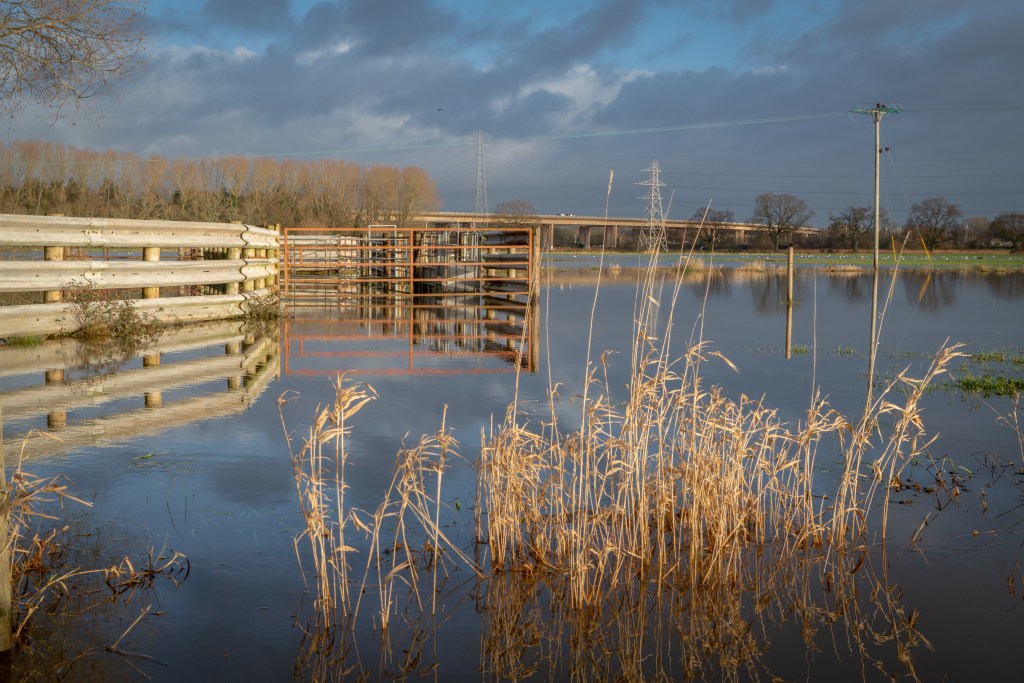
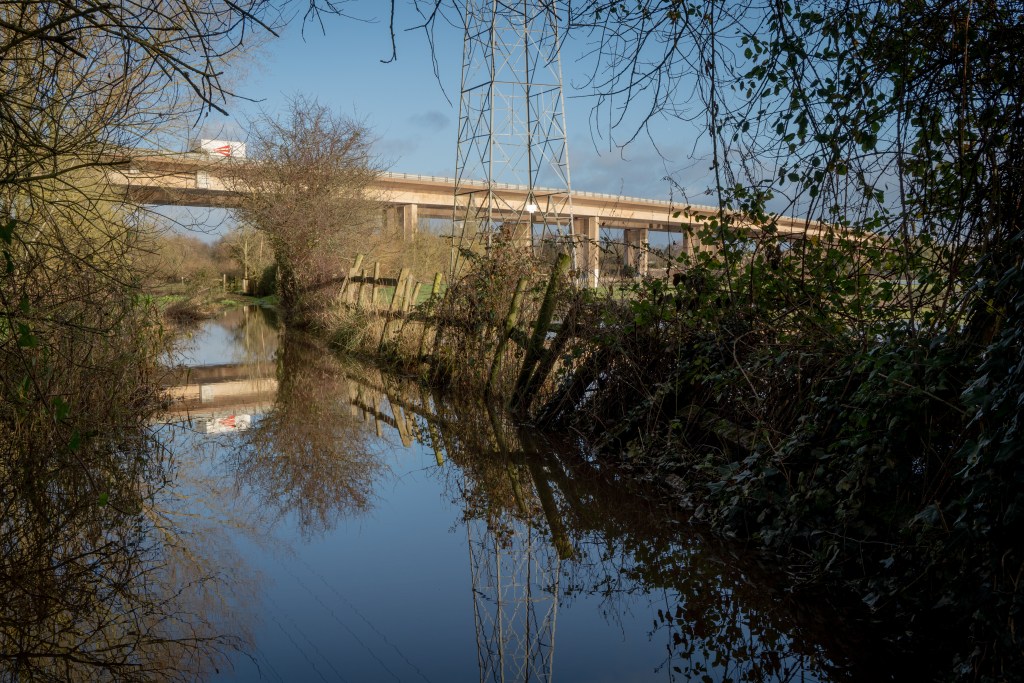
These two images express perhaps better than any my intention to explore. After December’s heavy rain, the fields around the bridge were under a considerable amount of water and I was excited to discover the aesthetic possibilities and also how a landscape I have come to know intimately was changed. Had I not been out to photograph, I would not have bought a decent pair of wellies and waded carefully into the flood water to take these shots. Doing so was thrilling.
This intention is phenomenological. It is about using artistic activity to immerse myself in a place, to understand it better and engage with it on a deeper level. Director Gideon Koppel took exactly this approach for his celebrated slow-cinema documentary sleep furiously, spending 10 months in rural Wales, amassing a vast amount of footage all the while, learning at a deep level about the triumphs of a community in crisis and discovering his own relationship to the landscape and its people. It was not Koppel’s aim was not to come to any conclusive idea about Trefurig, but to document and express his experience of and interest in it. Sleep furiously is a film at Trefurig, rather than about it, and this has been my artistic strategy during the making of my two previous films, and I am exploring was of applying this at-ness to my photography.
Second is to assemble a shot that pleases, whether through repositioning myself, or technological manipulations, either of the camera or in post-production. This is a formalist intention: I am interested in working with line, texture, colour, contrast. Past a certain point, I stop ‘seeing’ the contents of an image as having inherent meaning but as simply being visual forms. I have recently learned this is referred to in painting as ‘retinal’. This is generally a personal intention: I am aiming to create an image that aesthetically pleases through its ‘rightness’. When I feel I have a shot I’m happy with, I will share it, but I’m uninterested in others while I’m composing.
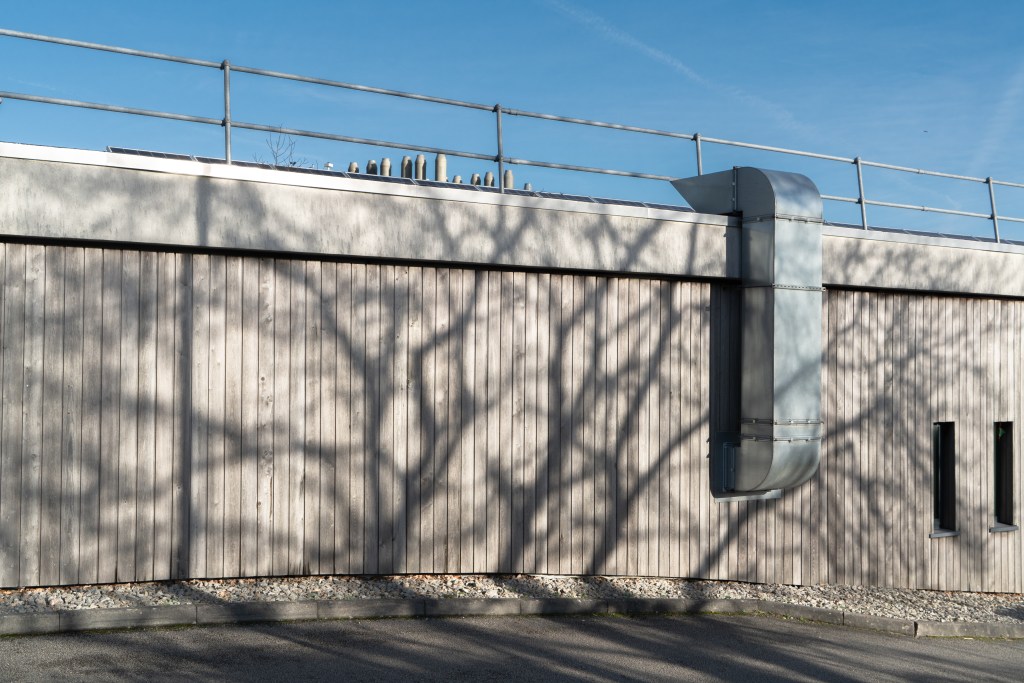
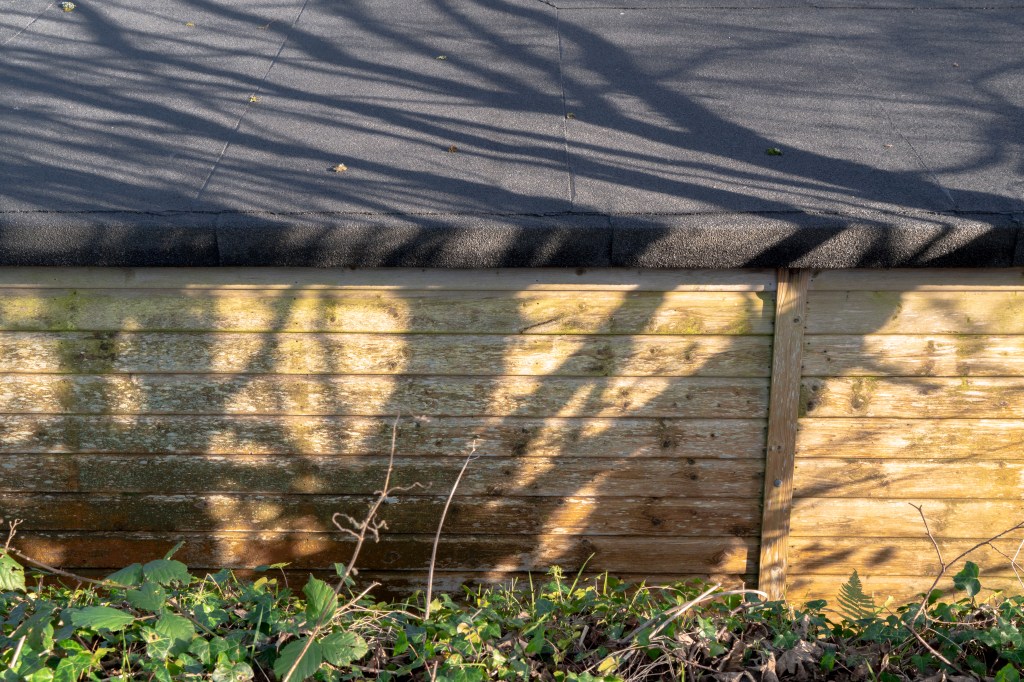
These two shots, taken at Falmouth University Penryn Campus, illustrate successful and unsuccessful examples. Tree shadows are a fascination of mine, and one of my favourite things about late winter and early spring. The shadows are the central feature in both, and were what drew my intention. The contrast has accentuated the shadows here, and another of my other stylistic interests – bands of texture/ colour – is present in both. However, the shed photo, despite the interesting shapes of the shadows themselves, doesn’t work – the colour isn’t interesting and there aren’t other elements to balance the shadow. The wall photo works much better – the palette is pleasing, there’s an interesting dialogue between the air duct and the shadow, there’s hints of beyond the frame through the glimpsed shapes at the top and the windows, a sense of depth thanks to the road, and a simplicity added by the blue sky. The shed photo might work as a painting, but not as a photo, and this reminds me of the limitations of the medium.
This intention is formalist. It is about using manifest reality to explore the grammar of images and while I might point to other intensely formalist photographers, such as Paul Hart, it is the work of Matisse, and in particular his cut-outs, that I have in mind: the rearrangement of shapes through the viewfinder, the rebalancing of colour in Lightroom, this is a dance that recalls Matisse’s ongoing work across the walls of his hotel apartment suite in Nice in the final decade of his life, an artistic endeavour he likened to the reordering, pruning and arranging central to gardening. While there is less freedom, clearly, with photography, there is considerable scope for rearrangement of shape and texture prior to releasing the shutter and rearrangement of colour and light in post-production. Like Matisse’s cutouts, photography is itself a hybrid form. Like them also, digital photography’s form lends itself to provisionality and ongoing revision, making formal playfulness an inherent possibility.
Third is the intention to create a shot that evokes, and this does involve others because it is the communicative aim of the image. I might aim to evoke an idea – such as the legal fragility of public access to land – or I might aim to evoke a sensory or emotive experience – such as the wind through reeds, the wonder of a frosty dawn over flooded fields. I will occasionally take a picture solely for this purpose, and draw on the picturesque in doing so, simply because something I encounter suggests itself, such as a vista through an opening in a hedgerow; doing this is simply because I know it will cause pleasure for others.

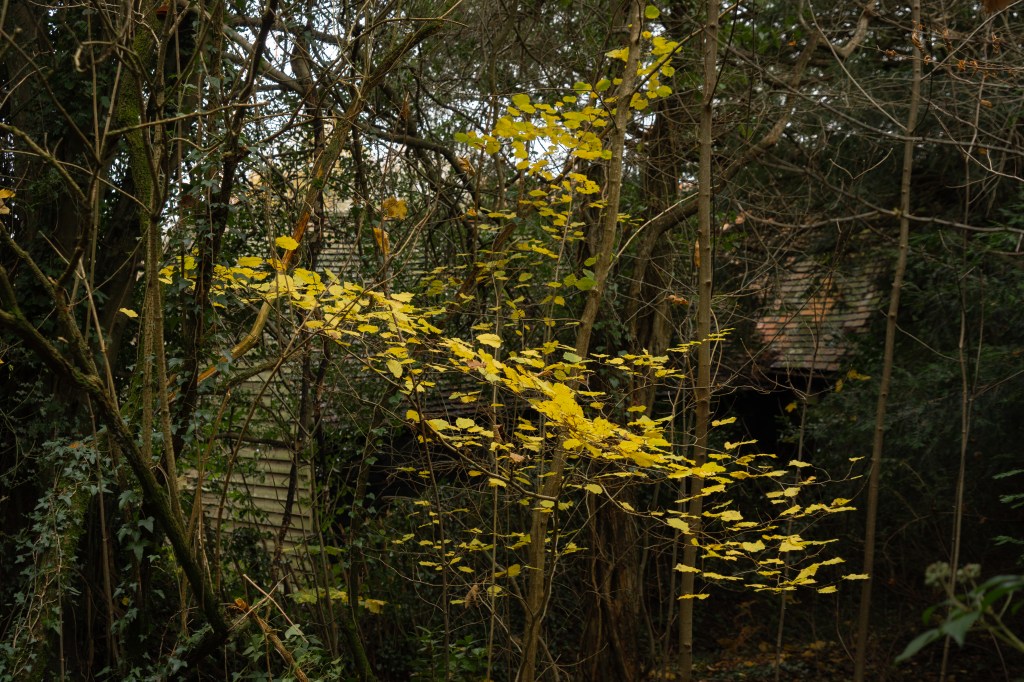
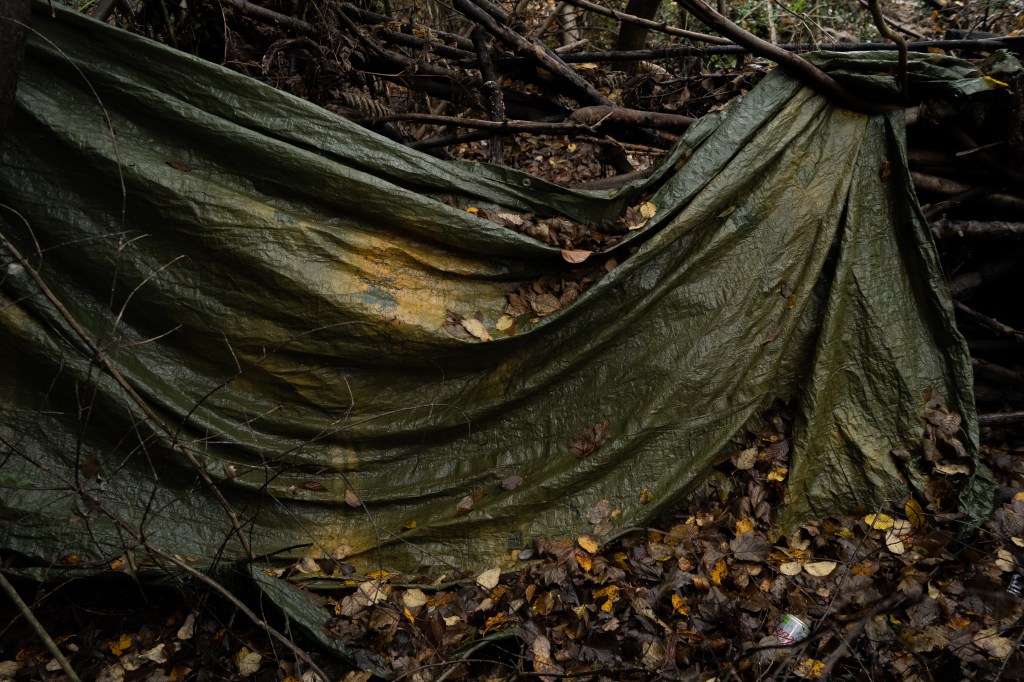
The view of Tunbridge Wells Common neither evokes nor provides an especially pleasing vista. The composition is fine, but the light and colour are uninteresting, and this demonstrates how views can often fail to evoke the places they capture where a less pictorial image succeeds – such as the second shot. I was very happy with this – it evokes both the season, the denseness of the wooded common, and also the sense of discovery, through the (very typically Kentish) buildings glimpsed in the background. It is, I hope, also pleasing, as I found the shape of the leaves against the dark background very elegant. The image of the tarp – the remnants of a hidden drug den – is both evocative of the thick, sinister holly and rhododendron undergrowth at the bottom of the common, and also evidence of conflicting ideas of land use, and manmade despoilation of the natural environment. I also like it aesthetically – the lines are dramatic – and it was this primarily which drew me to take it.
This balancing of the sensory and the political, of both experience and meaning of place, is central to the work of Fay Godwin, one of the first photographers I encountered whose work I believed I could learn something important from. Godwin’s interest, like mine, is not didactic – though her work is heavily political. She is drawn, she says, to land that has been ‘worked’, while ‘wilderness areas’ such as the American West, ‘have fewer resonances’. Speaking of photographing the Scottish Highlands, she talks in terms of getting across both the sense of bleakness, and also of strategically choosing viewpoints to combine different layers of history, such as a barrow and a castle. Godwin’s work is thus both at the places she photographs and very much about them.
During Informing Contexts I want to explore ways of translating and expressing phenomenological and ideological experiences of landscape, both my own and that of others, by theoretical research, close evaluation of other photographers’ work, and personal experimentation, including informal interviews. I want to deepen my awareness of the contemporary and historic aesthetics and ideologies of the landscape idiom across the visual arts. Aesthetically and technically, I want to deepen an understanding of the relationship between line and texture, colour manipulation and combination, the use of dusk lighting conditions, and the sequencing logic of series. I want this term to be about establishing a basis for future work, rather than conducting in-depth investigation. Likewise, I want my photography to focus on experimentation rather than refining towards a polished, finished outcome. I will continue to learn about commons, immerse myself in nature writing and engage personally with common land, including as a volunteer at the Pebblebed Heaths Conservation Trust. I have a considerable reading list and will continue to work my way through this, and develop any productive or promising new areas illuminated through course learning materials and activities.
Bibliography.
Buchberg, K., et al. (eds.) 2014. Henri Matisse: The Cut-Outs. London: Tate Publishing.
Godwin, F. 1990. Our Forbidden Land. London: Jonathan Cape.
Harrison Levy, A. 2015. Henri Matisse: The Lost Interview. Design Observer [online]. Available at: https://designobserver.com/feature/henri-matisse-the-lost-interview/38738 [Accessed 09.01.20]
Koppel, G. 2007. Documentary – the evocation of a world. Journal of Media Practice, 8. pp. 305-323.
Newland, P. 2016. sleep furiously: interview with Gideon Koppel. In Newland (ed.) British Rural Landscapes on Film. Manchester: Manchester University Press. pp. 180-189.
Wood, J. 2014. Gideon Koppel. In Wood (ed.) Last Words: Considering Contemporary Cinema. New York: Wallflower Press. pp. 60-65.
Audiovisual works.
sleep furiously. [feature film] Dir. Gideon Koppel. Bard Entertainments, Van Films. UK. 2009. 94 mins.
The South Bank Show: Fay Godwin [TV episode]. Dir. Unknown. London Weekend Television. UK. 1986. 50 mins.
 out of the picture