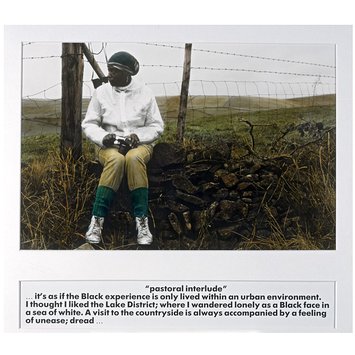
I got talking to an art historian last night who specialises in black women artists of the 1980’s. The historian knows Pollard very well, and it’s a name I’ve come across a few times and meant to check out – as her landscape photography is highly political and very subjective. This is from her book Pastoral interlude, from 1988.
The photo has an extraordinary depth and a great many layers of meaning. The photographic process – hand tinting – takes the viewer first back to the nostalgia of hand tinted postcards, but then, when weighed against the subject of a black woman, one encounters the prejudices and exploitation of the British Empire. Nostalgia is challenged just as the present, with its prejudices and exploitations, is contextualised by an ever-present past.
Pollard’s pose likewise unsettles. Sitting on a dry stone wall, knees bent inwards, her posture, and her clothes, are identical to any female rambler. However, her very dark skin contrasts with the white coat, her headscarf bulges as if hiding dreadlocks, and again the familiar is unsettled, something that is echoed in the text: we feel Pollard’s unease.
As elsewhere in the book, Pollard is excluded from the landscape – here explicitly by the wall and the barbed wire, but also implicitly, hemmed in by the framing fence posts. In fact, the vista occupies only a fraction of the photo, and appears flat, an almost abstract stripe of largely uniform texture.
But Pollard is victorious. The camera in her lap is an expression of agency and power. Her partial profile accentuates her strong facial features and, like the camera, the force of her gaze – though both are directed far away from the recording lens. Moreover, Pollard’s skin tone is precisely echoed in the dry stone wall, perhaps the most archetypal symbol of the Lake District. While Pollard remains separate from the landscape, she is one with the power structures which define it.
 out of the picture